
In the pursuit of better home audio, two popular options consistently rise to the top: soundbars and bookshelf speakers. One promises sleek simplicity with minimal wiring; the other delivers rich, authentic stereo imaging at the cost of visible cables and more complex setup. But when it comes down to it—does the superior stereo separation of bookshelf speakers justify the added clutter and effort? For audiophiles, casual listeners, and design-conscious homeowners alike, this question isn’t just technical—it’s deeply personal.
The answer depends on how you use your audio system, what you value in listening experience, and how much compromise you’re willing to make between form and function. Let’s explore both sides in depth, comparing performance, setup, aesthetics, and long-term satisfaction to help you make an informed decision.
Understanding the Core Differences
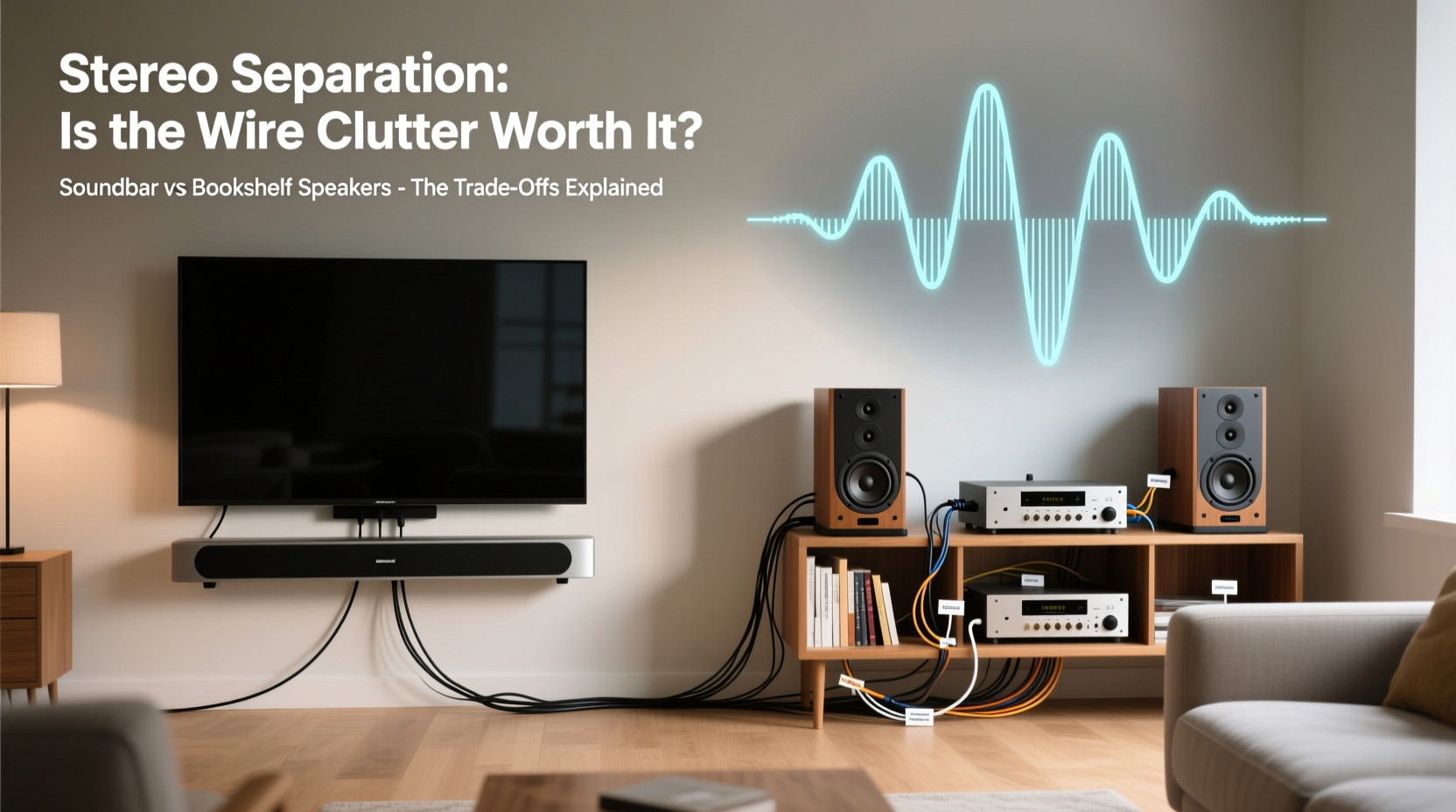
At their core, soundbars and bookshelf speakers serve the same purpose: to improve upon the lackluster built-in speakers of modern TVs and laptops. But they do so in fundamentally different ways.
A soundbar is a single elongated speaker unit that typically sits below or above a TV. It houses multiple drivers (left, center, right, and sometimes upward-firing for Atmos) within one enclosure. Many include wireless subwoofers and rear satellites for surround sound. The appeal lies in its plug-and-play nature—minimal wires, no wall mounting, and seamless integration into living spaces.
Bookshelf speakers, by contrast, are standalone left and right stereo units placed apart from each other—ideally forming an equilateral triangle with the listener. They require an AV receiver or integrated amplifier to power them, along with speaker wire running from the amp to each speaker. This setup enables true stereo separation, where each ear receives distinct audio cues, creating a wider, more immersive soundstage.
The key difference isn’t just physical—it’s psychoacoustic. True stereo separation allows your brain to perceive depth, directionality, and spatial detail in music and film that even the most advanced virtual processing in soundbars can only simulate.
“Stereo separation isn’t just about volume or clarity—it’s about dimension. When done right, you can pinpoint where a guitar is panned, hear footsteps move across a room, or feel the breath behind a vocal.” — Marcus Lin, Audio Engineer & Studio Designer
Performance Comparison: Sound Quality Under the Microscope
To understand whether stereo separation is worth the trade-offs, we need to examine real-world performance across several key areas.
| Feature | Soundbar | Bookshelf Speakers |
|---|---|---|
| Stereo Imaging | Limited; relies on digital processing to simulate width | Natural and precise; actual physical separation creates depth |
| Bass Response | Often enhanced via included wireless subwoofer | Depends on speaker size and room acoustics; may require separate sub |
| Soundstage Width | Narrow to moderate; expands virtually but lacks realism | Wide and organic; especially effective in properly treated rooms |
| Dialogue Clarity | Excellent; dedicated center channel and voice-enhancing modes | Good, but depends on center speaker or careful EQ tuning |
| Music Fidelity | Fair to good; compressed dynamics due to driver proximity | Superior; dynamic range and instrument separation shine |
| Setup Complexity | Very low; often Bluetooth or HDMI ARC setup | Moderate to high; requires wiring, calibration, space planning |
While soundbars have made impressive strides—especially models with Dolby Atmos and beamforming technology—they still operate within physical constraints. A single cabinet simply cannot replicate the time-of-arrival differences and phase coherence that real stereo pairs provide. Even high-end soundbars using AI-driven spatial rendering fall short when compared side-by-side with well-placed bookshelf speakers in a controlled environment.
For movies, soundbars often deliver a satisfying experience, particularly for casual viewing. Dialogue remains crisp, explosions have punch, and overhead effects add novelty. But during subtle scenes—like a quiet conversation in a forest or a jazz trio playing in a smoky lounge—the limitations become apparent. Instruments blur together, ambiance feels artificial, and directional cues lack precision.
With bookshelf speakers, these moments come alive. You hear the rustle of leaves to the left, a distant train rumbling from the rear, and the vocalist centered with lifelike presence. This isn’t just louder sound—it’s more truthful sound.
The Real Cost of Wire Clutter: Aesthetic and Practical Trade-Offs
No discussion of bookshelf speakers is complete without addressing the elephant in the room: wires. Running speaker cables across a room, managing power strips, hiding connections behind furniture—these tasks demand time, patience, and often some DIY ingenuity.
For many, the visual impact matters. In minimalist apartments, open-plan lofts, or rented spaces where wall modifications are restricted, exposed cables can disrupt the clean lines and curated aesthetics people strive for. A soundbar, by comparison, often connects via a single HDMI or optical cable, with the rest handled wirelessly.
But wire clutter isn’t inevitable. With thoughtful planning, you can integrate bookshelf speakers seamlessly into your decor:
- Use flat adhesive cable channels to route wires along baseboards.
- Run cables under rugs or through carpet edges (where safe and permitted).
- Install in-wall conduits during renovations for a truly hidden setup.
- Choose neutral-colored wires or paintable speaker grilles to blend with surroundings.
Moreover, the “clutter” argument often fades once users experience the sonic payoff. What initially seems like a compromise becomes a small price for a transformative upgrade—one that enhances not just entertainment, but daily life.
Mini Case Study: From Soundbar to Bookshelf Upgrade
Consider Sarah, a graphic designer living in a Brooklyn brownstone. She owned a premium $800 Dolby Atmos soundbar with sub and rears. On paper, it was feature-rich. In practice, she found herself turning it off during music nights, reverting to her old Bluetooth speaker.
“It sounded big, but never real,” she said. “When I played Norah Jones, her voice felt pasted onto the screen instead of sitting in the room.”
After researching, she invested in a pair of KEF Q150 bookshelf speakers and a Marantz NR1200 receiver. She ran cables along the baseboard using cord covers, painted them to match the floor trim, and mounted the speakers on stands flanking her sofa.
The change was immediate. “Suddenly, I could hear the space between the piano and the vocals. A scene in Tár where Cate Blanchett conducts an orchestra gave me chills—I could track individual sections moving across the soundstage.”
The wires? “I barely notice them now. Honestly, I look at them and think, ‘This is what good sound costs.’”
When a Soundbar Makes More Sense
Despite the advantages of bookshelf speakers, there are legitimate scenarios where a soundbar remains the smarter choice.
- You prioritize convenience over fidelity. If you watch Netflix after work and want instant audio improvement with zero setup, a soundbar wins every time.
- Your space is small or highly transient. Dorm rooms, studio apartments, or multi-use areas benefit from compact, removable systems.
- You mainly consume dialogue-heavy content. News, talk shows, and sitcoms don’t require wide stereo fields. A soundbar’s voice enhancement features often outperform basic stereo setups.
- You rent and can’t modify walls or floors. Landlords rarely allow drilled holes or permanent installations. A soundbar offers flexibility.
- You’re building a secondary system. For kitchens, bedrooms, or outdoor patios, a soundbar’s simplicity outweighs the need for audiophile-grade sound.
Modern high-end soundbars like the Sonos Arc, Samsung HW-Q990D, or LG S95QR have closed much of the gap. With AI upmixing, room calibration, and support for lossless formats, they deliver impressive immersion—especially when paired with rear modules.
Still, they remain simulations. No amount of software can replace the physics of two discrete sound sources delivering unique waveforms to each ear.
Step-by-Step Guide: Building a Clean Bookshelf Speaker Setup
If you're ready to embrace stereo separation but want to minimize visual disruption, follow this practical guide:
- Choose the right location. Identify primary listening positions and measure distances to ensure symmetry.
- Select appropriately sized speakers. Compact models like Elac Debut B6.2 or Wharfedale Diamond 120 fit neatly on shelves or stands.
- Pick a central hub. Use an AV receiver or integrated amplifier placed near your TV or media console.
- Measure and cut speaker wire. Allow extra length for routing. Consider banana plugs for cleaner connections.
- Route cables discreetly. Use baseboard raceways, under-rug paths, or cord concealers. Avoid sharp bends or foot traffic zones.
- Mount or place speakers. Elevate to ear level if possible. Angle toward the sweet spot.
- Calibrate the system. Run automatic room correction (if available), then fine-tune levels manually.
- Evaluate and refine. Listen to familiar tracks and adjust placement incrementally for optimal imaging.
FAQ
Can I connect bookshelf speakers wirelessly?
Yes—but with caveats. Wireless adapters exist, but they introduce latency, compression, and potential dropouts. True high-fidelity wireless requires proprietary systems like Sonos Architectural or Bluesound Pulse, which are expensive and less flexible than wired setups.
Do I need a subwoofer with bookshelf speakers?
Not always, but often advisable. Most bookshelf speakers roll off below 50–60Hz. A subwoofer fills in deep bass for movies and electronic music. Modern AV receivers make integration seamless with crossover controls.
Is stereo separation worth it for TV watching?
It depends on what you watch. For sports, news, or reality TV—probably not. But for films, documentaries, concerts, and high-production dramas, stereo separation adds emotional depth and realism that enhances engagement.
Final Verdict: Is Stereo Separation Worth the Wire Clutter?
The truth is, stereo separation isn’t just an audio specification—it’s a sensory upgrade. It transforms passive listening into active immersion. While soundbars offer undeniable convenience and respectable performance, they operate within the limits of illusion. Bookshelf speakers, despite their demands, deliver authenticity.
Wire clutter is manageable with planning. The initial effort pays dividends in long-term enjoyment. Once you’ve heard a violin solo emerge distinctly from the left channel while percussion dances on the right, or felt the tension in a thriller scene build through subtle ambient shifts, going back feels like settling.
That said, this isn’t a one-size-fits-all conclusion. Your lifestyle, space, and priorities matter. There’s no shame in choosing simplicity. But if you value how things truly sound—if music moves you, if films should feel cinematic, if silence between notes carries weight—then yes, stereo separation is absolutely worth the wires.
Checklist: Choosing Between Soundbar and Bookshelf Speakers
- ☐ Assess your primary use case: music, movies, gaming, or general TV?
- ☐ Evaluate your tolerance for installation complexity and visible wiring.
- ☐ Measure available space and identify optimal speaker placement.
- ☐ Determine budget—including potential need for receiver, subwoofer, or cable management tools.
- ☐ Test both options if possible—visit a store or borrow a friend’s system.
- ☐ Prioritize long-term satisfaction over short-term convenience.
Conclusion
Technology tempts us to believe we can have everything—perfect sound, invisible design, effortless setup. But some trade-offs are fundamental. The spatial realism of true stereo separation requires physical distance between speakers. That means wires. That means planning. That means intentionality.
If you’re willing to embrace that, you unlock a richer, more engaging relationship with sound. Not because it’s louder or flashier—but because it’s more human.




 浙公网安备
33010002000092号
浙公网安备
33010002000092号 浙B2-20120091-4
Comments
No comments yet. Why don't you start the discussion?