
When your watch stops ticking or your calculator fails to power on, the culprit is often a dead button cell battery. Two of the most frequently encountered types are the SR44 and the 357. They look nearly identical—same size, same shape, similar voltage—and many people assume they’re interchangeable. But are they? And more importantly, could using the wrong one damage your device?
The answer isn’t as simple as “yes” or “no.” While SR44 and 357 batteries are close enough in specifications to work in some devices interchangeably, subtle differences in chemistry, voltage behavior, and capacity can affect performance and, in rare cases, lead to long-term issues. Understanding these nuances is essential to protecting sensitive electronics like hearing aids, vintage cameras, and precision instruments.
Understanding SR44 and 357 Batteries: What’s the Difference?
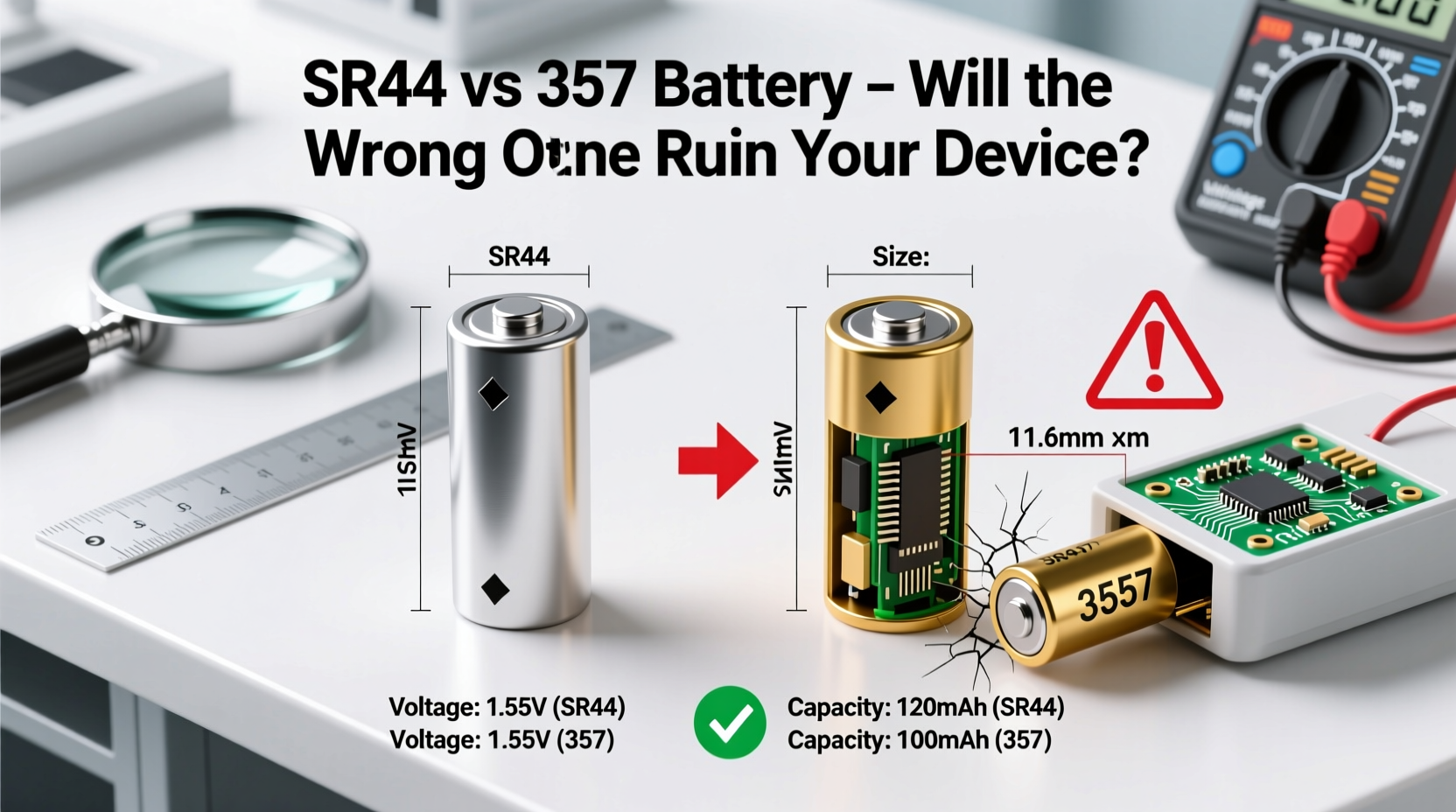
At first glance, the SR44 and 357 appear indistinguishable. Both are 11.6mm in diameter and 5.4mm thick, fitting into the same compact compartments. However, their internal chemistry sets them apart.
The **SR44** is a silver oxide battery. The \"S\" stands for silver, and the \"R\" indicates a round shape. Silver oxide batteries offer a stable voltage output (typically 1.55V) throughout their lifespan, making them ideal for devices that require consistent power, such as watches and medical equipment.
The **357**, also known as AG13, is typically an alkaline battery. It starts at around 1.5V but experiences a gradual voltage drop as it discharges. This decline can cause devices to behave erratically before the battery dies completely.
Because of their different chemistries, their performance under load and longevity vary significantly—even if they fit physically.
“Silver oxide batteries like the SR44 provide flatter discharge curves, which means more reliable performance in precision devices.” — Dr. Alan Reeves, Battery Technology Consultant
Can You Safely Substitute One for the Other?
In many consumer devices—especially low-drain gadgets like calculators, toys, or LED lights—an SR44 can replace a 357 and vice versa without immediate harm. However, this doesn’t mean it’s always advisable.
Devices designed for silver oxide batteries expect steady voltage. Using an alkaline 357 in such a device may result in inaccurate timekeeping, dimming displays, or premature shutdowns—even if the battery still has charge left. Conversely, placing an SR44 in a device built for alkaline cells usually works well, often improving performance due to the superior voltage stability.
The real danger lies not in voltage mismatch—which is minimal—but in leakage risk and long-term compatibility.
Comparison Table: SR44 vs 357
| Feature | SR44 (Silver Oxide) | 357 / AG13 (Alkaline) |
|---|---|---|
| Voltage (Nominal) | 1.55V | 1.5V |
| Capacity | ~150–200 mAh | ~100–130 mAh |
| Voltage Stability | Very stable (flat discharge curve) | Gradual decline |
| Lifespan in Low-Drain Devices | 3–5 years | 1–2 years |
| Leakage Risk | Low | Moderate to high over time |
| Common Uses | Watches, hearing aids, precision instruments | Calculators, toys, cheap electronics |
| Interchangeable? | Possible in some cases, but not recommended for critical devices | Sometimes acceptable, but may reduce performance |
Real-World Example: A Watch Owner’s Mistake
Consider Sarah, who owns a vintage Citizen quartz watch requiring an SR44. When her battery died, she used a 357 from a toy pack because it was available. The watch powered on, but within three months, the second hand began stuttering. By six months, the time was off by several minutes daily.
She took it to a repair shop, where the technician explained that the declining voltage of the alkaline 357 caused the quartz movement to misfire. Although the watch wasn’t permanently damaged, its accuracy suffered, and the battery leaked slightly, requiring cleaning of the contacts. Switching back to a proper SR44 restored normal function—but the experience highlighted how even small deviations matter in precision devices.
Step-by-Step Guide: How to Choose the Right Battery
- Check the device manual or label. Look inside the battery compartment or consult the user guide. If it says “SR44,” don’t assume “357” is fine just because it fits.
- Identify the chemistry. SR44 = silver oxide; 357/AG13 = usually alkaline. Some 357s may be silver oxide too—check packaging carefully.
- Assess device sensitivity. Is it a watch, hearing aid, or scientific tool? These need stable voltage—use SR44. For flashlights or toys, substitution is less risky.
- Inspect expiration dates. Old batteries, especially alkalines, may leak. Use fresh ones from reputable brands.
- Monitor performance. If a device behaves oddly after battery replacement, revert to the correct type immediately.
Can the Wrong Battery Ruin Your Device?
Direct physical damage from inserting an SR44 instead of a 357 (or vice versa) is unlikely due to identical dimensions. However, indirect harm can occur through:
- Voltage instability: Alkaline batteries’ dropping voltage can confuse microprocessors in digital calipers or medical devices.
- Battery leakage: Alkaline cells are more prone to leaking potassium hydroxide, which corrodes contacts and circuitry over time.
- Reduced lifespan: Using a lower-capacity 357 in place of an SR44 means more frequent replacements and higher risk of leaving depleted batteries inside.
While one incorrect battery likely won’t destroy your device, repeated misuse increases the chances of permanent damage—especially in expensive or hard-to-replace electronics.
Frequently Asked Questions
Are SR44 and 357 batteries the same?
No, they are not the same. While they share identical physical dimensions, SR44 batteries are typically silver oxide with a stable 1.55V output, while 357s are usually alkaline with a gradually decreasing voltage. Some 357 batteries may also be silver oxide—always verify the chemistry on the package.
Can I use a 357 instead of an SR44 in my watch?
You can, but it's not recommended. The alkaline 357 will drain faster and may cause timing inaccuracies due to voltage drop. Over time, it also poses a higher risk of leakage, which can damage the delicate internals of a watch.
What happens if I leave a dead alkaline battery in my device?
Dead alkaline batteries are highly susceptible to leaking corrosive electrolyte. This can eat away at metal contacts and ruin circuits. Always remove depleted batteries promptly, especially in rarely used devices.
Final Checklist Before Replacing Your Battery
- ✅ Confirm the required battery type (SR44 or 357).
- ✅ Check whether your device needs silver oxide or alkaline chemistry.
- ✅ Use fresh, high-quality batteries from trusted brands (e.g., Energizer, Maxell, Renata).
- ✅ Avoid mixing old and new batteries or different chemistries.
- ✅ Remove batteries from devices stored long-term.
- ✅ Dispose of used batteries properly at recycling centers.
Conclusion: Protect Your Devices with the Right Power Source
The convenience of assuming all small round batteries are the same can come at a cost. While SR44 and 357 batteries may seem interchangeable, their differences in chemistry, voltage delivery, and reliability make the right choice crucial for device longevity and performance. Whether you're powering a cherished heirloom watch or a vital hearing aid, taking a moment to verify the correct battery type protects your investment and ensures optimal operation.




 浙公网安备
33010002000092号
浙公网安备
33010002000092号 浙B2-20120091-4
Comments
No comments yet. Why don't you start the discussion?