
When it comes to wristwear, few accessories offer the personalization and elegance of bracelets. Among the most popular styles are stackable bracelets and charm bracelets—each with its own aesthetic appeal and functional strengths. But when building a versatile jewelry collection, one question often arises: which truly looks better with everything? The answer isn't always straightforward, as it depends on lifestyle, wardrobe preferences, and personal expression. This guide breaks down both styles in detail, comparing their adaptability, styling potential, and long-term wearability to help you make an informed choice.
Versatility and Wardrobe Compatibility
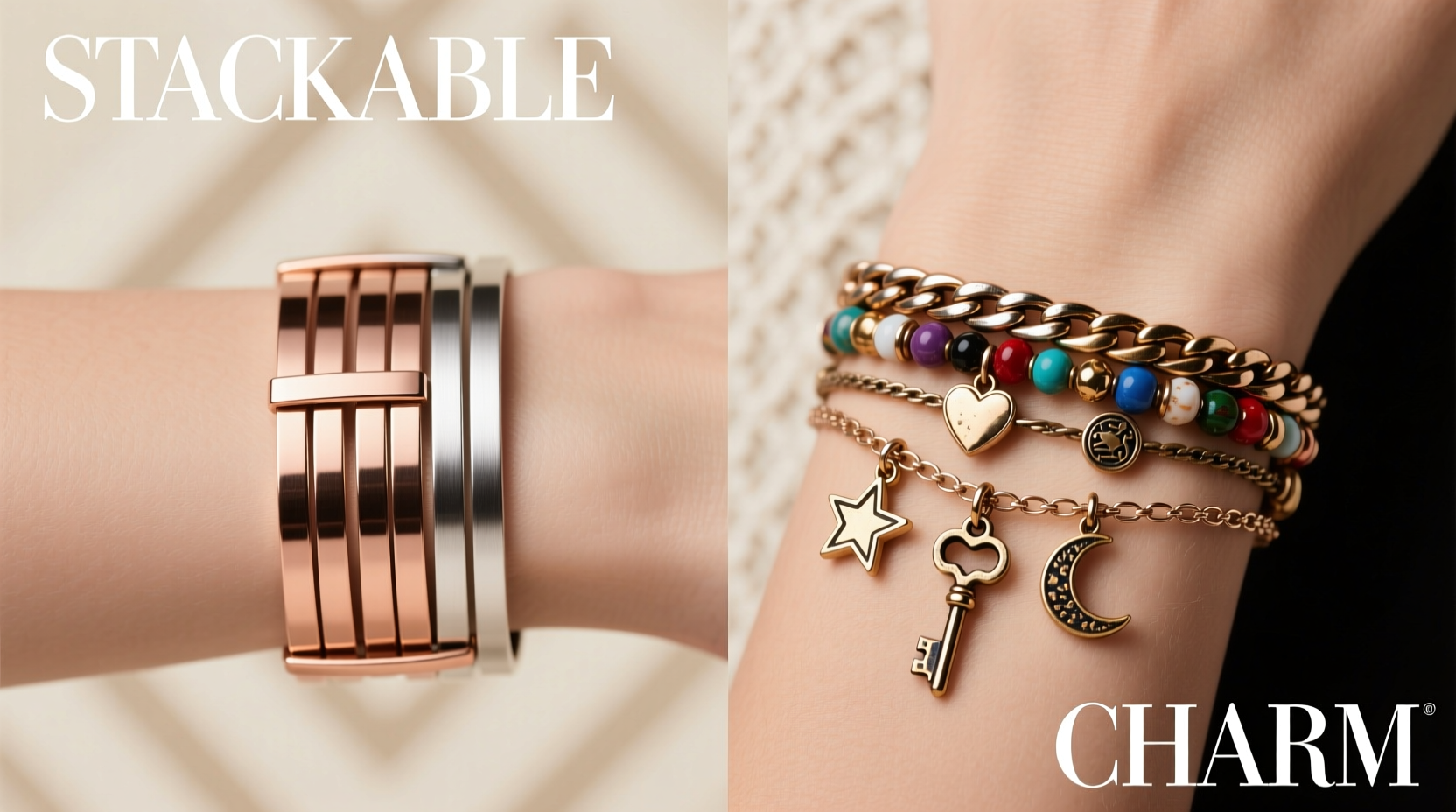
The hallmark of a “goes-with-everything” accessory is its ability to transition seamlessly across occasions—from casual daytime wear to formal evening events. Stackable bracelets excel in this area due to their minimalist design and modular nature. Typically made from delicate chains, thin bangles, or beaded strands, they can be worn individually for understated elegance or layered in curated combinations for a more dynamic look.
In contrast, charm bracelets feature a central chain adorned with symbolic pendants—birthstones, initials, travel icons, or sentimental keepsakes. While deeply meaningful, these elements can sometimes clash with certain outfits or settings. A charm bracelet covered in playful motifs may feel out of place at a business meeting, whereas a single slim gold chain from a stackable set would blend effortlessly.
Styling Flexibility and Layering Potential
One of the defining advantages of stackable bracelets is their adaptability through layering. You can mix textures, lengths, and materials to match your outfit’s mood—pair a leather wrap with metallic cuffs for bohemian flair, or combine sleek tennis bracelets for polished minimalism. This flexibility allows wearers to customize their look daily without needing an extensive collection.
Charm bracelets, while less adaptable in layering, serve as standalone statement pieces. Their storytelling nature means they often become the focal point of an ensemble. However, pairing them with other bracelets requires careful consideration to avoid visual clutter. Over-accessorizing around a busy charm bracelet can overwhelm the wrist and detract from the overall aesthetic.
“Layering is about balance. With stackables, you control the narrative—one piece at a time. With charms, the story is already written; your job is not to drown it out.” — Lila Monroe, Jewelry Stylist & Editor at *Glamour Accents*
Comparison Table: Key Features at a Glance
| Feature | Stackable Bracelets | Charm Bracelets |
|---|---|---|
| Versatility | High – works with nearly all attire | Moderate – best suited for casual or expressive looks |
| Customization | Modular – mix and match freely | Limited – changes require adding/removing charms |
| Everyday Wear | Excellent – low profile, comfortable | Good – but bulkier designs may snag or irritate |
| Emotional Value | Low to moderate – mostly aesthetic | High – often tied to memories and milestones |
| Formal Suitability | Strong – subtle elegance fits professional settings | Limited – unless minimalistic charm design |
| Longevity of Style | Timeless – classic minimalism endures trends | Seasonal – charm themes may date over time |
Real-Life Example: Two Women, Two Styles
Consider Sarah, a corporate attorney who dresses in tailored blazers and silk blouses. Her go-to accessory is a trio of fine gold stackable bracelets—thin, unadorned, and barely noticeable unless someone leans in. They complement her watch, don’t interfere during meetings, and add just enough refinement to elevate her look without distraction.
Then there’s Mia, a travel blogger who wears a charm bracelet gifted by her parents after her first solo trip to Japan. It features a tiny pagoda, her birthstone, and a plane charm. She loves it, but admits she removes it before client calls or formal dinners. “It’s my favorite piece,” she says, “but I wouldn’t call it ‘goes with everything.’ It goes with *me*—on the days I want my story front and center.”
This contrast illustrates a crucial distinction: stackables enhance any outfit, while charm bracelets enhance personal narratives—sometimes at the cost of universal compatibility.
Step-by-Step Guide: Building a Wrist Stack That Works Everywhere
If you're leaning toward stackable bracelets for their versatility, follow this practical approach to curating a timeless, adaptable set:
- Choose a Base Metal: Stick to one metal tone (e.g., sterling silver, 14k gold) to maintain cohesion.
- Select a Foundation Piece: Start with a simple chain or bangle that sits close to the wrist bone.
- Add Texture: Introduce one textured piece—a twisted wire, rope chain, or beaded strand—for dimension.
- Incorporate a Focal Point: Include one slightly bolder item, like a delicate pendant or a slim cuff, to anchor the stack.
- Test for Balance: Wear the combination with different outfits—casual, work, evening—to ensure it transitions smoothly.
- Limit Quantity: Three to five bracelets usually suffice. Too many can look cluttered, especially in professional environments.
When Charm Bracelets Shine
While stackable bracelets win in sheer versatility, charm bracelets have irreplaceable emotional and stylistic value. They’re ideal for:
- Gift-giving (birthdays, graduations, anniversaries)
- Telling a personal story (travel, family, achievements)
- Casual or creative settings where self-expression is encouraged
- Complementing relaxed, boho, or vintage-inspired outfits
Modern minimalist charm bracelets—featuring a single small charm or spaced-out symbols—can bridge the gap between sentiment and simplicity. These versions offer a middle ground, allowing for everyday wear without sacrificing meaning.
Checklist: Choosing the Right Style for Your Lifestyle
Ask yourself the following questions to determine which style aligns best with your needs:
- Do I wear jewelry daily in professional settings? → Favors stackables
- Do I value symbolism and personal milestones in accessories? → Favors charms
- Do I prefer changing my look frequently? → Favors stackables
- Am I drawn to storytelling through fashion? → Favors charms
- Do I want one wristwear option that works year-round? → Favors stackables
- Do I already own a meaningful charm piece? → Build around it with complementary stackables
Frequently Asked Questions
Can I wear stackable and charm bracelets together?
Yes, but with intention. Pair a simple charm bracelet with one or two thin stackable chains to avoid overcrowding. Keep the color tone consistent and let the charm remain the focal point.
Which is more durable for daily wear?
Stackable bracelets generally hold up better due to simpler construction and fewer moving parts. Charm bracelets, especially those with dangling elements, are more prone to snagging or charm loss over time.
Are stackable bracelets suitable for men?
Absolutely. Men can wear minimalist stackables—like leather cords, matte metal bands, or woven bracelets—for a refined, modern look. The key is restraint: one to two pieces max, in neutral tones.
Final Verdict: Which Looks Better With Everything?
If the goal is universal compatibility—something that enhances jeans and a t-shirt as effortlessly as it does a little black dress or a business suit—stackable bracelets are the clear winner. Their strength lies in subtlety, adaptability, and timeless design. They don’t compete with clothing; they complete it.
Charm bracelets, while powerful in emotional resonance and personality-driven style, are inherently more selective in their pairing potential. They’re not designed to be invisible—they’re meant to be seen, questioned, and admired. And that’s perfectly valid, just not always “goes with everything.”
The smart approach? Own both. Use stackable bracelets as your foundation—the reliable, always-appropriate base layer. Reserve charm bracelets for moments when you want your jewelry to speak. Together, they form a balanced, expressive, and highly functional wristwear strategy.




 浙公网安备
33010002000092号
浙公网安备
33010002000092号 浙B2-20120091-4
Comments
No comments yet. Why don't you start the discussion?