
The Pythagorean Theorem is one of the most foundational concepts in geometry and trigonometry. It allows us to calculate unknown side lengths in right triangles—triangles that contain a 90-degree angle. While many are familiar with the formula a² + b² = c², applying it to solve for a specific variable like b² requires careful attention to algebraic manipulation and understanding of triangle components. This guide walks through exactly how to isolate and compute b² using real-world context, structured steps, and common pitfalls to avoid.
Understanding the Pythagorean Theorem
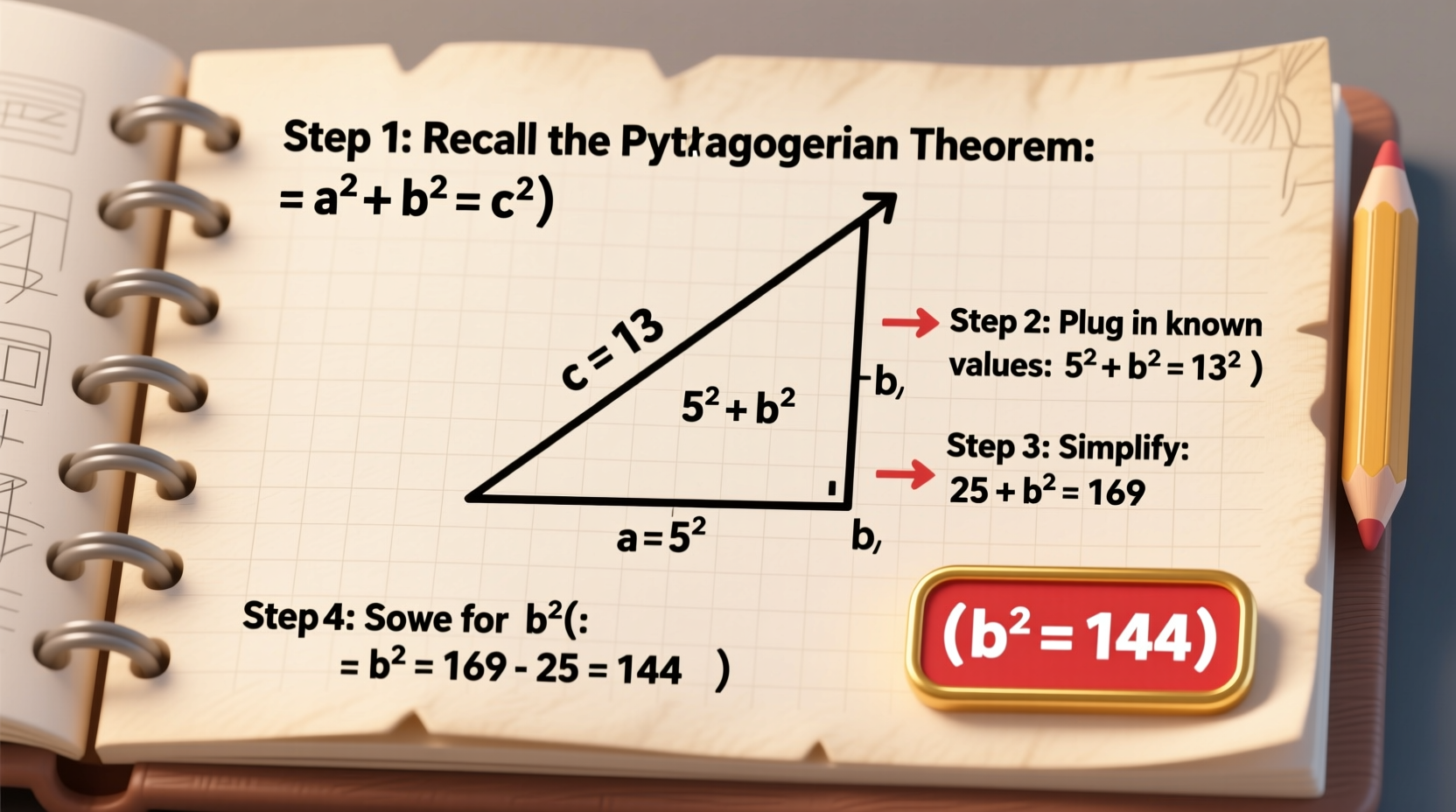
The Pythagorean Theorem states that in a right triangle, the square of the length of the hypotenuse (the side opposite the right angle) is equal to the sum of the squares of the other two sides. Mathematically:
a² + b² = c²
Here:
- a and b represent the lengths of the two legs (shorter sides adjacent to the right angle).
- c represents the length of the hypotenuse (always the longest side).
To find b² specifically, we must rearrange this equation algebraically so that b² stands alone on one side of the equals sign. This process becomes essential when you know the values of a and c but need to determine b²—or eventually, b itself.
Step-by-Step Guide to Find b²
Finding b² involves isolating it from the rest of the equation. Below is a clear, logical sequence to follow regardless of your starting values.
- Identify the known values. Determine which sides you already know. For example, if you’re given the length of leg a and the hypotenuse c, those will be used directly.
- Write down the Pythagorean equation: a² + b² = c².
- Rearrange the equation to solve for b². Subtract a² from both sides:
b² = c² – a²
- Substitute the known values into the equation. Plug in the numerical values for c and a.
- Square each value. Calculate c² and a² separately before subtracting.
- Perform the subtraction. The result is b²—the square of the unknown leg.
- (Optional) Take the square root to find b. If you need the actual length of side b, take the positive square root of b².
Example Calculation
Suppose you have a right triangle where:
- Side a = 3 units
- Hypotenuse c = 5 units
Find b².
Start with the formula:
b² = c² – a²
b² = (5)² – (3)²
b² = 25 – 9
b² = 16
So, b² equals 16. If needed, b = √16 = 4 units.
Common Scenarios and Applications
The ability to calculate b² isn't just theoretical—it applies across disciplines such as architecture, navigation, physics, and even video game design. Here are three realistic cases where solving for b² proves useful.
Mini Case Study: Building a Roof Truss
A carpenter is constructing a roof truss shaped like a right triangle. One sloped beam (hypotenuse) measures 10 feet, and the horizontal base (side a) is 6 feet long. To cut the vertical support beam accurately, they need to know b² first.
Using the formula:
b² = c² – a² = 10² – 6² = 100 – 36 = 64
Now knowing b² = 64, they can determine b = 8 feet. This ensures precise cutting and structural integrity.
Real-World Use: Distance Between Two Points
In coordinate geometry, the distance between two points forms the hypotenuse of a right triangle. Suppose point A is at (1, 2) and point B is at (4, 6). The horizontal change (a) is 3 units, vertical change (b) is unknown, and the total distance (c) is 5 units.
To verify consistency or find missing data:
b² = c² – a² = 25 – 9 = 16 → b = 4
This matches the actual vertical difference (6 – 2 = 4), confirming accuracy.
“Mastering the isolation of variables in the Pythagorean Theorem builds strong problem-solving foundations for advanced mathematics.” — Dr. Alan Reyes, Mathematics Educator
Do’s and Don’ts When Solving for b²
| Do’s | Don’ts |
|---|---|
| ✅ Double-check which side is the hypotenuse before plugging in values. | ❌ Never assume any side is 'b' without verifying its position. |
| ✅ Square the known sides *before* subtracting. | ❌ Avoid subtracting first and then squaring—that breaks order of operations. |
| ✅ Use parentheses when substituting negative numbers or decimals. | ❌ Don’t forget that b² is not the same as b; only take the square root if asked for the side length. |
| ✅ Label your final answer clearly as b² unless instructed otherwise. | ❌ Don’t round too early; keep full precision until the last step. |
Checklist: How to Accurately Find b²
Use this quick-reference checklist whenever working through a problem involving the Pythagorean Theorem:
- ☐ Confirm it's a right triangle (has a 90° angle)
- ☐ Identify the hypotenuse (longest side, labeled c)
- ☐ Label the other two sides as a and b (it doesn’t matter which is which, as long as c is correct)
- ☐ Write the equation: a² + b² = c²
- ☐ Rearrange to: b² = c² – a²
- ☐ Substitute known values
- ☐ Compute squares individually
- ☐ Subtract to get b²
- ☐ Box or highlight your final answer
- ☐ (If required) Take the square root to find b
Frequently Asked Questions
Can I use the Pythagorean Theorem if I only know two sides?
Yes—this is exactly when the theorem shines. As long as you know any two sides of a right triangle, you can find the third. If you know both legs (a and b), add their squares to get c². If you know one leg and the hypotenuse, subtract to find the missing leg squared.
What if I get a negative number when calculating b²?
You shouldn’t. Since b² = c² – a², c must be larger than a because the hypotenuse is always the longest side. If you get a negative result, recheck your identification of the hypotenuse. Swapping c and a causes errors.
Does it matter whether I call the unknown side ‘a’ or ‘b’?
No. The labels a and b are interchangeable for the two legs. Whether you solve for a² or b² depends only on which one is unknown. Just ensure c remains the hypotenuse.
Final Thoughts and Next Steps
Finding b² using the Pythagorean Theorem is more than a classroom exercise—it's a practical skill applicable in engineering, construction, computer graphics, and everyday spatial reasoning. By mastering the simple algebraic rearrangement b² = c² – a² and practicing with real measurements, you build confidence in handling geometric challenges efficiently.
Whether you're preparing for standardized tests, designing furniture, or simply curious about how math shapes the physical world, understanding how to isolate and compute b² empowers you to solve problems accurately and independently.




 浙公网安备
33010002000092号
浙公网安备
33010002000092号 浙B2-20120091-4
Comments
No comments yet. Why don't you start the discussion?