
The battle between subbed and dubbed anime isn’t just a fanboy feud—it’s a cultural clash rooted in authenticity, accessibility, and personal preference. For decades, viewers have taken sides: purists who swear by original Japanese audio with subtitles, and pragmatists who embrace English dubs for convenience. But beyond fandom loyalty, there's a deeper layer—especially for language learners. If you're studying Japanese, does watching subbed or dubbed anime actually impact your progress? The answer isn't simple, but understanding the nuances can help you make smarter choices.
Anime has evolved from niche entertainment to a global phenomenon, with platforms like Crunchyroll, Netflix, and Hulu offering both subtitled and dubbed versions of nearly every major series. This accessibility has intensified the debate. Yet for those aiming to learn Japanese, the choice between subbed and dubbed isn’t about comfort—it’s about cognitive engagement, linguistic accuracy, and immersion strategy.
The Cultural Heart of the Subbed vs Dubbed Debate
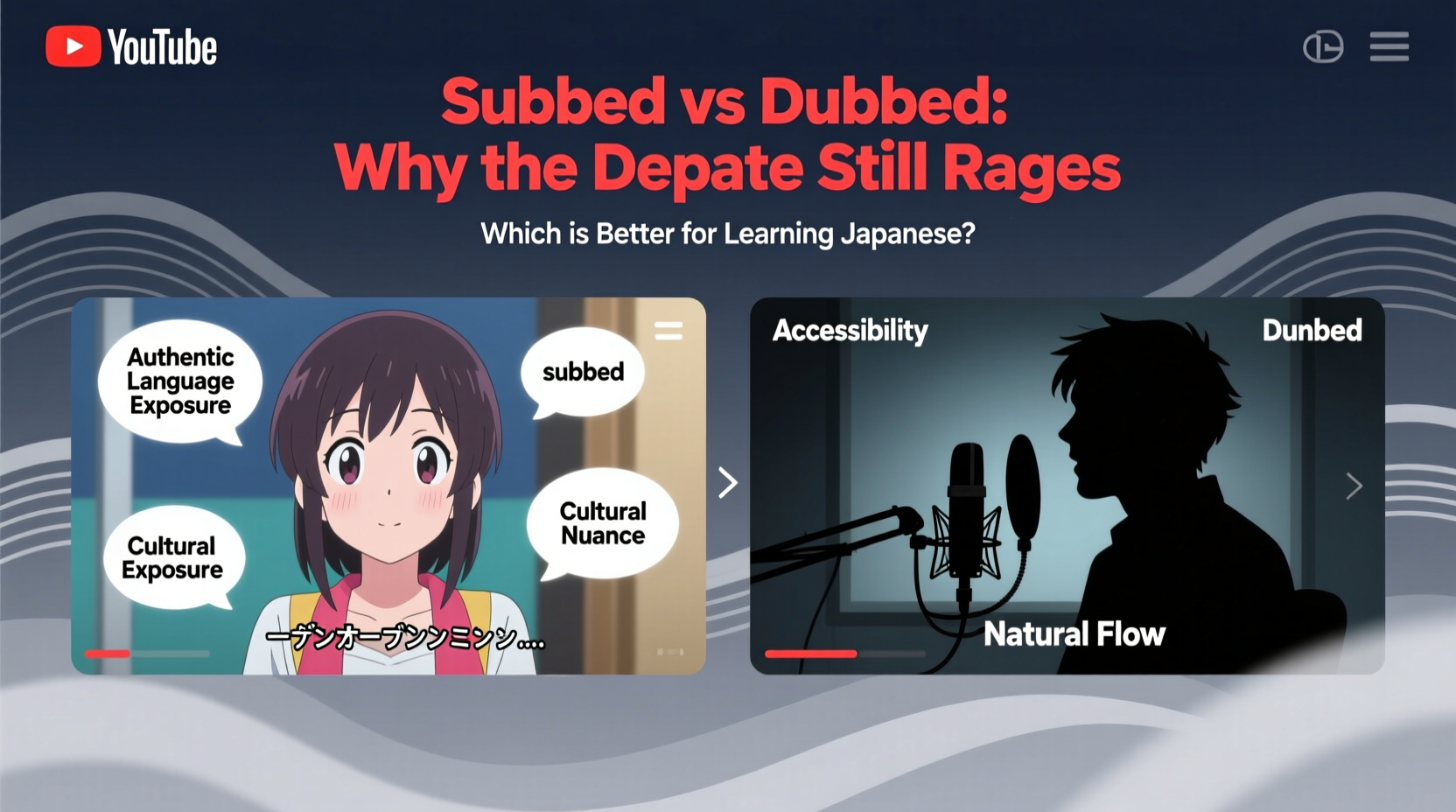
At its core, the subbed versus dubbed conflict reflects broader attitudes toward media consumption and cultural preservation. Fans who prefer subtitles argue that they preserve the original tone, timing, and emotional delivery of the voice actors. They point to subtle vocal inflections, pitch shifts, and pacing that often get lost—or altered—in translation.
Dubbing, on the other hand, prioritizes accessibility. It allows viewers who aren’t fluent in Japanese (or who struggle with reading speed) to enjoy anime without splitting attention between dialogue and text. However, dub scripts frequently adapt jokes, idioms, and cultural references to fit Western sensibilities, sometimes altering meaning entirely.
Consider the iconic phrase “Believe it!” from Naruto’s English dub. While energetic, it replaces the original “Dattebayo!”—a verbal tic tied to Naruto’s personality and regional dialect. For purists, this change dilutes character identity. For casual viewers, it makes the show more relatable.
Linguistic Fidelity: How Subtitles Preserve Language Nuance
When learning Japanese, exposure to authentic speech patterns is critical. Subbed anime provides direct access to native pronunciation, sentence structure, and colloquial expressions. Even if you’re reading English subtitles, your ears are still processing real Japanese—helping your brain map sounds to meaning over time.
Subtitles also allow you to observe how grammar functions in context. Honorifics like -san, -kun, or -sama appear in dialogue and are often reflected (or explained) in subtitles. Contractions, slang, and regional accents become part of your passive listening repertoire.
In contrast, dubbed anime replaces all of this with English equivalents. You might hear “Hey, Sasuke!” instead of “Sasuke-kun,” losing the social hierarchy implied by the honorific. Idioms like “mendokusai” (what a pain) become generic lines like “Ugh, not again,” stripping away linguistic richness.
“Language is more than vocabulary—it’s rhythm, politeness levels, and untranslatable feelings. Subbed anime captures that complexity.” — Dr. Aiko Tanaka, Linguist & Japanese Pedagogy Researcher
Can Dubbed Anime Help at All?
Surprisingly, yes—but only under specific conditions. Dubbed anime isn’t inherently useless for learners. In fact, it can serve as a bridge for beginners overwhelmed by fast-paced Japanese dialogue.
If you’re at an early stage (N5–N4 level), watching dubbed anime with Japanese subtitles (if available) can reinforce basic vocabulary recognition. Some platforms offer bilingual subtitle options, letting you see the original Japanese text while hearing the English dub. This setup helps associate spoken English with written Japanese, building foundational literacy.
However, relying solely on dubbed audio limits phonetic development. Without consistent exposure to native pronunciation, intonation, and pitch accent, your listening comprehension stalls. You may recognize words in writing but fail to identify them in real conversations.
Best Use Cases for Dubbed Anime in Learning
- Pairing with Japanese subtitles for vocabulary reinforcement
- Reviewing plot points after watching the subbed version
- Practicing shadowing with short clips (repeating English lines while reading Japanese script)
Which Format Is Better for Learning Japanese?
The evidence leans heavily toward subbed anime as the superior tool for language acquisition. Here’s why:
- Pronunciation Training: Regular exposure sharpens your ear to vowel length, consonant clarity, and syllable timing.
- Listening Comprehension: Real-time processing improves when you focus on spoken Japanese rather than translated narration.
- Cultural Context: Onomatopoeia, filler words (ano…, etto…), and emotional expressions remain intact.
- Vocabulary Retention: Seeing a word in hiragana/katakana/kanji while hearing it spoken strengthens neural connections.
That said, “better” doesn’t mean “exclusive.” Strategic use of both formats can accelerate learning—when applied correctly.
Step-by-Step Guide: Using Anime Effectively for Japanese Study
- Choose Beginner-Friendly Series: Start with shows using clear speech and everyday vocabulary (e.g., Shirokuma Cafe, Chi’s Sweet Home).
- Watch First with Subtitles: View one episode with Japanese audio and English subtitles to grasp the plot.
- Re-Watch Without Subtitles: Listen actively, focusing on phrases you recognized earlier.
- Use Clips for Repetition: Isolate 30-second segments and shadow the dialogue—repeat aloud until accurate.
- Analyze Subtitle Differences: Note where translations simplify or omit nuance (e.g., omitted honorifics, softened insults).
- Build a Phrase Journal: Record useful expressions with context, kanji, romaji, and translation.
- Progress to Raw Viewing: Gradually reduce reliance on subtitles as comprehension improves.
Comparative Breakdown: Subbed vs Dubbed for Language Learning
| Feature | Subbed Anime | Dubbed Anime |
|---|---|---|
| Original Pronunciation | ✅ Preserved | ❌ Replaced with English |
| Honorifics & Politeness Levels | ✅ Present and audible | ❌ Usually removed or simplified |
| Idioms & Cultural References | ✅ Often retained or explained | ❌ Frequently localized or changed |
| Listening Skill Development | ✅ High value | ❌ Minimal benefit |
| Beginner Accessibility | ⚠️ Challenging without support | ✅ Easier to follow |
| Vocabulary Retention (Passive) | ✅ Strong | ❌ Weak |
Real Example: Maria’s Journey from Dub-Reliant to Fluent Listener
Maria, a university student in Canada, started learning Japanese through the English dub of My Hero Academia. She enjoyed the action and characters but made little progress after six months. Her teacher suggested switching to the subbed version while using a subtitle parser to extract new vocabulary.
She began rewatching episodes she already knew, first with English subtitles, then without. Within three months, she noticed dramatic improvements: she could anticipate lines before subtitles appeared, distinguish between polite and casual speech, and even pick up recurring grammar patterns like ~te iru for ongoing actions.
Today, Maria watches most anime without subtitles and credits her breakthrough to consistent subbed viewing paired with active note-taking. “The dub felt easier,” she says, “but it was holding me back. Once I committed to the original audio, everything clicked.”
Common Pitfalls to Avoid
- Over-relying on subtitles: Reading can distract from listening. Try covering the screen or using audio-only modes during review.
- Watching too passively: Treat anime as study material, not just entertainment. Pause, rewind, and repeat.
- Ignoring grammar context: Don’t just memorize phrases—understand their structure and usage.
- Choosing overly complex shows too soon: Jumping into Death Note or Psycho-Pass early can overwhelm beginners.
Checklist: Optimize Your Anime-Based Japanese Practice
- ☐ Select shows with natural, conversational dialogue
- ☐ Use Japanese audio exclusively during primary viewing
- ☐ Enable English subtitles only for initial comprehension
- ☐ Rewatch key scenes without subtitles
- ☐ Extract and review 5–10 new phrases per episode
- ☐ Use playback tools to slow down difficult sections
- ☐ Track progress monthly with listening tests
Frequently Asked Questions
Is it okay to watch dubbed anime while learning Japanese?
Yes, in moderation. Dubbed versions can aid comprehension when used alongside Japanese subtitles or after watching the subbed version. However, they should not replace exposure to native audio, which is essential for developing accurate listening skills.
Can I learn Japanese just by watching subbed anime?
Not entirely. While subbed anime accelerates vocabulary acquisition and listening practice, it lacks structured grammar instruction and speaking opportunities. Combine it with formal study, conversation practice, and reading to achieve fluency.
What if I don’t understand anything at first?
Start with simpler content—children’s anime, slice-of-life series, or shows with repetitive dialogue. Use tools like Language Reactor or SRS apps to break down sentences. Progress takes time; consistency matters more than speed.
Conclusion: Choose Subbed, But Use Both Wisely
The subbed versus dubbed debate will likely never end—and that’s fine. Preferences vary, and so do learning styles. But when it comes to mastering Japanese, the data is clear: subbed anime offers unparalleled access to authentic language in motion. It trains your ear, expands your vocabulary, and immerses you in cultural context that dubs simply can’t replicate.
That doesn’t mean dismissing dubbed anime entirely. Used strategically, it can support comprehension and motivation, especially in the early stages. The key is intentionality. Don’t just watch—engage. Analyze. Repeat. Take notes. Let anime be more than entertainment; make it a dynamic component of your language journey.




 浙公网安备
33010002000092号
浙公网安备
33010002000092号 浙B2-20120091-4
Comments
No comments yet. Why don't you start the discussion?