
When it comes to handheld gaming on the go, few devices rival the Nintendo Switch lineup. But choosing between the Switch OLED and the Switch Lite isn’t always straightforward—especially when your primary use case is travel. Both systems deliver portable fun, but they differ significantly in design, display quality, versatility, and overall experience. For frequent travelers, backpackers, or anyone who games during commutes, the decision often hinges on whether the OLED’s superior screen justifies its trade-offs compared to the more compact and focused Switch Lite.
The core question isn’t just about specs—it’s about how those specs translate into real-world usability when you're on a plane, train, or tucked into a campsite. Is a richer, larger screen essential, or does simplicity and pocketability win out?
Design and Portability: Size Matters When You’re Moving
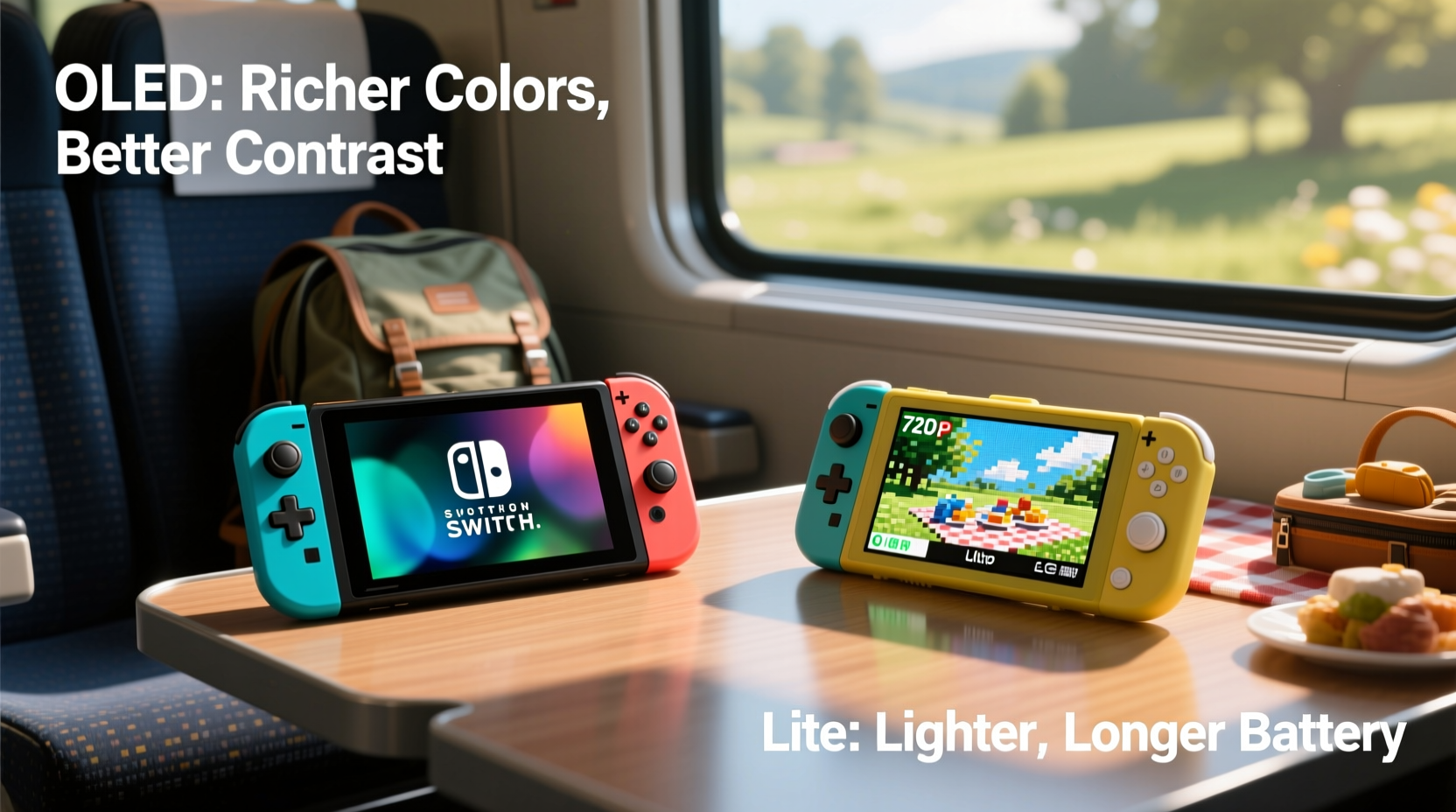
The most immediate difference between the two models is physical form. The Switch Lite is built from the ground up as a dedicated handheld. It measures 8.2 x 3.6 x 0.55 inches and weighs approximately 275 grams (9.7 oz), making it the lightest and most compact option in the Switch family. Its smaller footprint fits easily into coat pockets, small backpacks, or even large jeans pockets—ideal for minimalist travelers.
In contrast, the Switch OLED model retains the original hybrid design. With dimensions of 9.4 x 4.1 x 0.5 inches and a weight of 320 grams (11.3 oz), it’s noticeably wider and heavier. While still eminently portable, it demands more space and is less likely to disappear into a tight carry-on.
For digital nomads or business travelers packing light, every ounce counts. The Lite’s fixed controls mean you can’t attach Joy-Cons, but that also eliminates extra parts to lose or pack. The OLED, while bulkier, offers full modularity—detachable controllers, kickstand, and TV output—which adds flexibility but complicates travel logistics.
Display Quality: Where the OLED Shines—Literally
The defining upgrade of the Switch OLED is, unsurprisingly, its screen. It features a 7-inch OLED panel with vibrant colors, true blacks, and higher contrast than any previous Switch model. For games like Celeste, Hollow Knight, or The Legend of Zelda: Breath of the Wild, this means deeper immersion—dark caves feel darker, skies look more dynamic, and UI elements pop with clarity.
The Switch Lite, by comparison, uses a 5.5-inch LCD screen. While perfectly functional, it lacks the depth and richness of OLED. Colors appear flatter, blacks are grayish, and viewing angles aren’t as forgiving. In bright sunlight, both screens struggle without shade, but the OLED’s higher contrast gives it a slight edge in readability under challenging lighting.
“OLED displays transform handheld gaming—they bring console-level visual fidelity to your palm.” — David Chen, Senior Hardware Analyst at GameTech Weekly
But here’s the catch: better visuals come at a cost. The OLED screen consumes more power than the Lite’s LCD, though Nintendo offset this somewhat with a slightly larger battery. Still, actual gameplay time varies by title, and in practice, the difference in battery life between the two models is minimal for most users.
Battery Life and Real-World Performance
Nintendo rates both systems similarly in terms of battery longevity—approximately 3 to 7 hours depending on the game. Heavy 3D titles like Zelda or Fire Emblem: Engage drain batteries faster, regardless of model. However, due to the OLED’s higher power draw, some users report marginally shorter play sessions—about 15–20 minutes less per charge under identical conditions.
For travelers, this means planning charging stops. Whether you’re on a cross-country flight or a road trip, having a reliable USB-C power bank becomes essential. The good news? Both systems support pass-through charging, so you can top up mid-session without interrupting gameplay.
| Feature | Switch OLED | Switch Lite |
|---|---|---|
| Screen Size & Type | 7\" OLED | 5.5\" LCD |
| Weight | 320g | 275g |
| Battery Life (avg.) | 4–6 hrs | 4–7 hrs |
| Detachable Controllers | Yes | No |
| TV Mode Support | Yes (via dock) | No |
| Kickstand | Wide adjustable | None |
| Internal Storage | 64GB | 32GB |
The OLED’s 64GB internal storage is double that of the Lite’s 32GB—a meaningful advantage if you download large indie bundles or AAA ports like Control or Doom. Travelers who rely on digital purchases will appreciate the extra room, especially since microSD cards add cost and another component to manage.
Game Compatibility and Play Style
Both systems run the same software library, with one major exception: games requiring motion controls or detached Joy-Cons won’t work properly on the Switch Lite. Titles like Ring Fit Adventure, 1-2-Switch, or Just Dance are either unplayable or require purchasing separate Joy-Cons and sensors—an impractical solution for travel.
Similarly, local multiplayer is limited on the Lite. While you can play online co-op or link with another Switch, the lack of detachable controllers means you can’t hand a Joy-Con to a friend sitting beside you on a bus. The OLED, with its modular setup, supports spontaneous couch-style gaming anywhere.
For single-player enthusiasts, this limitation matters little. Most critically acclaimed Switch titles—Metroid Dread, Octopath Traveler II, Stardew Valley—are fully playable on the Lite. If your travel gaming revolves around story-driven adventures or retro-style RPGs, the Lite remains an excellent fit.
Real-World Example: Backpacking Through Southeast Asia
Consider Sarah, a digital nomad traveling across Thailand and Vietnam for three months. She packs light: one carry-on, a day bag, and essentials. Her goal is to unwind each evening with relaxing games after work.
She chose the Switch Lite for its compactness. It slips into her hostel locker without hassle, charges quickly from her solar-powered bank, and lasts through long train rides. She plays Animal Crossing: New Horizons and Tetris 99 daily—games perfectly suited to the device. When she meets fellow travelers, they connect online rather than sharing a screen.
Had she brought the OLED, she’d have enjoyed sharper visuals and a more comfortable stand for hotel viewing—but at the cost of added bulk and the need to safeguard detachable Joy-Cons. For her needs, the Lite struck the right balance: capable, durable, and truly mobile.
Contrast this with Mark, a family traveler flying cross-country with kids. He brings the OLED because he can prop it up on a tray table, let his children take turns with Joy-Cons, and even connect to a hotel TV if needed. His use case demands versatility—the OLED delivers.
Step-by-Step: Choosing the Right Model for Your Travel Needs
Follow this decision timeline to determine which system suits your lifestyle:
- Assess your primary gaming style: Do you play mostly solo, or do you want shared experiences?
- List your top 5 travel games: Check if any require detached controllers or motion play.
- Evaluate your luggage capacity: Can you spare the space and weight for a larger device?
- Consider connectivity options: Will you ever want to play on a bigger screen during longer stays?
- Test screen preferences: Visit a store if possible—view both screens side by side in natural light.
- Budget for accessories: Factor in cases, screen protectors, and power banks for either model.
- Make your choice: Prioritize either portability (Lite) or flexibility (OLED).
Frequently Asked Questions
Can I use the Switch OLED like a Switch Lite?
Yes—you can play the OLED entirely in handheld mode, just like the Lite. All games that work on the Lite function identically on the OLED when used portably. The reverse isn’t true: some OLED-compatible games don’t work on the Lite.
Is the OLED screen worth the price difference?
If visual quality enhances your enjoyment and you value future-proofing (e.g., better storage, TV mode), then yes. But if you prioritize minimalism and pure portability, the Lite offers better value at a lower cost.
Which is more durable for travel?
The Switch Lite has fewer moving parts—no detachable Joy-Cons or hinge mechanisms—making it less prone to mechanical failure. The OLED’s kickstand is sturdier than the original model’s, but the screen is larger and potentially more vulnerable to drops. Either way, a protective case is strongly recommended.
Final Verdict: Does the Screen Upgrade Matter?
The OLED’s screen is objectively better. It elevates the visual experience in ways that matter—especially for cinematic or atmospheric games. But “better” doesn’t always mean “necessary.” For travel gaming, necessity is defined by context: how you play, where you go, and what you’re willing to carry.
The Switch Lite excels as a purpose-built travel machine. It’s lighter, simpler, and cheaper. It does one thing very well: handheld gaming. If that’s all you need, the screen upgrade isn’t essential.
The Switch OLED, meanwhile, is a hybrid powerhouse. It improves the handheld experience while retaining full console functionality. If you move between environments—playing on planes, sharing with friends, or connecting to screens occasionally—it justifies its premium.
Conclusion
Ultimately, the choice isn’t about which device is “better” overall, but which aligns best with your travel habits and gaming priorities. If you crave immersive visuals and occasional TV play, the OLED’s screen upgrade is a worthwhile investment. But if you value compactness, efficiency, and pure portability above all, the Switch Lite remains a smart, capable companion—one that proves sometimes, less really is more.




 浙公网安备
33010002000092号
浙公网安备
33010002000092号 浙B2-20120091-4
Comments
No comments yet. Why don't you start the discussion?