
The 5 Ws—Who, What, When, Where, and Why—are foundational elements of effective communication, investigation, and decision-making. While often introduced in elementary journalism or writing classes, their application extends far beyond news reporting. From business strategy to personal development, mastering the 5 Ws enables clarity, precision, and deeper understanding. This article explores each component in detail, illustrates their practical use through real examples, and provides structured guidance on how to apply them systematically.
Understanding the Core Components
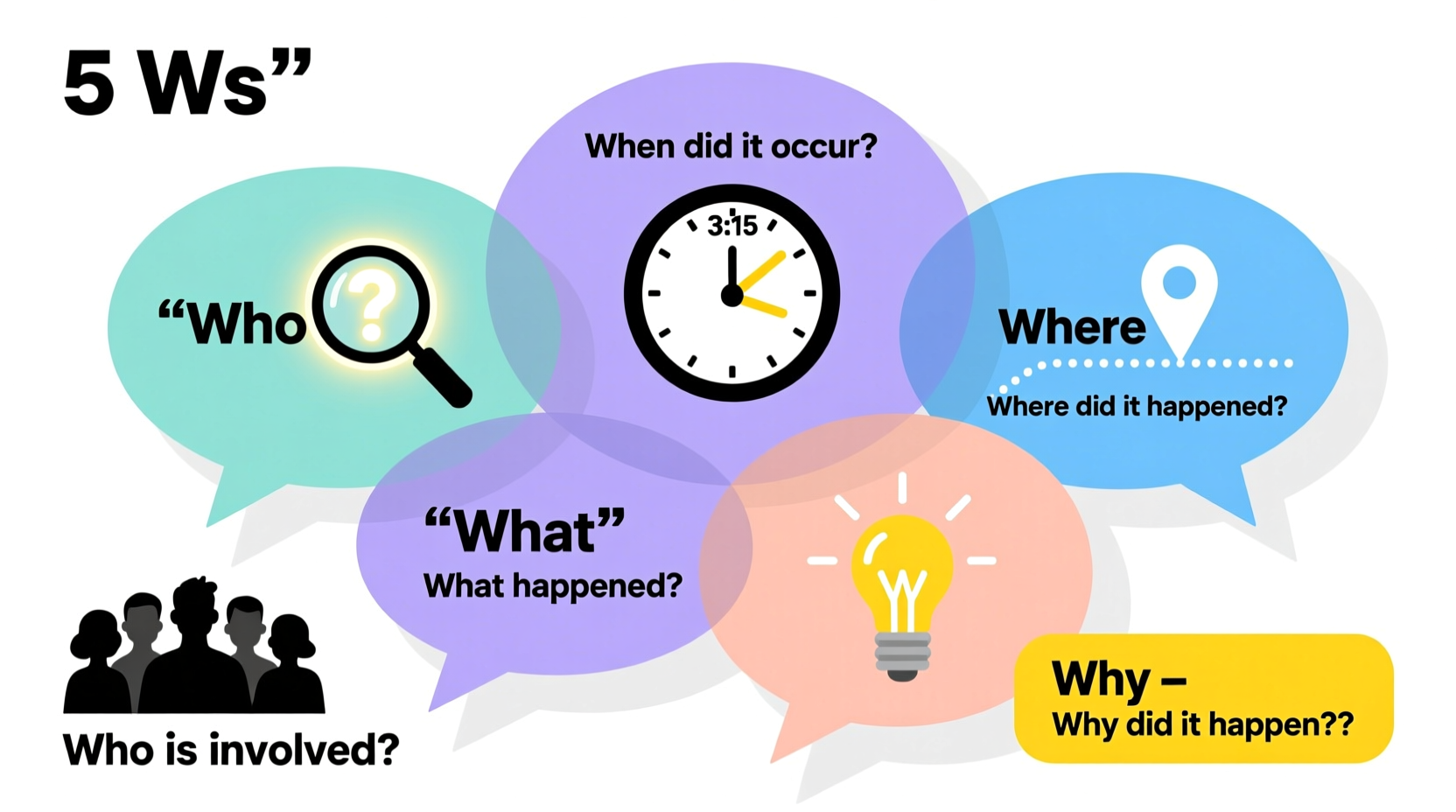
The 5 Ws form a framework designed to extract essential information from any situation. They act as cognitive prompts that help individuals gather facts, analyze context, and determine purpose. Each question targets a specific dimension:
- Who? Identifies people involved—subjects, stakeholders, or responsible parties.
- What? Defines the event, action, or object under discussion.
- When? Establishes timing: past, present, future, duration, or frequency.
- Where? Specifies location or environment.
- Why? Seeks motivation, cause, or underlying purpose.
Together, these questions create a comprehensive picture. Omitting even one can leave gaps in understanding, leading to miscommunication or flawed decisions.
Applications Across Disciplines
The 5 Ws are not confined to storytelling. Their versatility makes them valuable across multiple fields:
Journalism and Content Creation
In journalism, the 5 Ws traditionally appear in the lead paragraph of an article. A well-crafted news story answers all five upfront, giving readers immediate context. For example, a report on a city council decision would specify who voted (council members), what was decided (a new zoning law), when it happened (Tuesday night), where (City Hall), and why (to address housing shortages).
Business Strategy and Project Management
Managers use the 5 Ws during project planning. Before launching a campaign, teams define who the target audience is, what message they’re conveying, when the rollout occurs, where distribution happens (online, retail, etc.), and why the initiative matters (increasing brand awareness or driving sales).
Problem Solving and Root Cause Analysis
In quality control or incident review, the 5 Ws help dissect failures. After a system outage, engineers might investigate: Who reported it? What failed? When did it start? Where in the network? Why did safeguards not prevent it?
“The 5 Ws are the skeleton of critical thinking. Without them, analysis lacks structure.” — Dr. Lena Torres, Cognitive Psychologist
Step-by-Step Guide to Applying the 5 Ws
To harness the full power of this framework, follow a structured approach:
- Define the Situation: Clearly state the topic or issue you're examining. Ambiguity here undermines all subsequent answers.
- Ask Each Question Systematically: Go through Who, What, When, Where, and Why in order. Don’t skip any—even if one seems obvious.
- Seek Evidence-Based Answers: Support each response with data, observation, or testimony. Avoid assumptions.
- Validate Completeness: Review your responses. Do they paint a coherent picture? Are there contradictions?
- Use Gaps to Drive Further Inquiry: If a “Why” lacks a clear answer, dig deeper. Unresolved “Whens” may indicate timeline inaccuracies.
- Document and Communicate Findings: Present results using the 5 Ws as headings for clarity and accessibility.
This process ensures thoroughness and reduces cognitive bias by forcing objective evaluation.
Real Example: Investigating a Customer Complaint
A software company receives feedback: “I lost my work after the app crashed.” Using the 5 Ws, support staff conduct a diagnostic interview:
| Question | Answer |
|---|---|
| Who? | The user: Sarah Kim, a freelance designer using the app daily. |
| What? | The application crashed unexpectedly while she was editing a design file. |
| When? | Yesterday at 3:17 PM, shortly after she added a new layer. |
| Where? | On her MacBook Pro, using version 2.4.1 of the app. |
| Why? | Preliminary logs suggest a memory leak triggered by large file handling—under investigation. |
By organizing the inquiry around the 5 Ws, the team quickly isolates variables, reproduces the issue in testing, and deploys a patch within 48 hours. Without this framework, the cause might have been misattributed to user error.
Common Pitfalls and How to Avoid Them
Despite its simplicity, misuse of the 5 Ws can reduce effectiveness. Here are frequent mistakes and corrections:
| Mistake | Consequence | Solution |
|---|---|---|
| Skipping “Why” | Superficial understanding; recurring issues | Always include purpose or motive |
| Vague “When” responses | Timeline confusion | Specify exact dates/times or ranges |
| Overgeneralizing “Who” | Accountability gaps | Name individuals or roles clearly |
| Ignoring “Where” in digital contexts | Missed environmental factors | Note device type, platform, location settings |
| Assuming “What” is obvious | Misaligned expectations | Verify definitions with stakeholders |
Checklist: Mastering the 5 Ws in Daily Practice
Use this checklist to integrate the 5 Ws into your routine—whether writing, managing projects, or resolving conflicts:
- ☑ Start meetings by clarifying the 5 Ws of the agenda item
- ☑ Use the 5 Ws to draft emails for maximum clarity
- ☑ Apply the framework when delegating tasks to ensure full understanding
- ☑ Review reports or proposals by checking if all five questions are answered
- ☑ Train team members to use the 5 Ws in incident reporting
- ☑ Ask “Why?” repeatedly until reaching a root cause, not just symptoms
FAQ
Can the 5 Ws be used in personal goal setting?
Absolutely. Define who is involved (you, family, mentors), what you want to achieve, when you’ll reach milestones, where you’ll take action (gym, online course), and why the goal matters. This creates a focused roadmap.
Is there a sixth question that complements the 5 Ws?
Yes—“How?” While not part of the original five, “How?” addresses method or process. It’s often added to make the framework more complete: Who, What, When, Where, Why, and How.
Are the 5 Ws relevant in automated systems or AI prompts?
Increasingly so. Prompt engineers use the 5 Ws to structure queries for AI tools. For example: “Who is the audience? What output format? When is it due? Where will it be used? Why is this needed?” This improves accuracy and relevance of generated content.
Conclusion
The 5 Ws remain one of the most accessible yet powerful tools for clear thinking and effective communication. Whether diagnosing a technical fault, crafting a compelling narrative, or aligning a team around a shared objective, answering Who, What, When, Where, and Why brings order to complexity. Mastery doesn’t require special training—only discipline in asking the right questions consistently. As information overload grows, the ability to distill truth through simple, structured inquiry becomes not just useful, but essential.




 浙公网安备
33010002000092号
浙公网安备
33010002000092号 浙B2-20120091-4
Comments
No comments yet. Why don't you start the discussion?