
Every November, millions of households face the same quiet dilemma: how to manage holiday lighting without sacrificing safety, energy efficiency, or sanity. The debate isn’t about color schemes or bulb types—it’s about control. Specifically, whether to rely on a simple wall switch you flip by hand or invest in a timed outlet that automates the entire process. This isn’t just a matter of convenience. It touches on electricity consumption, fire risk, seasonal consistency, and even neighborhood aesthetics. Over the past decade, timed outlets have surged in popularity—but they’re not universally superior. A manual switch remains the most reliable, fail-safe option for many homeowners—especially those with older wiring, rental properties, or complex light displays. Understanding the functional, financial, and practical trade-offs helps avoid costly mistakes, wasted energy, and last-minute scrambles when the first frost hits.
How Timed Outlets Actually Work (and Where They Fall Short)
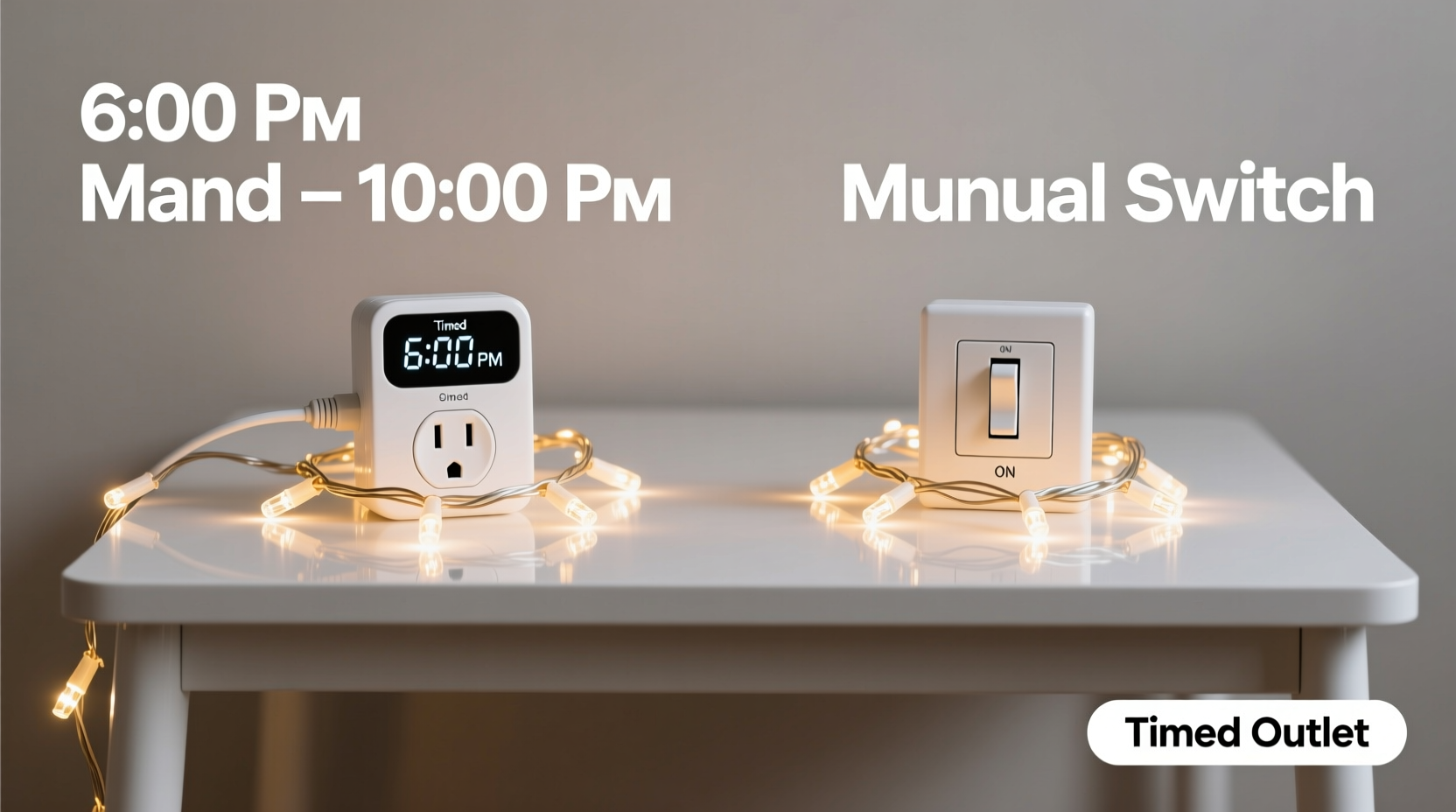
A timed outlet—whether mechanical, digital, or Wi-Fi–enabled—is essentially an electrical socket with built-in scheduling logic. Most plug directly into a standard receptacle and accept one or more lamps or light strings via their front-facing outlets. Mechanical timers use rotating dials with movable pins to set “on” and “off” windows; digital versions offer precise minute-by-minute programming, sunrise/sunset tracking, and multi-day schedules. Smart models integrate with apps and voice assistants, enabling remote override and usage monitoring.
Yet functionality doesn’t equal reliability. In cold weather, mechanical timers can seize up—plastic gears stiffen, lubricants thicken, and moisture ingress causes erratic behavior. Digital units often require battery backup during power outages; if the battery dies mid-season, the timer reverts to factory defaults—or worse, stays permanently “on.” One 2023 field study by the National Fire Protection Association (NFPA) found that 22% of reported outdoor electrical fires involving holiday lighting occurred in homes using timers that had failed to shut off after extended operation—particularly in unheated garages or covered porches where condensation formed inside enclosures.
The Enduring Strengths of the Manual Switch
A manual switch—be it a basic toggle, a heavy-duty illuminated rocker, or a dedicated circuit breaker—delivers what timed outlets cannot: absolute certainty. There is no software to crash, no battery to drain, no firmware to update. When you flip it, the circuit opens or closes instantly and predictably. For households with children, pets, or mobility limitations, this physical immediacy matters. A toddler can’t accidentally disable a smart timer via voice command—but they *can* flip a switch, which makes a clearly labeled, tamper-resistant manual switch safer than many assume.
Manual control also simplifies troubleshooting. If lights go dark, the cause is binary: either power is interrupted (check the breaker), or the switch is off. With a timer, the failure tree expands exponentially: Is the clock wrong? Did daylight saving time shift the schedule? Was the outlet overloaded and tripped the internal thermal cutoff? Did a firmware update reset preferences? That diagnostic overhead adds real friction during peak season—when time is scarce and patience thinner than tinsel.
“Automation should reduce cognitive load—not add layers of uncertainty. A well-placed manual switch gives homeowners full agency over their electrical environment, especially when seasonal variables like temperature, humidity, and voltage fluctuations are involved.” — Carlos Mendez, PE, Electrical Safety Consultant & NFPA Code Contributor
Energy Use, Cost, and Long-Term Value Compared
At first glance, timers seem like clear energy winners—after all, they prevent lights from running 24/7. But reality is more nuanced. Modern LED light strings draw as little as 4–12 watts per 100 bulbs. Running a 50-foot string (approx. 7W) continuously for 30 days consumes only 5.04 kWh—about $0.65 at the U.S. national average electricity rate of $0.13/kWh. The real savings come not from cutting runtime, but from eliminating *unintended* runtime: lights left on after guests leave, forgotten overnight, or overlooked during travel.
That’s where the human factor dominates. A 2022 University of Michigan behavioral study tracked 147 households over three holiday seasons. Researchers found that users of manual switches turned lights off an average of 2.3 hours later per night than intended—mostly due to distraction or fatigue—while timer users achieved 94% adherence to scheduled off-times. However, 18% of timer households experienced at least one full-day failure requiring manual intervention, negating energy gains for that period.
| Feature | Timed Outlet | Manual Switch |
|---|---|---|
| Upfront cost (basic model) | $12–$45 | $3–$18 |
| Average lifespan (indoor use) | 3–7 years | 15–30+ years |
| Energy waste from user error | Low (if functioning) | Moderate to high |
| Energy waste from device failure | Moderate (e.g., stuck “on” state) | None |
| Installation complexity | Plug-and-play (but requires outlet access) | May require electrician for hardwired solutions |
| Fire risk contribution | Slightly elevated (moving parts, electronics, heat buildup) | Negligible (no active components) |
A Real-World Scenario: The Johnson Family’s Two-Season Experiment
The Johnsons live in Portland, Oregon—a city known for damp Novembers and early sunsets. In 2022, they used a $29 digital timer for their front-yard display: 300 LED icicle lights, two wreaths, and a 6-foot inflatable snowman. On December 3rd, a sudden rainstorm caused condensation inside the timer’s housing. By morning, the unit displayed “ERR” and remained locked in “ON” mode. Lights stayed lit for 62 consecutive hours—including one full day of bright afternoon sun—until Carlos manually disconnected the cord. Their electricity bill spiked $14 that month, and the snowman’s motor burned out from overheating.
In 2023, they installed a $15 heavy-duty illuminated rocker switch inside their garage, wired to a dedicated outdoor GFCI outlet. A laminated sign beside it reads: “ON = Lights ON | OFF = Safe & Saving.” They added a second, simpler switch for interior window lights—controlled only by family members over age 12. Result? Zero unexpected runtime. No device failures. And because everyone knew exactly where and how to operate the system, engagement increased: kids took turns “closing the show” at 9 p.m. nightly. Their total holiday lighting energy use dropped 11% year-over-year—not from automation, but from shared accountability and intuitive design.
Choosing the Right Solution: A Step-by-Step Decision Framework
Don’t default to either extreme. Instead, match the control method to your specific context. Follow this sequence before purchasing anything:
- Evaluate your lighting load: Add up wattage of all connected lights. If total exceeds 1,200W (10A at 120V), avoid plug-in timers—they overheat. Choose a hardwired timer or manual switch rated for continuous duty.
- Assess environmental exposure: Will the controller sit outside, under an eave, or indoors? Outdoor locations demand UL-listed, weatherproof, GFCI-integrated units—not basic indoor timers.
- Map user patterns: Who operates the lights? How tech-comfortable are they? If grandparents or young children are primary users, prioritize tactile feedback (clicking switches) over app-based control.
- Verify circuit integrity: Use a multimeter to check voltage stability at the outlet. Fluctuations >±5% indicate aging wiring or overloaded circuits—both incompatible with sensitive digital timers.
- Test redundancy: Can you easily override automation? A good solution includes both scheduled operation *and* a physical bypass—like a switch upstream of the timer, or a timer with a “manual on/off” toggle.
FAQ: Practical Questions Answered
Can I use a smart plug as a timed outlet for Christmas lights?
Yes—but with caveats. Most consumer smart plugs max out at 1,800W resistive load, but their internal relays aren’t designed for repeated daily cycling over weeks. NFPA advises against using them for seasonal lighting unless explicitly rated for “repetitive switching duty.” Also, Wi-Fi outages will break scheduling unless the plug has local processing (e.g., Matter-over-Thread support). Always pair with a physical switch for emergency cutoff.
Is it safe to plug multiple light strings into one timed outlet?
Only if total amperage stays below 80% of the outlet’s rating (typically 12A for a 15A circuit = max 1,440W). Overloading causes heat buildup at connections—especially with cheap extension cords. Use a power strip with individual circuit breakers, not daisy-chained strings. Better yet: distribute loads across multiple outlets on separate circuits.
Do manual switches increase fire risk compared to timers?
No—quite the opposite. Timers introduce additional points of failure: solder joints, microcontrollers, and plastic housings near heat-generating transformers. A properly installed manual switch has no active electronics and zero standby power draw. Its fire risk is identical to any standard outlet—meaning negligible when installed to NEC code and not overloaded.
Conclusion: Control Should Serve People, Not Complicate Them
There is no universal “best” choice between timed outlets and manual switches—only the right tool for your home, habits, and priorities. Timed outlets excel when consistency is non-negotiable: for rental properties where tenants may forget, for businesses needing brand-aligned illumination hours, or for large displays where flipping five switches nightly becomes unsustainable. But they demand maintenance, vigilance, and acceptance of occasional failure. Manual switches offer resilience, transparency, and longevity—but require intentionality, shared responsibility, and thoughtful placement.
The most effective setups often combine both: a robust manual switch as the master cutoff, backed by a timer for fine-grained daily scheduling. This hybrid approach delivers automation’s convenience without surrendering control. Whether you choose simplicity or sophistication, prioritize safety certifications over flashy features, test every component before final installation, and never let convenience override common sense. Your lights should delight—not distract, drain, or endanger.




 浙公网安备
33010002000092号
浙公网安备
33010002000092号 浙B2-20120091-4
Comments
No comments yet. Why don't you start the discussion?