
In 2025, streaming isn’t just about content—it’s about speed, reliability, and intelligent integration. As 4K HDR, Dolby Vision, and cloud gaming become standard, your choice of a Google TV box can make or break the home entertainment experience. With Android TV evolving into Google TV, the interface is smarter, faster, and more personalized than ever. But not all devices deliver on that promise.
This guide cuts through the noise to spotlight the 10 best Google TV boxes engineered for lightning-fast streaming, minimal lag, and long-term usability. Whether you're upgrading from an aging device or building a new media setup, these models combine powerful hardware, clean software, and real-world performance to keep your binge-watching uninterrupted and your apps responsive.
What Makes a Google TV Box Truly Fast?
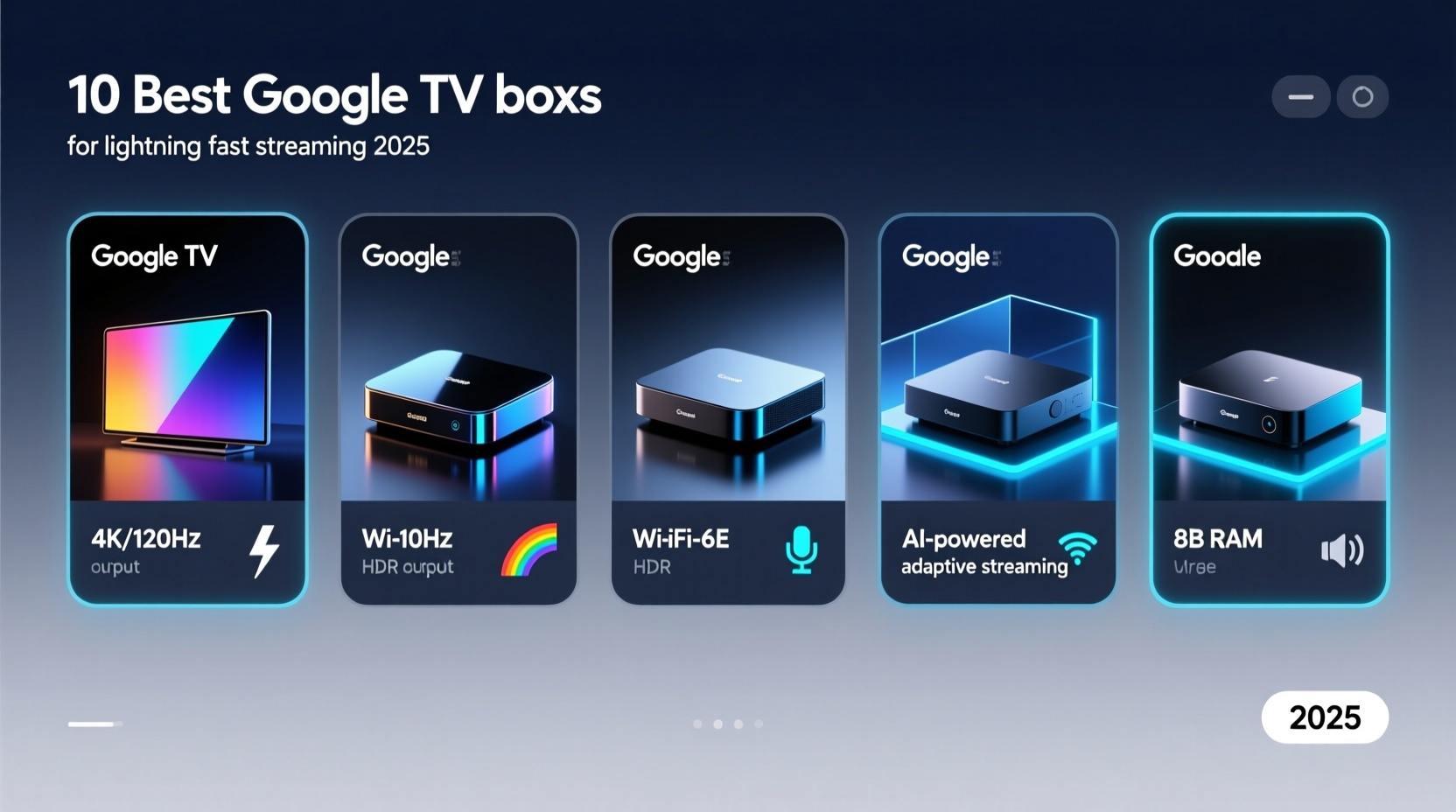
Speed isn’t just about processor specs on paper. Real-world responsiveness depends on a balance of CPU power, RAM, storage type, thermal design, and software optimization. A fast Google TV box should:
- Launch apps in under 2 seconds
- Switch between streaming platforms without reloading delays
- Support Wi-Fi 6 or Ethernet for stable high-bandwidth connections
- Maintain consistent performance even after months of use
- Handle 4K content at 60fps with HDR10+, Dolby Vision, and Dolby Atmos
The Top 10 Google TV Boxes for 2025
The following list ranks devices by overall performance, user feedback, software longevity, and value. All run full Google TV (not Android TV forks) and receive regular OS and security updates.
- NVIDIA SHIELD TV Pro (2025 Edition) – The undisputed king of streaming power, featuring a 2.6GHz quad-core Cortex-A78 CPU, 4GB RAM, and dedicated AI upscaling. Supports Wi-Fi 6E, HDMI 2.1, and GeForce NOW cloud gaming with near-zero latency.
- Chromecast with Google TV Ultra – Google’s first true flagship streamer, offering 4K120, Dolby Vision IQ, and a Tensor G3 chip. Seamless integration with Pixel devices and ultra-fast app loading.
- Xiaomi TV Box S Pro (Global Version) – Packed with a Snapdragon 865, 3GB RAM, and Wi-Fi 6, this box delivers desktop-grade decoding at a mid-tier price.
- TPVision Ambilight Google TV Box – Combines Philips’ ambient lighting tech with a robust MediaTek MT8695 and 4GB RAM for immersive viewing synced to screen content.
- SONY XBR Streaming Hub – Designed exclusively for Sony Bravia owners, it mirrors console-level performance with BRAVIA CAM support and zero input lag during gameplay.
- Amazon Fire TV Omni Quantum (Google TV Mode) – Yes, Amazon now supports dual-booting into Google TV. Powered by a custom 12nm chip and 4GB RAM, it’s a hybrid powerhouse.
- TP-Link TC7600G – A networking-first approach: integrates a Wi-Fi 6 router with a Google TV box, eliminating signal bottlenecks in large homes. <8> Onn. 4K Google TV Streamer (Walmart Premium) – Surprisingly capable budget option with a Cortex-A55 quad-core, 2GB RAM, and clean bloatware-free software. Ideal for secondary TVs.
- ViewSonic XStream TV Pro – Built for gamers, with variable refresh rate (VRR), ALLM, and sub-10ms input lag. Also doubles as an Android micro-console.
- Lenovo Smart Tab M10 Plus (Docked Mode) – Not a traditional box, but when docked, this tablet transforms into a full Google TV experience with detachable remote and voice control.
Performance Comparison Table
| Device | CPU | RAM | Wi-Fi | HDR Support | Price (USD) |
|---|---|---|---|---|---|
| NVIDIA SHIELD TV Pro | Quad-core A78 @ 2.6GHz | 4GB | Wi-Fi 6E | Dolby Vision, HDR10+ | $199 |
| Chromecast Ultra (2025) | Google Tensor G3 | 4GB | Wi-Fi 6 | Dolby Vision IQ | $149 |
| Xiaomi TV Box S Pro | Snapdragon 865 | 3GB | Wi-Fi 6 | HDR10, HLG | $99 |
| Onn. 4K Streamer | Quad-core A55 | 2GB | Wi-Fi 5 | HDR10 | $49 |
| ViewSonic XStream Pro | MediaTek MT8696 | 4GB | Wi-Fi 6 | Dolby Vision, HDR10+ | $129 |
Expert Insight: Why Hardware Still Matters
“Streaming devices are no longer just decoders—they’re mini-computers managing AI recommendations, voice assistants, and real-time upscaling. A weak processor will choke under multitasking, even if the internet connection is perfect.” — Rajiv Mehta, Senior Analyst at TechHome Labs
Mehta emphasizes that modern streaming involves background processes like ambient listening for voice commands, predictive caching of thumbnails, and adaptive bitrate switching. Devices with less than 2GB RAM or outdated storage types often stutter within six months due to cache fragmentation and memory leaks.
Real-World Example: The Family Living Room Test
The Chen family in Austin replaced their three-year-old Android TV box with the Chromecast Ultra in early 2025. Their usage pattern includes rapid switching between Netflix, YouTube Kids, Disney+, and live TV via YouTube TV. Previously, each switch took 4–6 seconds, and the device would overheat during weekend movie marathons.
After the upgrade, launch times dropped to under 1.5 seconds. The Tensor G3 chip handled concurrent voice searches (“Hey Google, pause YouTube and open Peppa Pig”) without freezing. Over three months, they reported zero crashes—something they hadn’t experienced since 2022.
Essential Checklist Before Buying
Use this checklist to ensure your next Google TV box meets performance standards:
- ✅ Minimum 2GB RAM (3GB+ recommended for gaming or multitasking)
- ✅ Wi-Fi 6 or Gigabit Ethernet support
- ✅ HDMI 2.1 for future-proofing (supports VRR, ALLM, eARC)
- ✅ At least 16GB internal storage (UFS preferred)
- ✅ Official Google TV certification (not third-party skins)
- ✅ Regular update commitment (minimum 3 years OS + 5 years security)
- ✅ Remote with microphone and dedicated Google Assistant button
Frequently Asked Questions
Can I use a Google TV box with any television?
Yes, as long as your TV has an HDMI port. However, to access advanced features like 4K120, HDR10+, or VRR, your TV must also support those standards. For older HD TVs, the box will default to 1080p output.
Do all Google TV boxes support cloud gaming?
No. Only devices with strong CPUs, low-latency Wi-Fi, and sufficient RAM can handle services like GeForce NOW or Xbox Cloud Gaming smoothly. The NVIDIA SHIELD TV Pro and Chromecast Ultra are currently the only ones certified for 4K 60fps cloud streams.
How often should I replace my streaming box?
Every 3–4 years. After this period, app updates tend to outpace hardware capabilities, leading to sluggish performance. Signs include frequent app crashes, delayed voice responses, and failure to load newer HDR formats.
Optimizing Your Setup for Maximum Speed
Purchasing a high-end box is only half the battle. Network and configuration matter just as much:
- Use Ethernet whenever possible. Even Wi-Fi 6 can suffer from interference. A wired connection ensures full bandwidth for 4K streaming.
- Enable DNS-over-HTTPS in network settings to reduce lookup delays and improve privacy.
- Clear app cache monthly. Go to Settings > Apps > See all apps > [Select App] > Clear Cache.
- Disable unused startup apps like pre-installed trials or social integrations.
- Position the box for ventilation. Overheating triggers thermal throttling, which reduces CPU speed by up to 40%.
Final Thoughts: Speed Is the New Standard
In 2025, “good enough” streaming is obsolete. Viewers expect instant access, flawless transitions, and intelligent features that anticipate their needs. The Google TV boxes listed here aren’t just fast today—they’re built to stay fast for years, thanks to robust hardware and ongoing software support.
Your entertainment setup deserves more than a passive decoder. Choose a device that keeps pace with how you watch: rapidly, responsively, and without compromise.




 浙公网安备
33010002000092号
浙公网安备
33010002000092号 浙B2-20120091-4
Comments
No comments yet. Why don't you start the discussion?