
Walking through a packed subway station, jostling at a festival, or navigating a bustling city street—crowds are unavoidable in modern life. In these environments, your tote bag isn’t just a fashion statement; it’s a mobile vault for essentials like your phone, wallet, and keys. But when pickpockets and opportunistic thieves thrive on distraction, the design of your bag can mean the difference between peace of mind and loss. The debate between zippered totes and open-top designs isn’t just about style—it’s about safety. So, which one actually protects your belongings better in crowded spaces?
The short answer: a tote with a zipper is generally safer. But the full picture involves more than just a closure mechanism. It includes how you carry the bag, where you place it, your awareness level, and even cultural context. This article breaks down the real risks, compares both styles objectively, and offers actionable guidance for staying secure—no matter what kind of tote you own.
Understanding the Threat: How Theft Happens in Crowds
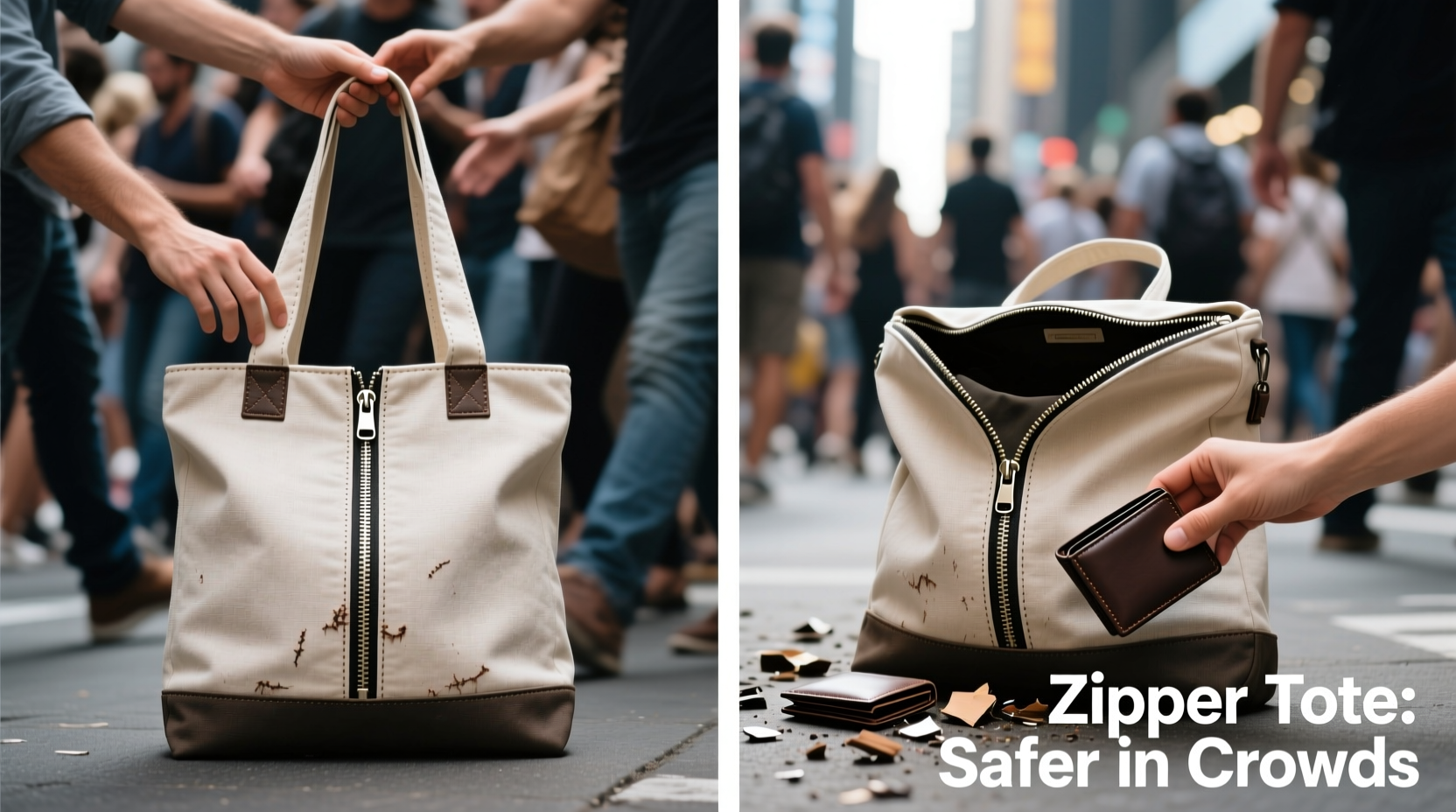
Pickpocketing isn’t random. It follows patterns. In dense crowds, thieves exploit three key vulnerabilities: visual obstruction, physical contact, and cognitive distraction. They don’t need strength—just speed and misdirection.
A common technique known as “the brush-and-swap” involves lightly bumping into someone while simultaneously sliding a hand into an open bag. Because tactile sensation is dulled during movement, many victims don’t notice until it’s too late. Another method, “the group squeeze,” uses two or more accomplices to corral a target into a confined space, creating confusion that masks theft.
According to a 2023 report from Global Urban Safety Insights, over 67% of personal bag thefts in high-density areas occurred with open-top bags. Most incidents took place within 90 seconds of entering a crowd—often before the victim even registered their surroundings.
“Thieves look for predictability. An open bag carried behind the shoulder is like a welcome sign.” — Carlos Mendez, Former NYPD Crime Prevention Specialist
This doesn’t mean open-top totes are inherently flawed—but they do require more vigilance to use safely.
Zippered Totes: Security Advantages and Limitations
A zipper adds a physical barrier that slows down access. Even a partially closed zipper forces a thief to spend extra time and effort, increasing their risk of detection. Full-length zippers that close completely across the top provide the strongest defense.
Modern zippered totes often include additional security features:
- Lockable zippers – Can be secured with small padlocks or TSA-approved sliders.
- Buried zippers – Positioned underneath fabric flaps, making them harder to locate quickly.
- RFID-lined compartments – Shield credit cards and passports from electronic scanning.
However, zippers aren’t foolproof. Some lightweight zippers can be pried open with fingernails or thin tools. Poorly aligned teeth may leave gaps. And if the zipper pull is oversized or brightly colored, it can actually draw attention instead of deterring it.
Open-Top Totes: Convenience vs Risk
Open-top totes dominate fashion markets for good reason—they’re easy to access, spacious, and stylish. Their wide mouth allows quick retrieval of items without fumbling. For many, this convenience outweighs perceived risk.
But in practice, that openness becomes a liability in motion. When carried over the shoulder with contents exposed, even a brief moment of distraction—checking a text, adjusting clothing, or turning to speak—creates an opening.
Worse, some users compound the risk by placing high-value items near the top. Phones left peeking out, wallets resting on books, or sunglasses casually draped inside become irresistible targets.
That said, not all open-top bags are equally vulnerable. Design elements can mitigate risk:
- Narrow openings – Reduce hand insertion depth.
- Internal snap pockets – Allow secure storage of critical items.
- Fold-over flaps – Provide partial coverage without full closure.
The real danger lies in complacency. Open-top tote owners often assume they’ll “feel” any tampering. Unfortunately, studies show that tactile awareness drops by up to 40% in crowded, moving environments due to sensory overload.
Direct Comparison: Zippered vs Open-Top Totes in Real-World Scenarios
| Feature | Zippered Tote | Open-Top Tote |
|---|---|---|
| Access Speed | Moderate (requires unzipping) | Fast (instant access) |
| Theft Resistance | High (physical barrier) | Low to moderate |
| Visibility of Contents | Low (contents hidden) | High (contents exposed) |
| Weight Distribution | Slight added weight from hardware | Lighter overall |
| Maintenance Needs | Higher (zippers require cleaning/lubrication) | Lower (fewer moving parts) |
| Best Use Case | Crowded transit, travel, urban commutes | Casual outings, short errands, low-risk areas |
This comparison shows a clear trade-off: security versus convenience. If your day involves subways, festivals, or international travel, the slight delay in accessing your bag is a worthwhile price for reduced risk. On the other hand, for quick coffee runs or neighborhood walks, an open-top tote may be perfectly adequate—especially with behavioral precautions.
Real-World Example: The Festival Incident
At last summer’s Riverbend Music Festival in Cincinnati, Sarah K., a 29-year-old graphic designer, learned this lesson firsthand. She arrived carrying her favorite canvas tote—an open-top design with a single interior pocket. Within 30 minutes of entering the main stage area, she felt a light tug but assumed it was someone brushing past.
It wasn’t until she reached for her phone—needed for a ride-share pickup—that she realized it was gone. Surveillance footage later showed a man in a hoodie using a diversion tactic: he pretended to stumble while a second person blocked her view. In under four seconds, her phone was lifted from the top of her bag.
“I thought I was being careful,” Sarah said in a follow-up interview. “I kept the bag in front of me. But I didn’t realize how fast it could happen.”
After replacing her phone, she switched to a crossbody tote with a full zipper and a slash-proof strap. Six months later, during a similar event, she noticed someone reaching toward her bag. This time, the zipper resisted, and the would-be thief moved on.
Her experience underscores a crucial point: no bag is 100% theft-proof, but design significantly influences outcomes.
Action Plan: How to Stay Safe Regardless of Bag Type
Security isn’t just about hardware—it’s about habits. Whether you own a zippered tote or prefer open-top styles, these steps will dramatically reduce your risk.
- Carry the bag in front of you – Never drape it over your shoulder behind your back. Front-carrying makes blind spots impossible.
- Use internal organization – Store valuables in inner pockets, not loose at the top. Consider a small zip pouch inside even an open-top bag.
- Minimize visible contents – Avoid leaving headphones, power banks, or documents exposed.
- Stay aware during transitions – Entering trains, passing through turnstiles, or boarding buses are peak vulnerability moments.
- Invest in anti-theft features – Look for slash-resistant straps, lockable zippers, or concealed side pockets.
Checklist: Choosing a Safer Tote for Crowded Environments
Before purchasing or relying on a tote in high-risk settings, run through this checklist:
- ✅ Does it have a full-length zipper or secure flap?
- ✅ Are the zippers recessed or covered?
- ✅ Is the strap adjustable and strong enough for crossbody wear?
- ✅ Does it include RFID protection for cards?
- ✅ Are there multiple internal compartments to hide valuables?
- ✅ Is the material puncture-resistant (e.g., nylon, ballistic weave)?
- ✅ Can it be worn snugly against the body?
If fewer than four apply, consider upgrading—especially if you frequently travel or commute in dense cities.
Expert Insight: What Security Professionals Recommend
When asked about everyday bag safety, Maria Tran, a private security consultant who advises corporate travelers, emphasized behavior over design alone.
“It’s not just about whether your bag has a zipper. It’s about how you treat it. A zippered bag left unattended on a café chair is just as vulnerable as an open one. Awareness is the first layer of defense.” — Maria Tran, Security Consultant & Travel Risk Analyst
She recommends treating your bag like a briefcase: keep it within arm’s reach, avoid setting it on floors in public, and use physical barriers (like your leg or a wall) to block access when seated.
Frequently Asked Questions
Is a partially zipped tote still safe?
No. Even a small opening allows skilled thieves to extract flat items like cards or phones. If your tote has a zipper, close it fully every time. Partial zipping creates a false sense of security.
Can I make my open-top tote safer?
Yes. Use a magnetic snap closure DIY kit to add a front flap, insert a zippered clutch inside for valuables, and always carry it in front. You can also attach a portable alarm clip that sounds if the bag is opened unexpectedly.
Are crossbody bags safer than shoulder totes?
Generally, yes. Crossbody styles stay tighter to the body and are harder to access from behind. Combined with a zipper, they offer superior protection in crowds compared to traditional shoulder-carry totes.
Conclusion: Make the Right Choice for Your Lifestyle
In the contest between tote bags with zippers and open-top designs, the data and expert consensus lean clearly toward zippers for safety in crowds. The physical barrier they provide disrupts the speed and ease that thieves depend on. That said, no bag can compensate for inattention.
The most secure approach combines smart design with mindful habits. Choose a zippered tote with thoughtful construction if you navigate high-risk environments regularly. If you prefer open-top styles, adopt compensating behaviors: limit exposed items, carry it in front, and never let it out of your immediate control.
Ultimately, safety isn’t just about what you carry—it’s about how you carry it. Upgrade your awareness as much as your accessories, and you’ll move through crowds with confidence.




 浙公网安备
33010002000092号
浙公网安备
33010002000092号 浙B2-20120091-4
Comments
No comments yet. Why don't you start the discussion?