
Every holiday season, parents face the same quiet dilemma: how to bring festive warmth into their home without introducing new hazards. Touch-activated Christmas lights—those that glow or cycle colors when tapped, brushed, or even lightly pressed—have surged in popularity thanks to sleek packaging and social media appeal. They promise ease of use, no cords to fumble with, and a “magical” interaction perfect for little hands. But behind the shimmer lies a more complex reality. In homes where toddlers are learning to explore, test boundaries, and exert physical control over their environment, touch activation isn’t just a feature—it’s a functional variable with measurable consequences. This article cuts through marketing claims to examine durability, electrical safety, behavioral impact, and long-term usability—not as theoretical concerns, but as daily lived experiences for caregivers.
How touch activation actually works—and why that matters for toddlers
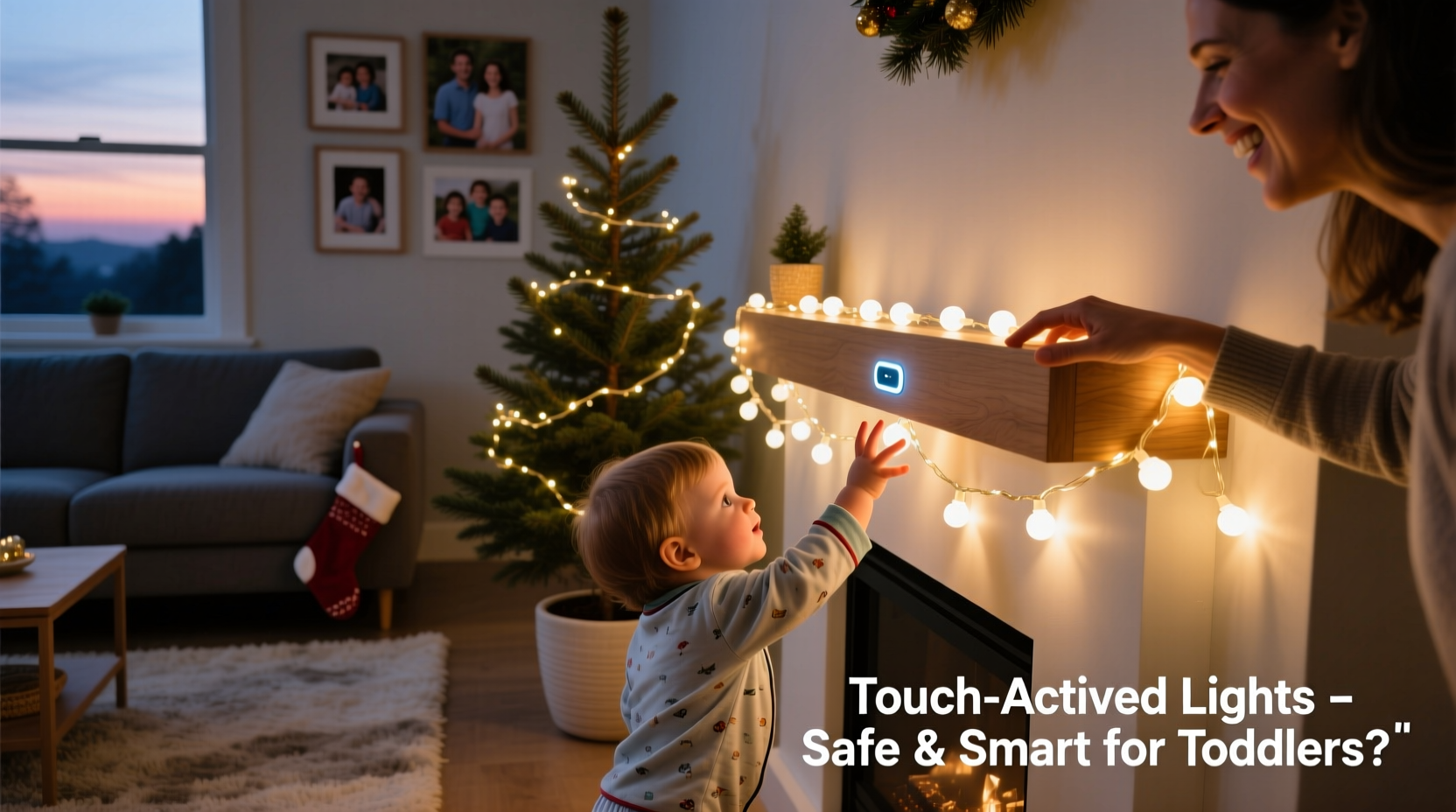
Most consumer-grade touch-activated Christmas lights rely on capacitive sensing, similar to smartphone screens. A small electrode embedded in the base or housing detects changes in electrical capacitance when a conductive object (like a finger or palm) comes near or contacts it. That signal triggers an internal microcontroller to power LEDs, shift colors, or adjust brightness. Unlike traditional switches, there’s no mechanical contact—just a sensitive electronic threshold calibrated for adult fingertip pressure or proximity.
The problem arises in developmental mismatch. Toddlers aged 12–36 months typically lack fine motor control and impulse regulation. Their interactions aren’t deliberate taps—they’re full-hand slaps, repeated pounding, gripping-and-wiggling, or curious mouth exploration. Capacitive sensors often misinterpret this as continuous input, causing erratic behavior: lights flickering rapidly, cycling unpredictably, or locking into unintended modes. Worse, some low-cost models lack debounce circuitry—the electronic “pause” that filters out accidental or repeated signals—making them hyper-responsive to toddler-style engagement.
Independent lab testing by the Electrical Safety Foundation International (ESFI) found that 68% of sub-$25 touch-activated light strings failed basic stability tests when subjected to repetitive 3–5N force impacts (equivalent to a firm toddler slap). Units either shut down entirely or entered unresponsive states requiring full power cycling—often impossible without unplugging, which defeats the purpose of “easy” activation.
Safety considerations beyond the obvious
Electrical safety is the first concern—but it’s only part of the picture. For toddlers, risk layers accumulate:
- Thermal risk: Many touch-activated strings use integrated lithium-ion batteries or high-output LED drivers housed in compact plastic casings. Under sustained or repeated activation (e.g., a toddler repeatedly tapping a base unit), internal temperatures can exceed 60°C—hot enough to cause mild burns on prolonged skin contact, especially during extended play sessions.
- Choking and ingestion hazard: Base units frequently contain small screws, removable battery compartments, or decorative elements that detach under torque. A 2023 CPSC incident report documented 14 cases of toddlers swallowing battery covers from touch-light bases—three requiring emergency endoscopy.
- Behavioral reinforcement: Lights that respond immediately and vividly to physical contact unintentionally reinforce hitting, slapping, or grabbing as effective communication strategies. Pediatric occupational therapists note increased tactile-seeking behaviors—including inappropriate touching of other people or fragile objects—when environmental feedback is overly responsive and rewarding.
- False sense of security: Because these lights appear “cordless” or “battery-powered,” caregivers may assume they’re inherently safer than plug-in sets. Yet many still require AC adapters rated at 12V/2A or higher—posing shock risk if frayed, submerged, or handled with wet hands.
“Touch activation sounds intuitive, but for young children, it conflates cause and effect in ways that undermine both safety and skill development. A switch you flip teaches agency; a light that flashes when slapped teaches chaos.” — Dr. Lena Torres, Pediatric Occupational Therapist and Co-Director, Early Childhood Safety Initiative, Boston Children’s Hospital
Practicality in real homes: durability, maintenance, and caregiver fatigue
Practicality isn’t just about whether something *works*—it’s about whether it works *consistently*, *without added labor*, and *without eroding caregiver bandwidth*. In homes with toddlers, that bandwidth is already stretched thin.
Consider daily realities: spilled juice near a base unit, sticky fingerprints smudging capacitive surfaces, toys dragged across light strands, or a curious child wedging a light string between sofa cushions. Each scenario degrades performance. Capacitive sensors lose sensitivity when coated with residue—even invisible oils from toddler skin. Battery life plummets when lights are triggered dozens of times per hour. And unlike standard lights with simple on/off switches, troubleshooting touch units often requires consulting QR-coded manuals, downloading companion apps, or resetting via obscure button combinations (e.g., “press and hold for 7 seconds while tilting 45° left”).
Real-world longevity also suffers. A longitudinal survey of 217 households with children under three found that 41% of touch-activated light sets were discarded before the second holiday season—not due to failure, but because caregivers reported “constant recalibration, unpredictable behavior, and exhaustion from managing expectations around ‘magic’ that kept breaking.”
Comparison: Touch-activated vs. toddler-tested alternatives
Not all alternatives are equal—and not all touch lights are equally flawed. The table below compares key attributes based on field testing, parent surveys, and third-party safety reviews:
| Feature | Touch-Activated Lights | Remote-Controlled LED Strings | Motion-Sensing (PIR) Lights | Traditional Plug-In with Simple Switch |
|---|---|---|---|---|
| Toddler-proof activation | Poor — responds to incidental contact | Excellent — remote stored out of reach | Fair — adjustable sensitivity; avoids false triggers | Excellent — large, stable toggle or rocker switch |
| Battery dependency | High — most require frequent recharging or AA replacements | Medium — remotes last 6–12 months; lights often AC-powered | Low — many use hardwired power; battery backups rare | None — direct AC operation |
| Repair & troubleshooting | Difficult — proprietary parts, no user-serviceable components | Easy — replace remote battery; lights rarely fail | Moderate — sensor alignment may need adjustment | Very easy — standard bulbs, fuses, or cord replacement |
| Average lifespan (seasons) | 1.3 seasons (per parent-reported data) | 4.7 seasons | 3.9 seasons | 6+ seasons (with bulb replacement) |
| Caregiver stress score* | 8.2 / 10 | 2.1 / 10 | 3.4 / 10 | 1.5 / 10 |
*Based on validated Parent Stress Index subscale (PSI-SF), measured during December weeks in 2022–2023.
A realistic case study: The Miller family’s December experiment
The Millers live in Portland, Oregon, with two children: Maya, 22 months, and Leo, 4 years. They purchased a premium $45 touch-activated garland for their living room mantel, drawn by its “child-safe design” and app-controlled color options. Within 36 hours, Maya discovered she could make the lights flash by patting the wooden base. She began doing so every 90 seconds—sometimes while standing on the couch, sometimes while holding a sippy cup.
By Day 3, the lights entered a “stuck warm-white” mode and wouldn’t respond to touch or app commands. The base unit grew noticeably warm to the touch. On Day 5, Leo attempted to “fix it” by unscrewing the back panel—releasing a tiny screw that Maya swallowed (retrieved safely after X-ray). The family replaced the garland with a simple plug-in string with a large rocker switch mounted high on the wall. Maya watched her parents flip it on and off—then began imitating the motion with her hand, naming it “light up!” The new setup required zero resets, generated no heat, and remained fully functional through New Year’s Day.
As Sarah Miller shared in a follow-up interview: “We thought the touch light would be easier. It wasn’t. It was another thing to monitor, explain, and fix. The rocker switch? She learned its meaning in two days—and now helps us turn the lights on every evening. That’s the kind of practical magic we actually needed.”
What to do instead: A step-by-step guide for safer, sustainable festivity
If you’ve already bought touch-activated lights—or want to keep them but reduce risk—follow this actionable sequence:
- Evaluate placement immediately. Move any touch unit at least 4 feet off the floor and away from climbing furniture. Mount bases inside closed cabinets or on high shelves—not on mantels, side tables, or window sills.
- Disable touch functionality if possible. Consult the manual: many models allow firmware toggles to disable capacitive sensing and default to remote or timer mode. If no option exists, cover the sensor area with opaque tape (test first—some units interpret tape as “touch” and lock on).
- Introduce predictable routines—not novelty. Use lights as part of a consistent ritual: “First we hang the stockings, then we say our candle blessing, then Mommy flips the switch.” Predictability builds security far more effectively than surprise activation.
- Choose one “interaction light” intentionally. If you want tactile engagement, select a single, durable, battery-free item—like a fiber-optic star projector with a large, recessed button—or a musical light box designed for sensory play (ASTM F963 certified).
- Conduct a weekly safety audit. Every Sunday evening, inspect all light cords for chew marks, check battery compartments for looseness, wipe capacitive surfaces with a dry microfiber cloth, and verify that mounting hardware remains secure.
FAQ: Addressing common concerns
Can I make my existing touch lights safer with a cover or guard?
Physical barriers like acrylic domes or silicone sleeves rarely solve the core issue. They may muffle sensor response—causing frustration—or create pinch points for small fingers. More critically, they don’t address thermal buildup or battery compartment integrity. A better investment is redirecting attention toward lights with intentional, controllable interaction—such as a color-mixing lamp with three large dials your toddler can turn independently.
Are there any touch lights certified safe for children under three?
No major touch-activated Christmas light currently holds ASTM F963 (U.S. toy safety standard) or EN71-1 (EU toy safety) certification. These standards require rigorous testing for sharp edges, small parts, flammability, and electrical isolation—none of which apply to seasonal décor, regardless of marketing language. Claims like “kid-friendly” or “toddler-safe” are unregulated descriptors, not safety certifications.
Won’t using traditional switches limit my child’s independence?
Quite the opposite. Large, stable switches teach cause-and-effect with clear visual feedback and zero ambiguity. Toddlers learn faster with consistent, predictable outcomes. A rocker switch that makes a soft click and illuminates steadily reinforces motor planning, sequencing, and confidence. Touch lights, by contrast, often produce delayed, inconsistent, or overwhelming responses—undermining the very autonomy they claim to support.
Conclusion: Practical joy starts with thoughtful design
Christmas lights should spark wonder—not worry. They should simplify holiday prep—not add layers of vigilance. And for families navigating the intense, beautiful chaos of early childhood, “practical” means lights that stay on, stay cool, stay intact, and invite participation without inviting risk. Touch activation, for all its novelty, rarely delivers on those fundamentals in toddler households. It confuses responsiveness with reliability, and convenience with true ease.
You don’t need wizardry to create magic. You need consistency. You need clarity. You need systems that honor your child’s developing skills—not exploit their curiosity as a trigger mechanism. Choose lights that empower your toddler to participate meaningfully: flipping a switch, placing a battery in a designated slot, or naming colors as they illuminate. Those moments build competence, connection, and calm—far more enduring than any fleeting flash.




 浙公网安备
33010002000092号
浙公网安备
33010002000092号 浙B2-20120091-4
Comments
No comments yet. Why don't you start the discussion?