
When stepping into the world of high-end watches, two complications often dominate conversations: the tourbillon and the chronograph. One spins hypnotically beneath the crystal, a mechanical ballet of precision; the other offers practical timing functions used by pilots, racers, and everyday professionals. But here’s the real question—does the mesmerizing dance of a tourbillon justify its five- or six-figure price tag over a finely made chronograph? Or is it simply mechanical theater with diminishing returns in accuracy?
To answer this, we need to go beyond marketing gloss and examine the engineering, history, utility, and emotional value behind each complication.
The Tourbillon: Engineering Artistry or Mechanical Theater?
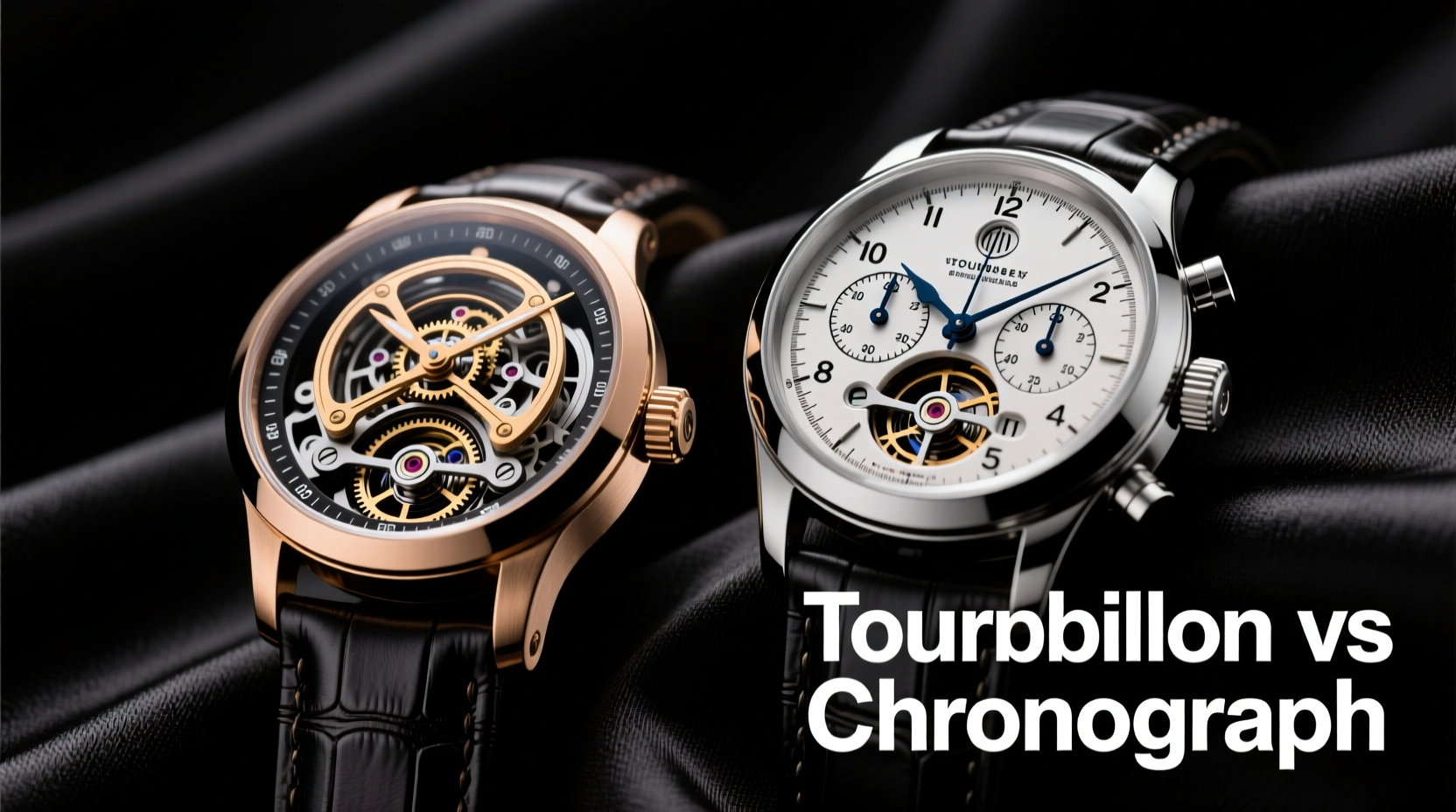
Invented by Abraham-Louis Breguet in 1801, the tourbillon was designed to counteract the effects of gravity on a watch’s accuracy. In pocket watches—which were typically carried vertically—gravity would pull unevenly on the balance wheel, causing timing inconsistencies. The solution? Mount the escapement and balance wheel in a rotating cage that turns 360 degrees per minute, averaging out positional errors.
In theory, brilliant. In practice, modern wristwatches experience far less consistent positioning than pocket watches. Wearing a watch on the wrist introduces constant motion, reducing the gravitational bias the tourbillon was meant to correct. Moreover, advancements in materials, lubrication, and precision manufacturing have made high-beat movements so stable that even without a tourbillon, chronometric performance can exceed COSC standards.
“Today’s tourbillons are more about horological heritage and craftsmanship than measurable timekeeping improvement.” — Laurent Martinez, Master Watchmaker at Atelier Horlogerie Suisse
Yet, the tourbillon remains the pinnacle of haute horlogerie. Crafting one requires extraordinary skill—some take weeks to assemble by hand. Brands like Patek Philippe, Audemars Piguet, and Greubel Forsey charge upwards of $250,000 for multi-axis tourbillons, not because they keep better time, but because they represent the zenith of mechanical artistry.
The Chronograph: Functionality Meets Everyday Utility
Unlike the tourbillon, the chronograph serves a direct, functional purpose: measuring elapsed time. Whether timing a lap, a meeting, or a coffee brew, the chronograph is one of the most useful complications in horology. It operates via pushers on the side of the case that start, stop, and reset a central seconds hand, often accompanied by subdials for minutes and hours.
Iconic models like the Rolex Daytona, Omega Speedmaster, and Tag Heuer Carrera have cemented the chronograph’s reputation as a tool watch. The Speedmaster, famously, was flight-qualified by NASA and worn during moon landings. Its reliability under extreme conditions speaks volumes about the chronograph’s real-world value.
From an engineering standpoint, chronographs are complex—but their complexity serves function. Modern versions feature column-wheel mechanisms or cam-actuated systems, each offering different tactile feedback and durability. While not as visually dramatic as a tourbillon, a well-finished chronograph movement reveals intricate detailing: perlage, Geneva stripes, blued screws, and beveled edges.
| Feature | Tourbillon | Chronograph |
|---|---|---|
| Purpose | Improve timekeeping (historically) | Measure elapsed time |
| Real-World Accuracy Gain | Negligible in modern wear | None (but highly functional) |
| Average Price Range | $80,000 – $1M+ | $3,000 – $50,000 |
| Maintenance Complexity | Extremely high | Moderate to high |
| Everyday Usefulness | Low (aesthetic/emotional) | High |
Is the Spinning Cage Worth the Premium?
Let’s be clear: a tourbillon does not make your watch significantly more accurate than a top-tier chronograph. In fact, many chronometers equipped with chronographs outperform tourbillon pieces in official testing. So why pay ten times more?
The answer lies in exclusivity and artistry. A tourbillon is a statement—a declaration that you appreciate the limits of micro-engineering. It takes hundreds of hours to design, machine, and assemble. Each component is often finished by hand: anglage, polishing, chamfering. Owning one is akin to owning a Stradivarius violin or a Picasso sketch—not because it plays music better, but because it represents human ingenuity pushed to its edge.
That said, if your goal is practicality, resale value, or versatility, the chronograph wins hands down. It’s more durable, easier to service, and widely appreciated across collector circles. You can wear a Daytona daily without fear of damaging a delicate mechanism. Try that with a $300,000 open-dial tourbillon, and you might think twice before jogging with it on your wrist.
Mini Case Study: Two Collectors, Two Priorities
Consider two collectors: Daniel and Sofia. Daniel bought a F.P. Journe Chronomètre à Résonance with a tourbillon for $120,000. He rarely wears it, keeps it in a safe, and views it as a long-term investment and artistic possession. He values the rarity—one of only 200 made—and the fact that Journe himself signed the movement.
Sofia, meanwhile, owns a vintage Omega Speedmaster Professional ref. 105.012. She paid $22,000 at auction. She wears it weekly, uses the chronograph to time her workouts, and loves knowing it’s a Moonwatch lineage piece. Her watch gains attention not for technical spectacle, but for historical significance and usability.
Both are passionate collectors. But while Daniel’s watch is a museum-grade artifact, Sofia’s is a living tool. Neither is “better”—they serve different purposes.
How to Decide: A Practical Checklist
Still unsure which path suits you? Ask yourself the following:
- Do I want a watch I’ll wear every day, or one I’ll display occasionally?
- Am I drawn to mechanical beauty, or practical functionality?
- Is my budget flexible enough to absorb high maintenance costs?
- Do I care about historical context and provenance?
- Will I appreciate the craftsmanship even if others don’t notice it?
Frequently Asked Questions
Can a tourbillon improve my watch’s accuracy?
In controlled vertical positions, perhaps slightly. But in real-world wrist use, modern chronometers without tourbillons often perform just as well—or better. The accuracy benefit is minimal today.
Are chronographs harder to maintain than simple watches?
Yes, due to additional moving parts. However, they’re generally more reliable and less fragile than tourbillons, which require specialized servicing and careful handling.
Why are tourbillons so expensive?
Cost stems from labor intensity, low production volume, finishing quality, and brand prestige. Some tourbillons take longer to build than entire sports watches.
Conclusion: Value Beyond Timekeeping
The debate between tourbillon and chronograph isn’t really about mechanics—it’s about intent. Are you seeking a functional instrument or a masterpiece of micro-engineering? The chronograph answers to utility, legacy, and daily joy. The tourbillon answers to art, obsession, and the pursuit of perfection for its own sake.
If you’re looking for the best return on investment, both financially and emotionally, consider starting with a high-quality chronograph. It will serve you, impress others, and hold its value. Save the tourbillon for when you’re ready to collect watches not just to wear, but to marvel at—as miniature monuments to what humans can build with patience and precision.




 浙公网安备
33010002000092号
浙公网安备
33010002000092号 浙B2-20120091-4
Comments
No comments yet. Why don't you start the discussion?