
Understanding how to calculate the area of different shapes is a foundational skill in mathematics, engineering, architecture, and everyday life. Whether you're measuring a room for flooring, designing a garden layout, or solving a complex geometry problem, knowing the right formula—and how to apply it—can save time and prevent errors. This comprehensive guide walks through the essential formulas, practical tips, and real-world applications for calculating the area of every major geometric shape.
Basic Principles of Area Calculation
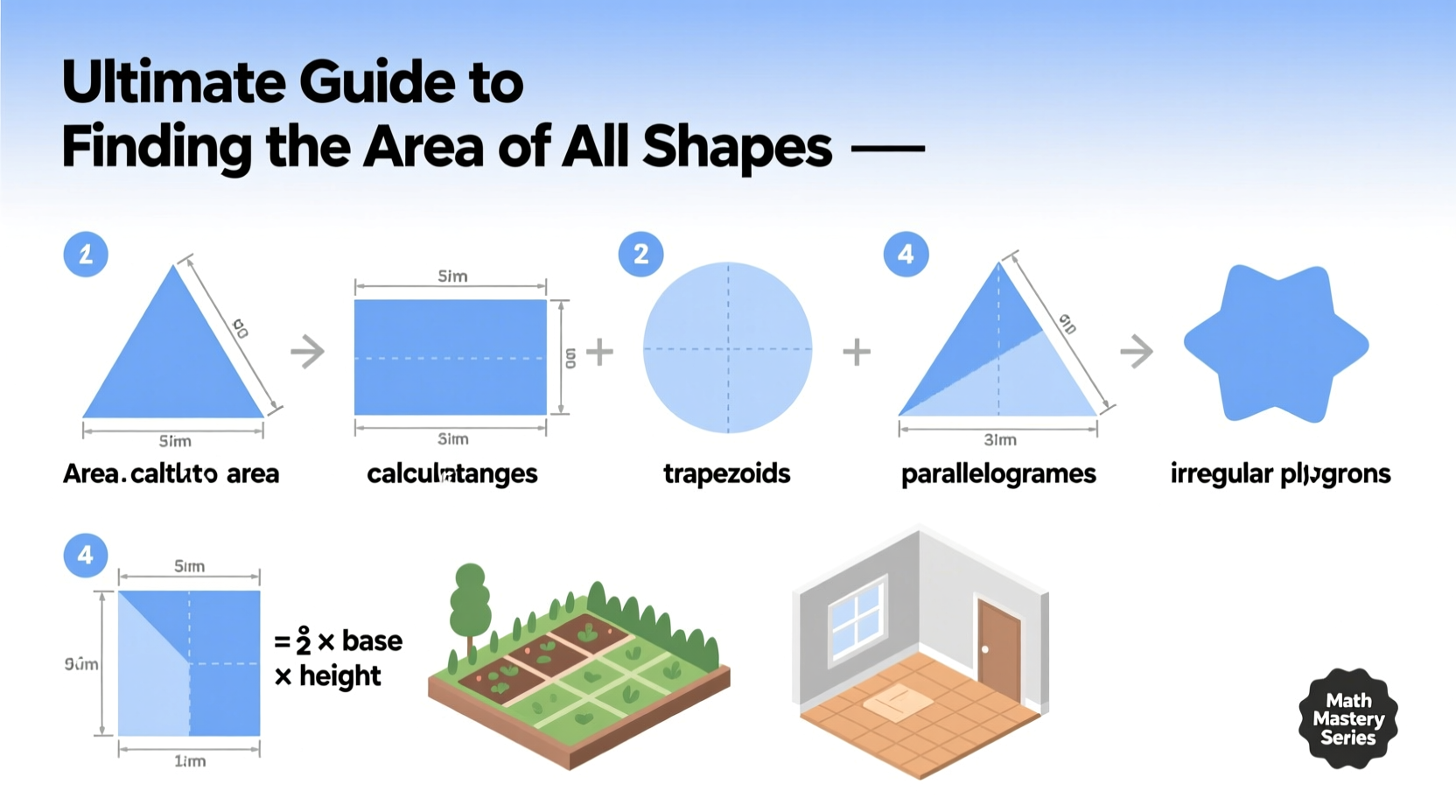
Area measures the amount of space inside a two-dimensional shape, expressed in square units such as square meters (m²), square feet (ft²), or square centimeters (cm²). The method used depends on the shape’s properties: number of sides, angles, symmetry, and available measurements.
The key to accurate area calculation lies in identifying the correct formula and ensuring all measurements are in the same unit before computing. Misidentifying a shape or mixing units can lead to significant errors, especially in construction or design work.
Area Formulas for Common 2D Shapes
Below is a breakdown of the most frequently encountered shapes and their respective area formulas. Memorizing these basics empowers you to tackle nearly any area-related challenge.
| Shape | Formula | Variables Explained |
|---|---|---|
| Rectangle | Area = length × width | L = length, W = width |
| Square | Area = side² | s = length of one side |
| Triangle | Area = ½ × base × height | b = base, h = perpendicular height |
| Parallelogram | Area = base × height | b = base, h = vertical height |
| Trapezoid | Area = ½ × (base₁ + base₂) × height | b₁, b₂ = parallel sides, h = distance between them |
| Circle | Area = π × radius² | r = radius, π ≈ 3.14159 |
| Ellipse | Area = π × semi-major axis × semi-minor axis | a and b = half-lengths of axes |
These formulas form the backbone of area computation. With practice, applying them becomes second nature.
Step-by-Step Guide to Solving Complex Area Problems
Not all real-world problems involve perfect rectangles or circles. Often, you’ll encounter composite shapes—combinations of multiple basic forms. Follow this logical sequence to break them down and solve efficiently.
- Identify the overall shape: Determine whether it’s a single standard shape or a combination.
- Break into simpler parts: Divide composite figures into rectangles, triangles, circles, etc.
- Label known dimensions: Mark lengths, heights, radii, and any other measurable attributes.
- Apply individual formulas: Calculate the area of each component using the correct equation.
- Sum the areas: Add all calculated areas together for the total.
- Verify units: Ensure all measurements were in the same unit system before finalizing.
“Geometry isn’t about memorization—it’s about pattern recognition. Once students see how complex shapes decompose into basics, their confidence soars.” — Dr. Alan Reyes, Mathematics Educator
Real Example: Calculating the Area of an L-Shaped Room
Imagine you’re installing hardwood flooring in an L-shaped living room. The main section measures 6 m by 5 m, and the smaller extension is 3 m by 2 m, overlapping at one corner.
To find the total floor area:
- Main rectangle: 6 × 5 = 30 m²
- Extension: 3 × 2 = 6 m²
- Total area: 30 + 6 = 36 m²
No need for advanced tools—just division and addition. This approach works for patios, walls, land plots, and more.
Advanced Shapes and Special Cases
Beyond the basics, certain polygons and curved shapes require specific strategies.
Regular Polygons (e.g., Pentagon, Hexagon)
For regular polygons (equal sides and angles), use:
Area = (1/2) × perimeter × apothem
where the apothem is the distance from the center to the midpoint of any side.
Alternatively, for a regular polygon with n sides of length s:
Area = (n × s²) / (4 × tan(π/n))
Sectors and Segments of Circles
A sector is a \"slice\" of a circle. Its area is proportional to its central angle:
Area = (θ/360°) × πr² (for degrees)
or
Area = (1/2) × r² × θ (for radians)
A segment is the area between a chord and the arc. Subtract the triangle area from the sector to get the segment.
Irregular Shapes
When no formula fits, use approximation techniques:
- Grid method: Overlay a grid and count full and partial squares.
- Planimeter tool: Mechanical or digital device for precise measurement.
- Break into triangles: Use triangulation, especially useful in surveying.
Common Mistakes and How to Avoid Them
Even experienced individuals make avoidable errors. Here’s what to watch out for:
| Mistake | Why It’s Wrong | How to Fix |
|---|---|---|
| Using diameter instead of radius in circle formulas | Leads to incorrect squaring and overestimation | Always halve the diameter first |
| Confusing slant height with vertical height in triangles | Slant height ≠ perpendicular height needed for area | Ensure height meets base at 90° |
| Mixing units (e.g., cm and m) | Causes calculation errors by orders of magnitude | Convert all values to same unit before computing |
| Applying rectangle formulas to parallelograms without adjusting height | Height must be perpendicular, not side length | Use vertical drop, not slanted side |
Checklist: Before Finalizing Any Area Calculation
- ☑ Identified the correct shape type
- ☑ Used the appropriate formula
- ☑ Measured perpendicular height where required
- ☑ Converted all units consistently
- ☑ Double-checked arithmetic or used calculator verification
- ☑ Rounded appropriately for context (e.g., construction vs. academic)
Frequently Asked Questions
Can I find the area of a triangle without knowing the height?
Yes. If you know two sides and the included angle (SAS), use: Area = ½ × a × b × sin(C). For three known sides (SSS), apply Heron’s formula: Area = √[s(s−a)(s−b)(s−c)], where s = (a+b+c)/2.
What if a shape doesn’t match any standard formula?
Break it into standard components. Most irregular shapes can be divided into triangles, rectangles, or sectors. Sum their individual areas for the total.
Does area change if a shape is rotated or tilted?
No. Rotation does not affect area. A square remains the same size regardless of orientation. Only actual dimensions matter.
Final Thoughts and Action Steps
Calculating area is more than a classroom exercise—it’s a practical skill with daily applications. From home improvement to technical design, mastering these methods builds confidence and precision. Start by memorizing the core formulas, then practice decomposing complex layouts into manageable pieces.
Next time you face a tricky shape, pause, analyze, and break it down. Trust the process, verify your units, and cross-check results when possible.




 浙公网安备
33010002000092号
浙公网安备
33010002000092号 浙B2-20120091-4
Comments
No comments yet. Why don't you start the discussion?