
The leek spin technique is not a dance move or a metaphor—it’s a refined, efficient method used by skilled cooks to slice leeks uniformly while minimizing waste and maximizing control. Unlike standard chopping, which can lead to uneven pieces and inconsistent cooking, the leek spin leverages rotational hand movement and blade coordination to produce clean, consistent cuts with minimal effort. This technique is especially valuable when preparing delicate dishes where texture and even heat distribution are critical, such as risottos, quiches, or sautéed vegetable medleys. While often taught in professional kitchens, it's accessible to home cooks willing to practice deliberate knife work. Mastering the leek spin enhances precision, improves ingredient yield, and reflects a deeper understanding of how form affects function in cooking.
Definition & Overview
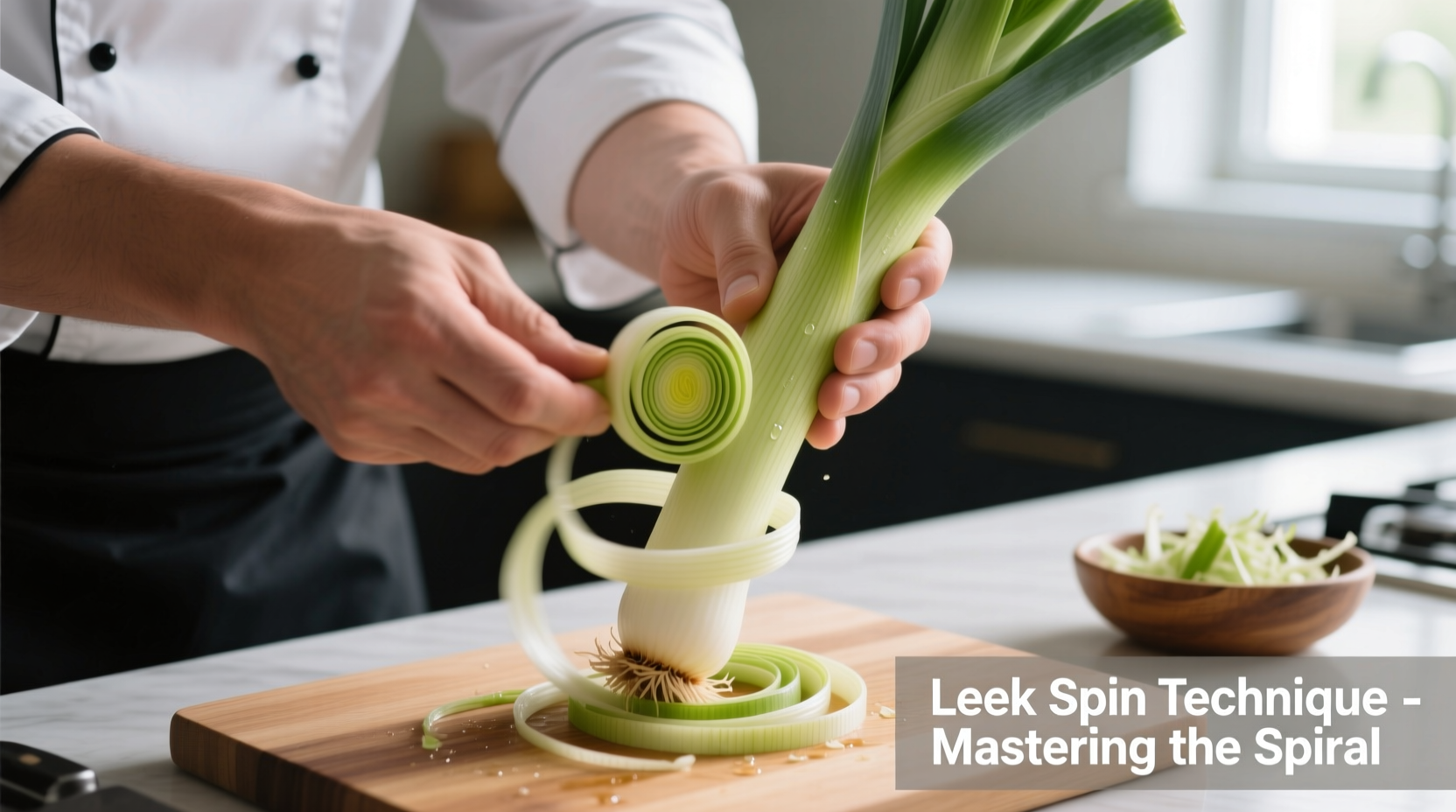
The leek spin technique refers to a controlled, circular hand motion used during the slicing of leeks—specifically when cutting crosswise into thin rounds. It involves stabilizing the leek with the non-dominant hand while the dominant hand guides the knife in a rhythmic, rotating pattern that follows the natural curvature of the leek’s layers. As each slice is made, the cook gently rotates the leek slightly, aligning the next cut with the previous angle, creating uniform rings that separate cleanly without crushing the cell structure.
Leeks themselves are part of the Allium family, closely related to onions, garlic, and scallions. They feature a long cylindrical stalk composed of tightly wrapped layers, with a broad dark green top and a tapered white base. The edible portion primarily comes from the pale white and light green sections, though the darker greens can be used for stocks. Mild in flavor compared to their allium cousins, leeks offer a sweet, grassy aroma and a tender texture when cooked. Because of their layered structure, improper cutting can result in either under-cut clumps or over-separated shreds, making techniques like the leek spin essential for optimal results.
Key Characteristics of Leeks
Before applying any cutting technique, it’s important to understand the physical and sensory properties of leeks. These characteristics influence how they respond to handling, heat, and storage.
| Characteristic | Description |
|---|---|
| Flavor Profile | Mildly sweet, onion-like but less pungent; develops richness when sautéed |
| Aroma | Fresh, green, subtly earthy; faint sulfur notes when raw |
| Color/Form | White base transitioning to light green, then dark green; tubular, layered structure |
| Texture (Raw) | Crisp and firm in the lower half; fibrous and tough in upper greens |
| Texture (Cooked) | Tender, silky, almost creamy when slowly cooked; holds shape if not overcooked |
| Culinary Function | Aromatic base ingredient; also used as a main vegetable in tarts, gratins, soups |
| Shelf Life | 5–7 days refrigerated in crisper drawer; best used within 4–5 days for peak quality |
Practical Usage: How to Apply the Leek Spin Technique
The leek spin is most effective when preparing leeks for dishes requiring even cooking and visual appeal. It excels in applications where texture consistency matters—such as custards, sauces, braises, and fine vegetable preparations. Below is a step-by-step guide to executing the technique correctly.
- Trim and Clean: Remove the root end and the tough dark green leaves (reserve for stock). Slice the leek in half lengthwise from top to bottom. Rinse thoroughly under cold water, fanning the layers to remove trapped dirt between the concentric rings. Pat dry.
- Position the Leek: Place one half flat-side down on the cutting board. Align the curved edge toward your dominant hand. Use a claw grip with your non-dominant hand to stabilize the leek just behind the cutting zone.
- Begin Slicing: With a sharp chef’s knife, make your first perpendicular cut about ¼ inch thick. Keep the tip of the knife in contact with the board at all times.
- Initiate the Spin: After each cut, rotate the leek slightly—about 10 to 15 degrees—following its natural curve. This rotation ensures that each subsequent slice meets the same angle relative to the fibers, promoting uniform thickness and preventing jagged edges.
- Maintain Rhythm: Let the knife do the work. Use a rocking motion while allowing the leek to “spin” incrementally under your guiding hand. Do not force rotation; let it happen naturally with each slice.
- Repeat Until Complete: Continue slicing and spinning until you reach the end of the leek section. Discard any remaining fibrous core if present.
Pro Tip: For maximum efficiency, work with both halves simultaneously after cleaning. Store sliced leeks in a bowl of ice water for up to 30 minutes before cooking to maintain crispness and prevent premature oxidation.
This technique differs significantly from simply chopping straight across without rotation. Without the spin, cuts tend to compress the inner layers, resulting in clumped rings that cook unevenly. The rotational movement distributes pressure more evenly, preserving the integrity of each layer and producing visually appealing, restaurant-quality results.
Variants & Types of Leek Preparation
While the leek spin produces ideal results for many applications, different cooking methods call for different cuts. Understanding these variants allows chefs to choose the right technique based on desired outcome.
- Standard Crosswise Chop: A basic perpendicular cut without rotation. Suitable for soups or stews where appearance is secondary.
- Julienne (Matchstick Cut): After halving lengthwise, slice very thinly along the grain. Ideal for salads or garnishes where bite-sized strips are preferred.
- Lengthwise Planks: Cut into vertical strips for grilling or roasting whole. Preserves structural integrity and creates dramatic presentation.
- Dice (Small or Medium): After crosswise slicing, gather rings and cut them into cubes. Used in mirepoix-style bases or stuffings.
- Butterfly Cut: Open the leek like a book after halving, then score the inner surface in a crisscross pattern. Enhances absorption of marinades or dressings.
The leek spin technique is best applied when aiming for thin, even rounds intended for gentle cooking. It is less useful for dicing or julienning, where directional alignment takes precedence over rotational symmetry.
| Cutting Method | Best Used For | Requires Leek Spin? |
|---|---|---|
| Leek Spin (Rotational Slice) | Risotto, quiche, sautés, veloutés | Yes |
| Standard Crosswise Chop | Stocks, soups, rustic dishes | No |
| Julienne | Salads, stir-fries, garnishes | No |
| Dice | Mirepoix, fillings, casseroles | No (but spin may precede dicing) |
| Lengthwise Planks | Grilling, roasting, baking | No |
Comparison with Similar Ingredients and Techniques
Leeks are frequently confused with other members of the Allium family, particularly scallions and shallots. Additionally, the term “spin” might evoke comparisons to techniques used with other vegetables. Clarifying these distinctions helps avoid misuse and improves culinary accuracy.
Leeks vs. Scallions
- Size: Leeks are much larger and thicker than scallions.
- Flavor Intensity: Scallions have a sharper bite; leeks are milder and sweeter.
- Cutting Technique: Scallions rarely require the leek spin due to their smaller diameter and softer texture.
- Yield: One large leek yields roughly the same volume as 6–8 scallions when prepped.
Leeks vs. Shallots
- Structure: Shallots grow in clusters like garlic; leeks are single-stalked.
- Preparation: Shallots are peeled and minced, not spun. Their layered bulb structure doesn’t support rotational slicing.
- Use Case: Shallots excel in vinaigrettes and reductions; leeks shine in slow-cooked dishes.
Leek Spin vs. Onion Turning
“Turning” is a classical French technique used to shape root vegetables like onions or potatoes into even, barrel-shaped units for even cooking. While both involve precision, they differ fundamentally:
- Purpose: Turning shapes whole pieces; the leek spin focuses on slicing.
- Movement: Turning uses multiple angled cuts; the leek spin relies on continuous rotation during slicing.
- Skill Level: Turning requires advanced knife skills; the leek spin is intermediate and easier to learn.
“The leek spin isn’t about showmanship—it’s about consistency. When every ring cooks at the same rate, you elevate the entire dish.” — Chef Elena Marquez, Culinary Instructor, San Francisco Cooking Institute
Practical Tips & FAQs
How do I clean leeks properly before using the spin technique?
Always halve the leek lengthwise first. Submerge in a bowl of cold water, separating the layers to release trapped soil. Swirl gently, then lift out—the dirt will settle at the bottom. Pat dry before slicing to ensure clean cuts and prevent slipping.
Can I use the dark green parts of the leek?
Yes, but not in fresh applications. The dark greens are too fibrous to eat directly but are excellent for making vegetable stock, soup bases, or aromatic sachets. Freeze them until you have enough for a batch.
What knife is best for the leek spin?
A sharp 8-inch chef’s knife with a slightly curved blade works best. The curve supports the rocking motion, while the length provides stability during rotational slicing. Avoid serrated or paring knives.
Why do my leek slices stick together after cutting?
This usually happens when the leek isn’t rotated or when pressure is uneven. Ensure you’re using the spin motion and rinsing thoroughly post-cut to separate rings. A quick soak in icy water helps loosen them.
Can I prep leeks ahead of time?
Sliced leeks can be stored in an airtight container with a damp paper towel for up to 24 hours. Beyond that, they begin to oxidize and lose texture. For longer storage, blanch briefly and freeze—though this alters texture and is unsuitable for delicate dishes.
Is the leek spin necessary for all recipes?
No. For heartier dishes like chowders or roasted vegetable mixes, standard chopping suffices. Reserve the leek spin for refined preparations where appearance and uniformity matter.
Are there tools that mimic the leek spin?
Some mandolines and spiralizers claim to replicate uniform cuts, but they often crush delicate leek tissue or fail to follow the natural curve. Hand-cutting with the spin technique remains superior for quality control.
Storage Checklist:
- Unwashed whole leeks: Wrap in paper towels, store in crisper drawer (up to 7 days)
- Sliced raw leeks: Refrigerate in sealed container with moisture barrier (use within 24 hours)
- Blanched leeks: Cool quickly, drain well, freeze in portions (up to 3 months)
- Never store wet leeks—they degrade rapidly due to excess moisture
Summary & Key Takeaways
The leek spin technique represents a small but significant refinement in vegetable preparation—one that separates competent home cooking from truly polished results. By combining rotational hand movement with precise knife control, cooks achieve uniform leek slices that cook evenly, look elegant, and enhance the overall quality of a dish. Though rooted in professional kitchen practices, the method is approachable and highly beneficial for anyone committed to improving their culinary craft.
Key points to remember:
- The leek spin involves rotating the leek slightly after each cut to maintain alignment with fiber direction.
- It produces cleaner, more consistent slices than straight chopping, reducing clumping and improving texture.
- Best suited for dishes like risotto, quiche, sautés, and creamy soups where even doneness is crucial.
- Proper cleaning is essential—always halve and rinse leeks thoroughly before cutting.
- Not all recipes require the leek spin; reserve it for refined applications where precision matters.
- Store prepped leeks carefully—moisture and time are the primary enemies of freshness.
Challenge Yourself: Try preparing two batches of leeks—one using the standard chop, the other with the leek spin. Cook them side by side in a simple butter sauté. Note the differences in color, texture, and mouthfeel. This exercise reveals why technique transforms ingredients.




 浙公网安备
33010002000092号
浙公网安备
33010002000092号 浙B2-20120091-4
Comments
No comments yet. Why don't you start the discussion?