
Most people chasing bigger arms spend hours on barbell curls and dumbbell variations—yet see minimal growth in width or overall arm size. The truth is, building noticeably wider, fuller biceps requires more than just lifting weights. It demands strategic exercise selection, proper mechanics, time-under-tension control, and a holistic approach to muscle development. While the biceps brachii are the primary focus, true arm width comes from developing both the biceps and the brachialis—a deeper muscle that pushes the biceps outward when developed.
This guide dives into the overlooked principles and advanced tactics that separate average arm development from truly impressive, wide arms. Forget generic routines; these are evidence-based strategies used by elite trainers and physique athletes to unlock real growth.
Why Traditional Curls Aren’t Enough for Arm Width
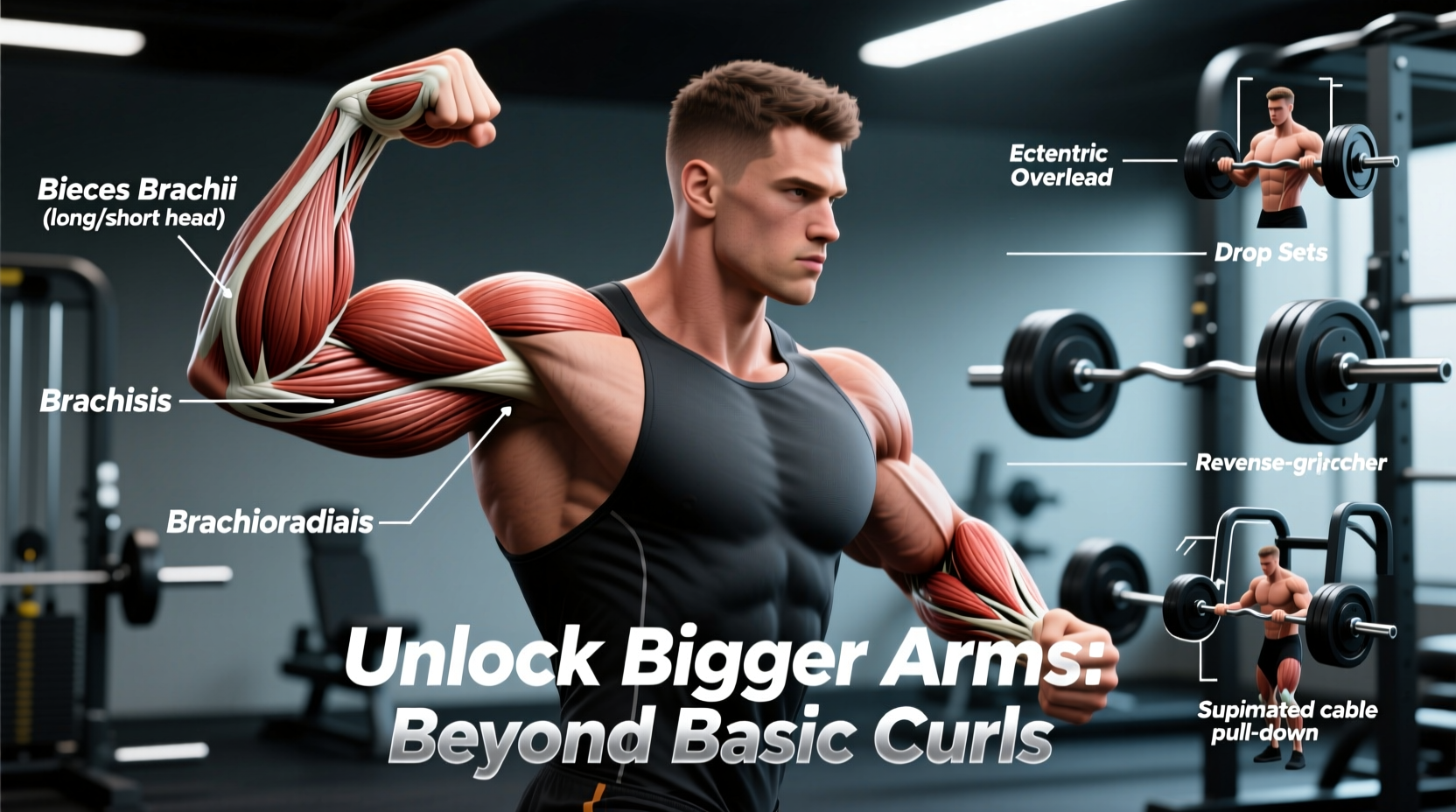
The standard preacher curl or standing barbell curl primarily targets the long head of the biceps but often neglects the brachialis and lateral head activation needed for visual width. Additionally, many lifters rely on momentum, short range of motion, and poor scapular positioning, which reduce muscle tension and limit hypertrophy.
To achieve wider arms, you must train not only for strength but for muscle architecture—specifically targeting fiber recruitment patterns that expand the outer sweep of the upper arm. This means integrating exercises that emphasize peak contraction, stretch under load, and synergistic elbow flexor engagement.
“Arm width isn’t built through volume alone—it’s built through precise mechanical tension and muscle isolation.” — Dr. Mike Israetel, Sports Scientist and Co-Founder of Renaissance Periodization
Target the Brachialis: The Secret to Wider Arms
The brachialis lies beneath the biceps brachii and, when developed, pushes the biceps upward and outward, creating the appearance of greater arm girth and width. Unlike the biceps, the brachialis isn’t involved in forearm supination, so it responds best to neutral or pronated grips.
Incorporate these brachialis-focused movements:
- Hammer curls – Use moderate weight with strict form, focusing on squeezing at the top.
- Zottman curls – Combine supinated up and pronated down phases for dual muscle stimulation.
- Reverse curls – Engage the brachialis and brachioradialis using an overhand grip.
- Neutral-grip cable curls – Maintain constant tension throughout the range.
Advanced Training Techniques for Bicep Hypertrophy
Growth stalls when muscles adapt. To keep progressing, integrate advanced techniques that increase mechanical stress and metabolic fatigue:
- Eccentric Overload: Slow the lowering phase (4–6 seconds) to create microtears and stimulate satellite cell activity.
- Supersets: Pair a compound pulling movement (like chin-ups) with an isolation curl to pre-fatigue and then isolate.
- Drop Sets: Perform a set to failure, immediately reduce weight by 20–30%, and continue for additional reps.
- Peak Contraction Holds: Squeeze the biceps at the top of each rep for 1–2 seconds to enhance motor unit recruitment.
- Stretch-Emphasis Exercises: Include incline dumbbell curls where the arm extends behind the torso, placing the long head under maximal stretch.
Sample Arm Hypertrophy Superset
| Exercise | Sets | Reps | Rest |
|---|---|---|---|
| Chin-Ups (bodyweight or assisted) | 3 | 8–10 | 60 sec |
| Standing Hammer Curl | 3 | 10–12 | 90 sec after pair |
Optimize Frequency, Volume, and Recovery
Biceps recover faster than larger muscle groups due to their size, allowing for higher training frequency. Research suggests that training arms 2–3 times per week yields better hypertrophy than once weekly, provided volume is managed.
Aim for 12–18 total working sets per week for the elbow flexors, distributed across sessions. For example:
- Day 1: 6 sets of curls + 4 sets of pull-ups
- Day 3: 5 sets of hammer curls + 3 sets of cable concentration curls
Overtraining occurs not from frequency, but from excessive volume without adequate recovery. Ensure sleep (7–9 hours), protein intake (1.6–2.2g/kg body weight), and deload weeks every 6–8 weeks.
Do’s and Don’ts for Bicep Growth
| Do | Don't |
|---|---|
| Train biceps after back workouts for synergy | Use momentum or swing during curls |
| Focus on full range of motion | Train to failure every set |
| Include stretch-position exercises | Ignore elbow joint health and warm-up |
| Rotate grip styles weekly | Train arms daily without variation |
Real Example: How Mark Added 1.5 Inches to His Arms in 12 Weeks
Mark, a 29-year-old intermediate lifter, plateaued at 14-inch arms despite consistent curling for years. He followed a typical routine: 3x10 barbell curls, 3x10 dumbbell curls, twice weekly. Progress stalled after six months.
He adjusted his approach:
- Added incline dumbbell curls (3x12) to emphasize stretch overload.
- Switched to alternating hammer curls with a 3-second eccentric.
- Integrated chin-up supersets before arm days.
- Increased protein intake to 180g/day and prioritized sleep.
- Trained arms three times weekly with rotating emphasis (strength, hypertrophy, pump).
After 12 weeks, Mark measured 15.5 inches at peak contraction. Photos showed visible improvement in bicep peak and outer sweep—changes he hadn’t seen in years of traditional training.
Step-by-Step Plan to Build Wider Arms (8-Week Roadmap)
- Week 1–2: Technique Reset
Relearn proper curl form. Eliminate swinging. Focus on mind-muscle connection using lighter weights. - Week 3–4: Add Stretch & Eccentrics
Introduce incline dumbbell curls and 4-second negatives on all curl variations. - Week 5–6: Increase Frequency
Split arm volume across three sessions: heavy, moderate, and pump-focused. - Week 7–8: Integrate Advanced Methods
Add drop sets on final sets and supersets with vertical pulls (e.g., pull-ups + concentration curls).
Frequently Asked Questions
Can I build wider arms without heavy weights?
Yes. Moderate loads (60–75% of 1RM) with high time-under-tension and controlled eccentrics can stimulate significant hypertrophy, especially in fast-twitch dominant muscles like the biceps.
Why aren’t my biceps growing despite regular training?
Likely causes include insufficient volume, lack of progressive overload, poor nutrition, or inadequate recovery. Also, ensure you’re engaging the brachialis and not relying solely on supinated curls.
Are cables better than free weights for bicep width?
Cables provide constant tension, ideal for peak contraction and metabolic stress. Free weights offer greater strength stimulus. Use both: free weights for foundational growth, cables for finishing and refinement.
Conclusion: Go Beyond the Curl
Bigger, wider arms aren’t built by repeating the same curls year after year. They require intelligent programming, attention to biomechanics, and a commitment to progressive overload across multiple angles and grips. By targeting the brachialis, emphasizing stretch and eccentric control, and integrating smart volume distribution, you can transform underdeveloped arms into a standout feature.
Start applying these strategies today—not just in your workouts, but in your recovery and tracking. The next phase of your arm development begins now.




 浙公网安备
33010002000092号
浙公网安备
33010002000092号 浙B2-20120091-4
Comments
No comments yet. Why don't you start the discussion?