
A tachymeter is more than just an elegant ring of numbers around the bezel of a chronograph watch—it’s a functional tool rooted in mathematical precision. Originally developed for engineers and racing professionals, the tachymeter allows wearers to calculate speed based on travel time over a fixed distance. Despite its vintage origins, it remains a valuable feature for drivers, pilots, and horology enthusiasts who appreciate analog ingenuity in a digital world. This guide demystifies the tachymeter, explaining how to use it accurately, avoid common mistakes, and apply it in practical situations.
Understanding the Tachymeter Scale
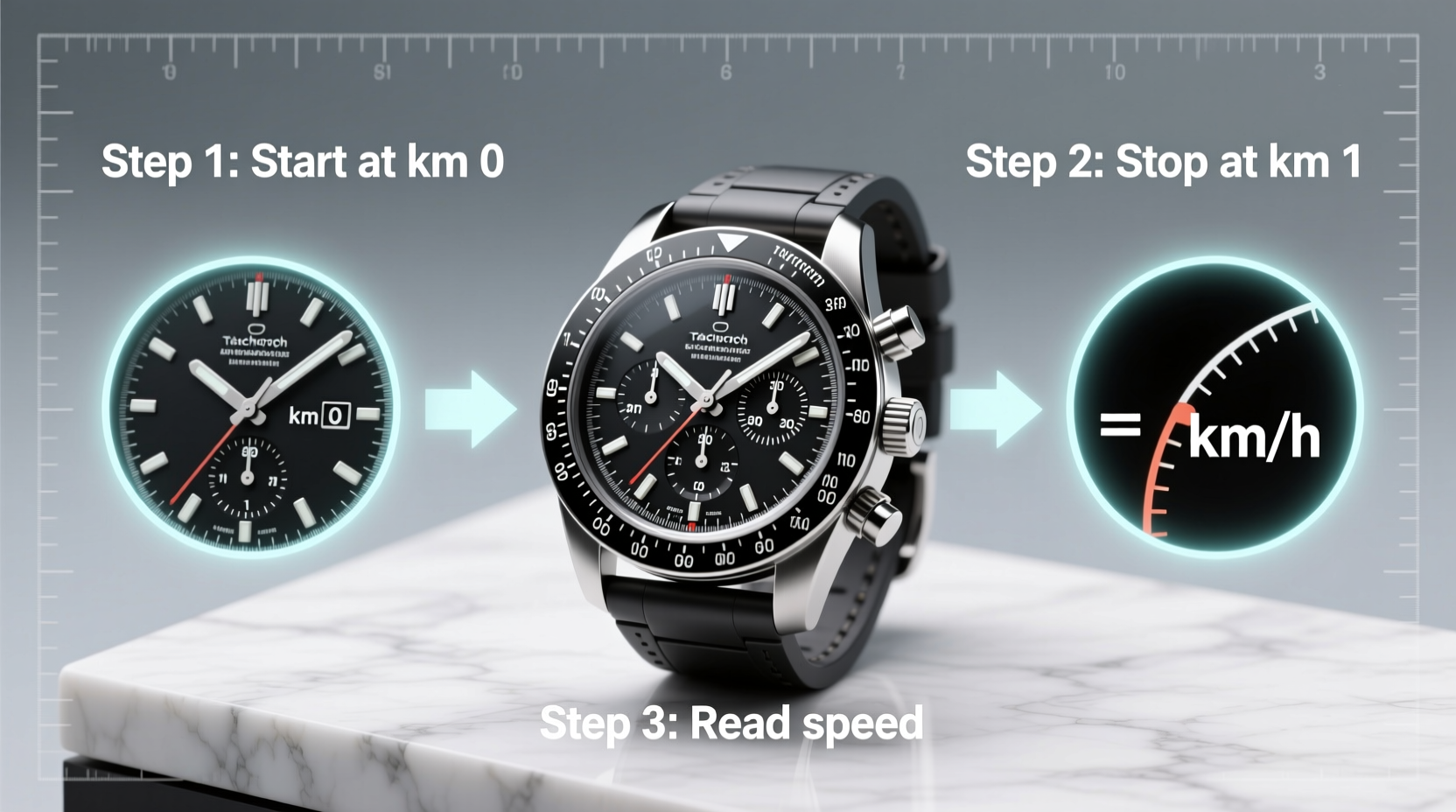
The tachymeter scale is typically inscribed on the bezel or dial of a chronograph watch, adjacent to the seconds track. It converts elapsed time (in seconds) into units per hour—most commonly kilometers per hour or miles per hour—over a known distance. The underlying formula is:
Speed = 3600 / Elapsed Time (in seconds)
This equation derives from the number of seconds in an hour (3,600), meaning if you travel one unit (e.g., one kilometer) in 36 seconds, your speed is 100 km/h (3600 ÷ 36). The tachymeter scale pre-calculates this for times between approximately 7.2 and 60 seconds, translating them directly into speed values.
Step-by-Step Guide to Measuring Speed
- Choose a fixed distance: Identify two points exactly one kilometer or one mile apart. Use highway markers, GPS verification, or mapped routes to ensure accuracy.
- Start the chronograph: As your vehicle passes the first marker, press the start button on your chronograph.
- Stop at the second marker: When you reach the second point, stop the chronograph. Note the position of the chronograph seconds hand on the tachymeter scale.
- Read the speed: The seconds hand will point to a value on the tachymeter scale—this is your average speed in km/h or mph over that distance.
- Verify conditions: Ensure consistent distance units (km vs. miles) and confirm your watch uses a standard tachymeter calibration (based on 3,600 seconds).
For example, if it takes 45 seconds to travel one kilometer, the seconds hand will point to “80” on the tachymeter, indicating an average speed of 80 km/h.
Practical Applications and Real-World Example
Consider a motorsports enthusiast attending a track day. They want to compare their lap consistency without relying on electronic dashboards. Using a tachymeter-equipped chronograph, they mark a straight 1-kilometer section of the circuit. On each lap, they start the chronograph at the beginning of the straight and stop it at the end. The tachymeter reading gives immediate feedback: 120 km/h on the first lap, 135 on the second, and 110 on the third after braking adjustments. This analog method provides instant performance insight, independent of car electronics.
“Analog tools like the tachymeter teach precision through engagement. You’re not just reading data—you’re participating in its creation.” — Daniel Reeves, Horological Educator and Watch Historian
Common Mistakes and How to Avoid Them
- Misjudging distance: Using non-standard intervals (e.g., 800 meters) invalidates the tachymeter reading. Always use exactly one kilometer or one mile.
- Reaction delay: Human reflexes introduce error. Practice starting and stopping the chronograph smoothly to minimize lag.
- Ignoring scale limits: If the event takes longer than 60 seconds, the tachymeter cannot compute speed. For slower speeds, use alternative methods or reduce distance proportionally (see table below).
- Confusing units: Some watches assume kilometers; others are calibrated for miles. Know your watch’s default setting.
| Elapsed Time (seconds) | Tachymeter Reading (km/h) | Applicable Distance | Valid? |
|---|---|---|---|
| 36 | 100 | 1 km | Yes |
| 45 | 80 | 1 km | Yes |
| 72 | Not marked (below scale) | 1 km | No – too slow |
| 30 | 120 | 1 mile | Yes (if calibrated for miles) |
| 40 | 90 | 0.8 km | No – distance must be 1 unit |
Advanced Uses: Beyond Speed Calculation
While primarily designed for speed, the tachymeter can measure any rate-per-hour phenomenon. For instance:
- Production rate: Time how long it takes a machine to produce one item. The tachymeter indicates units produced per hour.
- Fuel consumption: If your car uses 1 liter every 45 seconds at constant speed, the tachymeter shows ~80 liters per hour (though actual consumption would require correction).
- Event frequency: Measure how often a recurring event occurs—such as vehicles passing a point—and derive hourly volume.
This versatility makes the tachymeter useful beyond automotive contexts, especially in industrial or logistical settings where quick estimations are valuable.
Checklist: Mastering Your Tachymeter
- ✅ Confirm your watch has a functioning chronograph and tachymeter scale.
- ✅ Identify a precise 1 km or 1 mile stretch for testing.
- ✅ Calibrate your start/stop timing to reduce human error.
- ✅ Understand whether your tachymeter uses km or miles.
- ✅ Practice in controlled environments before relying on it in dynamic situations.
- ✅ Avoid using for durations exceeding 60 seconds.
- ✅ Cross-check readings with GPS or digital speedometers initially.
FAQ
Can I use a tachymeter on any watch?
No. Only chronograph watches with a tachymeter scale (usually on the bezel or dial) can perform this function. Basic time-only watches lack both the stopwatch mechanism and the calibrated scale.
What if my distance isn’t exactly one kilometer?
The tachymeter assumes a fixed unit. If your distance is shorter, adjust the result mathematically. For example, over 0.5 km in 24 seconds, the tachymeter reads 150, but actual speed is 75 km/h (half the distance in same relative time).
Is the tachymeter still relevant in the age of GPS?
Absolutely. While GPS offers greater precision, the tachymeter provides an immediate, battery-free, mechanical method of calculating speed. It’s valued in vintage car rallies, pilot watches, and among collectors who appreciate self-reliance and analog craftsmanship.
Conclusion: Embrace Analog Precision
The tachymeter is a brilliant fusion of horology and practical mathematics—a tool that turns time into motion. By mastering its use, you gain more than a speed-reading trick; you connect with a legacy of engineering elegance. Whether you're timing laps, measuring productivity, or simply exploring your watch’s capabilities, the tachymeter rewards attention and practice. In a world saturated with digital automation, knowing how to extract meaningful data from a simple sweep of a seconds hand is both empowering and deeply satisfying.




 浙公网安备
33010002000092号
浙公网安备
33010002000092号 浙B2-20120091-4
Comments
No comments yet. Why don't you start the discussion?