
For players transitioning between tactical first-person shooters, few adjustments are as immediate—or as jarring—as learning how a game handles movement. Two of the most prominent titles in this genre—Counter-Strike: Global Offensive (CS:GO) and Valorant—share DNA in design philosophy, but diverge significantly in how they handle player motion. While both games emphasize precision, positioning, and economy, their movement mechanics operate under different rulesets that shape how players approach combat, map control, and even team coordination.
Understanding these differences is crucial, especially for beginners or veterans switching from one title to the other. What feels intuitive in CS:GO may be ineffective—or even punishable—in Valorant, and vice versa. This guide breaks down the core distinctions in movement mechanics between the two games, explains why those differences matter, and provides practical advice for mastering each system.
Movement Philosophy: Realism vs. Responsiveness
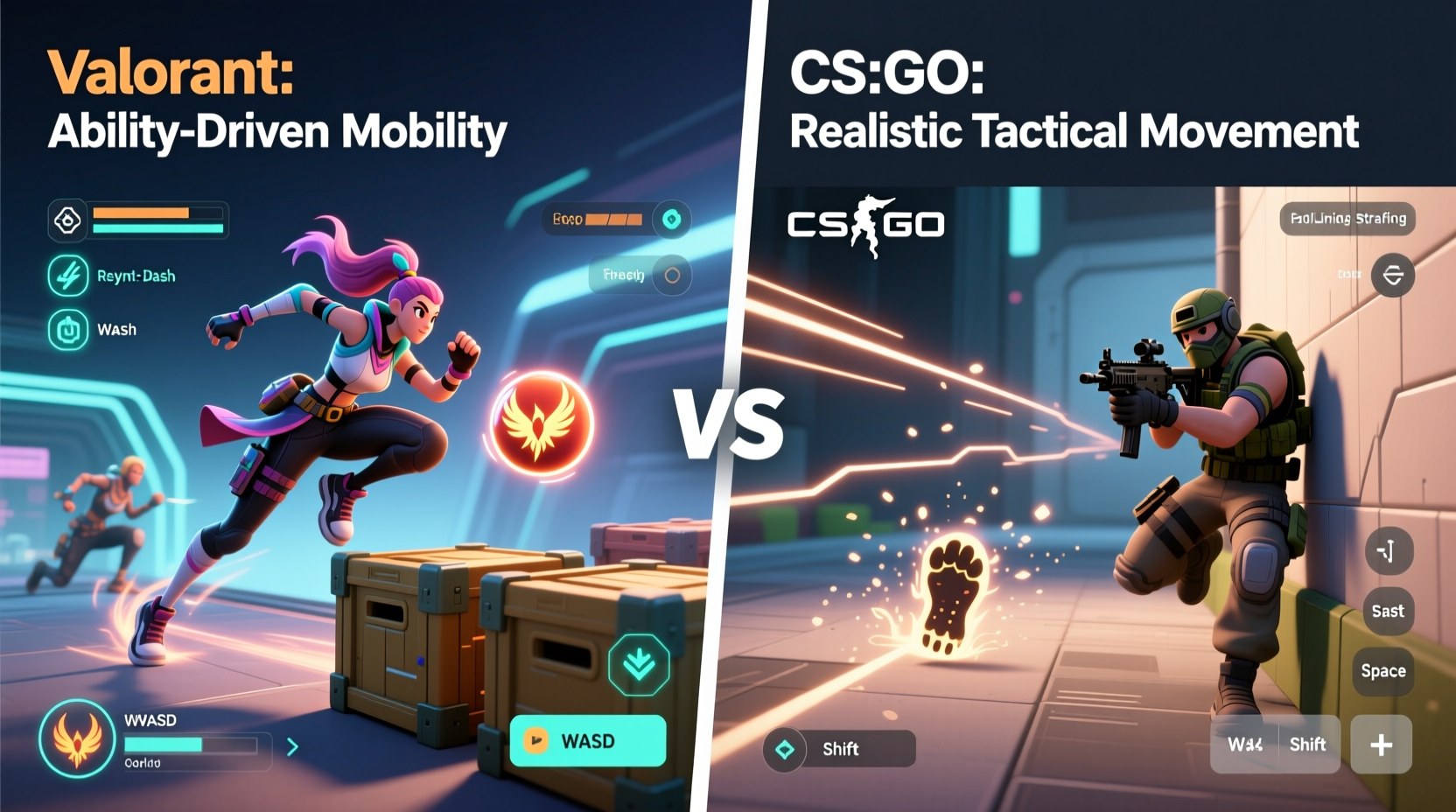
At a high level, CS:GO and Valorant represent two schools of thought in FPS design. CS:GO prioritizes realism and consequence-driven mechanics. Every action has weight: shooting while moving reduces accuracy, sprinting creates noise, and stopping to shoot requires anticipation. Movement is grounded, with momentum playing a significant role in advanced techniques like strafing and counter-strafing.
Valorant, by contrast, leans into responsiveness and accessibility. The game streamlines many aspects of movement to lower the entry barrier for new players while still preserving tactical depth. Shooting on the move is more forgiving, sprint cancels are built-in, and character abilities often interact directly with movement. The result is a faster-paced experience where split-second repositioning and ability-assisted mobility play a larger role than in CS:GO.
“Valorant’s movement is designed to empower agents, not punish players for wanting to stay dynamic.” — Riot Games Design Team, Developer Interview (2020)
Core Differences in Movement Mechanics
The following table outlines the most impactful differences between CS:GO and Valorant in terms of movement behavior:
| Mechanic | CS:GO | Valorant |
|---|---|---|
| Shooting Accuracy While Moving | High penalty; full accuracy only when fully stopped or using burst fire after stopping | Moderate penalty; partial accuracy retained while walking, severe loss while sprinting |
| Sprint Behavior | Sprint continues until manually canceled or obstacle hit; noisy | Sprint automatically cancels upon releasing input; quieter than CS:GO |
| Stopping Time | Requires counter-strafing (opposite directional input) to stop quickly | Natural friction stops players faster; no need for active counter-strafing |
| Air Control | Full horizontal control mid-air; critical for flick shots and micro-adjustments | Reduced air control; harder to adjust aim mid-jump |
| Jumping While Shooting | Always inaccurate; used primarily for utility throws | Inaccurate, but slightly more predictable spread pattern |
| Ability-Assisted Movement | None; all movement is player-controlled | Yes; agents like Jett, Raze, and Sage offer dashes, lifts, and teleports |
Why These Differences Matter
These mechanical disparities aren’t just cosmetic—they influence every aspect of gameplay. In CS:GO, mastery of movement means understanding your weapon’s delay, managing momentum, and using sound discipline. A player who sprints into site risks giving away their position and will likely miss their first shots due to slow deceleration and bloom.
In Valorant, the same player might survive the mistake. Sprint cancels reduce noise exposure, and the faster natural stop allows quicker engagement. However, over-reliance on sprinting can still lead to poor shot execution, especially with rifles. The presence of agent abilities further changes how space is navigated—Jett’s updraft isn’t just for show; it’s a vertical repositioning tool that bypasses traditional line-of-sight limitations.
Adapting from CS:GO to Valorant: A Step-by-Step Guide
If you're coming from CS:GO, adjusting to Valorant’s movement can feel like driving an automatic after years of manual transmission. Here’s a structured way to recalibrate your instincts:
- Unlearn constant counter-strafing: In CS:GO, tapping A or D while moving forward helps stop faster. In Valorant, this is unnecessary. Let go of movement keys and let friction do the work.
- Practice walking pre-fire without sprinting: Use walk speed (Shift) to approach sites quietly. Unlike CS:GO, walking in Valorant doesn’t require timing a release before shooting—the transition is smoother.
- Master the sprint-release timing: Sprint to cover, then release the key before peeking. This ensures you’re not shooting while sprinting, which causes massive bullet spread.
- Use jump shots sparingly: While possible, jumping and shooting is far less reliable than in CS:GO. Save it for desperate moments or specific agent combos (e.g., Raze’s blast pack).
- Integrate agent movement tools: If playing Jett, practice dash-canceling to break angles unexpectedly. For Sage, use wall placements to create elevated positions that change engagement dynamics.
Common Mistakes New Players Make
- Sprinting into fights and immediately shooting: This leads to missed shots due to sprint bloom. Always release sprint before engaging.
- Overusing abilities for movement: Dashing or floating unnecessarily makes you predictable and wastes cooldowns.
- Ignoring sound cues: Although sprint is quieter, footsteps still give away position. Walk when stealth matters.
- Trying to “flick” mid-air: Air control is limited. Land before taking important shots whenever possible.
Case Study: Transitioning a CS:GO Player to Valorant
Consider Alex, a 1,500-hour CS:GO player with solid aim and map knowledge. When he first tried Valorant, he struggled despite his experience. He would sprint into B site on Haven, tap his rifle immediately, and miss every shot. Frustrated, he assumed the guns were “broken.”
After reviewing a replay, his coach pointed out the issue: Alex was treating Valorant like CS:GO. In CS:GO, experienced players time their counter-strafe to stop and shoot in one fluid motion. But in Valorant, sprinting directly into a fight leaves residual movement bloom—even if you’re technically stopped. The fix? Release sprint earlier, walk the last few steps, and engage from a stable position.
Within three days of focused practice, Alex’s kill-death ratio improved by 40%. His biggest breakthrough wasn’t better aim—it was understanding that movement in Valorant rewards patience and timing over raw mechanical twitch responses.
“In CS:GO, movement is about minimizing mistakes. In Valorant, it’s about maximizing opportunities.” — Pro coach Marcus “Veyder” Tran, former CS:GO analyst
Checklist: Mastering Movement in Both Games
Whether you're improving in one title or balancing both, use this checklist to refine your movement fundamentals:
- ✅ Practice stopping drills in both games (e.g., sprint → stop → shoot within 0.5 seconds)
- ✅ Use walk speed (Shift) when approaching contested areas
- ✅ Avoid shooting while sprinting—release sprint first
- ✅ Learn at least one movement ability per agent (e.g., Jett’s dash, Sage’s wall)
- ✅ Watch your footsteps: minimize noise during executes or retakes
- ✅ Drill jump shots only when necessary; prioritize landing before engaging
- ✅ Record and review your gameplay to spot movement inefficiencies
Frequently Asked Questions
Can I use CS:GO movement techniques in Valorant?
Some principles transfer—like the importance of crosshair placement and avoiding unnecessary movement—but direct techniques like counter-strafing are less relevant. Valorant’s physics model handles stopping differently, so focus on timing your sprint release rather than active braking.
Why is my spray so inaccurate in Valorant when sprinting?
Valorant applies a hidden “sprint bloom” multiplier that drastically increases bullet spread if you fire immediately after sprinting. Even if you’ve stopped moving, the game checks whether you were sprinting in the last 0.3–0.5 seconds. To fix this, release sprint early and wait a split second before shooting.
Do I need to bunny hop in either game?
No. Neither CS:GO nor Valorant uses traditional bunny hopping for speed boosts. Jumping continuously slows you down and hurts accuracy. Use jumps only to throw grenades over obstacles or evade enemy aim temporarily.
Conclusion: Movement as a Mindset
At its core, the difference between Valorant and CS:GO movement isn’t just about buttons or physics—it’s about intent. CS:GO teaches restraint: every step matters, every sound reveals, and hesitation can be fatal. Valorant encourages calculated aggression: use abilities to reposition, close gaps dynamically, and control space through verticality and surprise.
Beginners don’t need to master both systems overnight. Start by recognizing that movement is context-dependent. In CS:GO, your legs are part of your weapon discipline. In Valorant, they’re part of your tactical toolkit. Respect the rules of each game, practice deliberately, and you’ll find that adapting isn’t about unlearning—it’s about expanding your understanding of what’s possible.




 浙公网安备
33010002000092号
浙公网安备
33010002000092号 浙B2-20120091-4
Comments
No comments yet. Why don't you start the discussion?