
When conducting interviews—whether for journalism, podcasting, research, or documentary work—audio clarity is non-negotiable. Poor sound quality can render even the most insightful conversation unusable. Today, nearly everyone carries a smartphone equipped with a voice recording app, making it tempting to rely on convenience over quality. But when precision matters, the real question emerges: should you trust your phone’s built-in microphone and default recording app, or invest in an external microphone?
The answer isn’t always straightforward. While modern smartphones have made significant strides in audio capture, they still face inherent limitations. External microphones, on the other hand, offer superior fidelity but come with added cost and complexity. This article breaks down the technical, practical, and situational differences between using a voice recorder app versus an external mic for interviews, helping you make an informed decision based on your needs.
Understanding the Core Differences
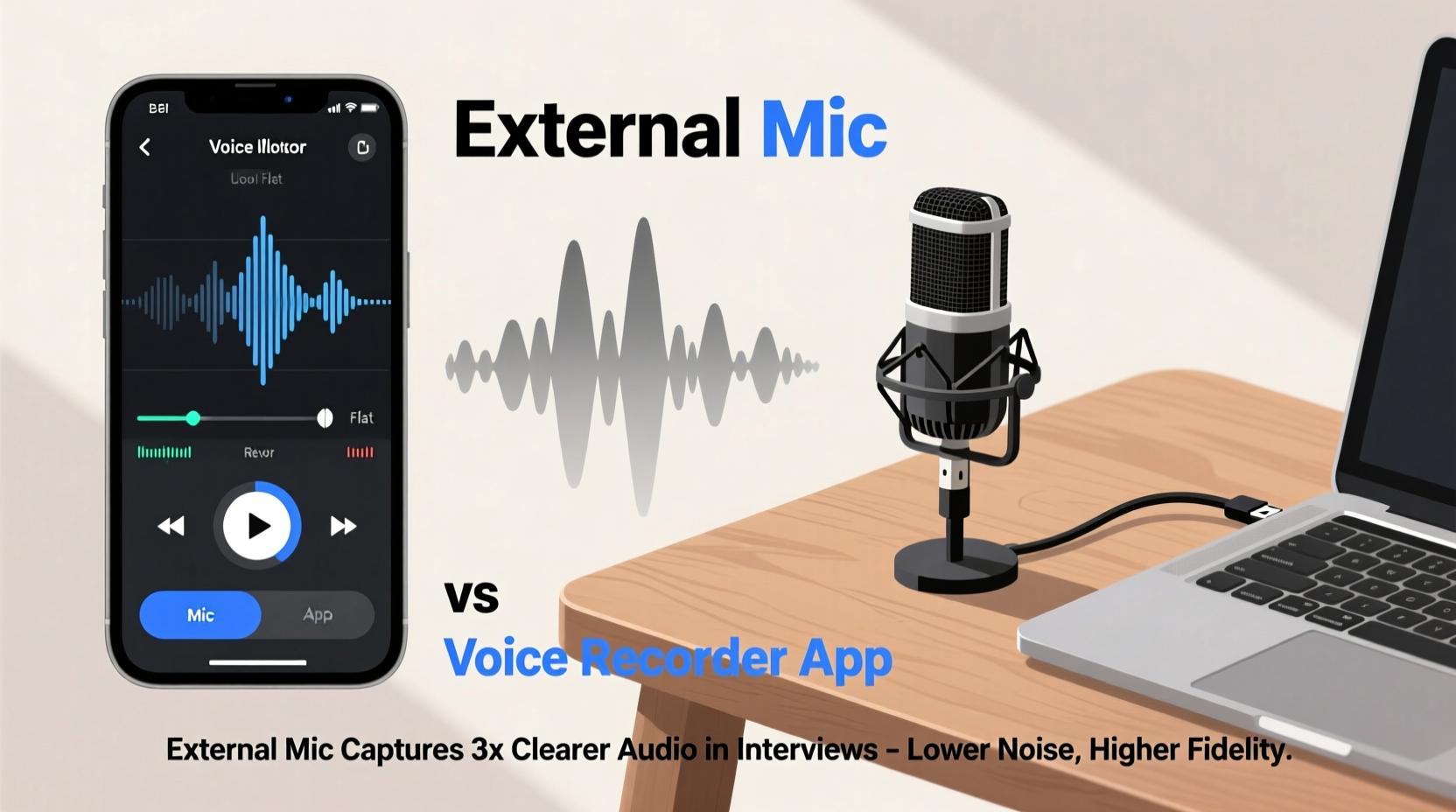
At the heart of this debate lies a fundamental distinction: internal processing versus external hardware enhancement. Voice recorder apps use the device’s built-in microphone and digital signal processing (DSP) to capture sound. These apps are convenient and often include basic editing features, cloud syncing, and transcription support. However, their performance is limited by the physical constraints of the phone’s microphone placement, size, and noise filtering algorithms.
External microphones bypass these limitations by introducing higher-quality components—better diaphragms, directional pickup patterns, preamps, and shielding from electromagnetic interference. They connect via USB, Lightning, or 3.5mm jacks (or wirelessly via Bluetooth with pro-grade codecs), allowing direct input into recording devices or smartphones with appropriate adapters.
The key takeaway? Apps are software solutions running on existing hardware; external mics are hardware upgrades that enhance the entire audio chain. One optimizes workflow; the other improves source quality.
Audio Quality: Signal-to-Noise Ratio and Frequency Response
One of the most critical factors in interview audio is the signal-to-noise ratio (SNR)—the level of desired speech compared to background noise. Built-in phone microphones typically have low SNR because they’re omnidirectional and sit flush against the device casing, picking up handling noise, wind, and ambient sounds indiscriminately.
In contrast, external mics—especially lavalier (lapel), shotgun, or dynamic handheld models—offer directional polar patterns such as cardioid or supercardioid. These focus on capturing sound directly in front of the mic while rejecting off-axis noise. For example, a cardioid mic picks up primarily what’s within a 120-degree arc in front of it, significantly reducing room echo, HVAC hum, or distant conversations.
Frequency response also plays a major role. Most smartphone mics roll off below 100 Hz and above 12 kHz, resulting in thin-sounding voices lacking warmth or presence. Professional external mics maintain flat frequency responses across 20 Hz–20 kHz, preserving vocal nuances like breathiness, tone depth, and consonant clarity—all essential for intelligibility and emotional resonance in interviews.
Real-World Performance Comparison
To illustrate the difference, consider two scenarios:
- Scenario 1: A journalist interviews a subject in a moderately noisy café using only their iPhone’s Voice Memos app. The resulting file captures both voices, but dialogue is buried under clattering dishes, overlapping chatter, and distant music. Despite decent volume, words like “project” and “protest” become indistinguishable.
- Scenario 2: The same journalist uses a Sennheiser MKE 200 connected to their phone via USB-C. With proper positioning just 6 inches from the speaker’s mouth, the recording isolates speech effectively. Background noise is present but doesn't compete with the voice. Transcription accuracy jumps from ~70% to over 95%.
This isn’t hypothetical. In controlled tests conducted by audio engineers at Sound On Sound magazine, recordings made with entry-level external mics consistently outperformed built-in smartphone mics in clarity, dynamic range, and post-production flexibility—even when recorded through budget-friendly interfaces.
“Even a $50 external mic will get you closer to broadcast quality than any stock phone app. It’s not about price—it’s about physics.” — David Kim, Audio Engineer & Podcast Producer
Key Factors Influencing Your Choice
Selecting between a voice recorder app and an external mic depends on several interrelated factors:
- Interview Environment: Quiet rooms favor apps; noisy or reverberant spaces demand external mics.
- Mobility Needs: If you're moving quickly between subjects, compact apps win. For studio-style setups, external gear is preferable.
- Budget: Free apps cost nothing. Entry-level external mics start around $40–$60, with pro models exceeding $300.
- Post-Production Access: External mics often record in WAV or high-bitrate formats, giving more headroom for editing. Apps may compress audio heavily, limiting recovery options.
- Subject Cooperation: Lavalier mics require clipping onto clothing. Some interviewees may resist wearing visible equipment.
When Voice Recorder Apps Are Sufficient
There are legitimate cases where relying solely on a voice recorder app makes sense:
- You're conducting informal, one-off interviews in quiet environments.
- Speed and discretion are priorities (e.g., street interviews).
- You lack technical expertise or time to manage additional gear.
- Your final output doesn’t require broadcast-level quality—such as internal notes or rough drafts.
Popular apps like Otter.ai, Rev Voice Recorder, and Apple’s Voice Memos now include AI-powered transcription, speaker separation, and cloud backup. These features add immense value beyond raw audio capture, especially for researchers or journalists managing large volumes of spoken content.
When You Need an External Microphone
An external mic becomes essential when:
- You're producing content for public release (podcasts, documentaries, news segments).
- The environment includes unpredictable noise sources (traffic, crowds, office chatter).
- Distance between interviewer and subject exceeds three feet.
- Vocal subtleties matter—such as emotion, hesitation, or emphasis.
- You plan to edit, mix, or amplify the audio later.
In these situations, even mid-tier microphones like the Rode VideoMic Me-L (for iOS) or Azden iXLR (for Android/iOS) dramatically improve intelligibility and professionalism.
Comparison Table: App vs External Mic
| Feature | Voice Recorder App (Built-in Mic) | External Microphone |
|---|---|---|
| Audio Fidelity | Moderate; compressed, narrow frequency range | High; full-range, uncompressed options available |
| Noise Rejection | Poor; omnidirectional pickup | Good to excellent; directional patterns reduce ambient noise |
| Portability | Excellent; no extra gear | Fair to good; requires carrying and setup |
| Cost | Free (app included) | $40–$300+ |
| Setup Time | Near-instant | 1–3 minutes (connection, positioning) |
| Transcription Accuracy | ~70–80% in ideal conditions | ~90–98% due to cleaner signal |
| Best Use Case | Note-taking, casual conversations | Professional publishing, archival, legal documentation |
Step-by-Step Guide: Choosing and Using the Right Tool
Follow this process to determine whether you need an external mic for your next interview:
- Assess the environment: Visit the location beforehand or ask about ambient conditions. Is there constant background noise? Echo? Multiple speakers?
- Determine the purpose: Will this recording be published, transcribed, or archived? Higher stakes mean higher quality requirements.
- Test both options: Record a 30-second sample using your phone’s app and then with an external mic (if available). Play back on headphones and compare clarity.
- Check compatibility: Ensure your phone supports external mic input (some Android models disable 3.5mm jack functionality in favor of charging-only OTG).
- Position correctly: If using an external mic, place it within 6–12 inches of the speaker’s mouth, slightly off-axis to avoid plosives (“p,” “b” sounds).
- Monitor during recording: Use earbuds to listen live. Many apps allow real-time monitoring, helping catch issues early.
- Backup files immediately: Save recordings to multiple locations—cloud storage and local device—to prevent data loss.
Mini Case Study: From Muffled Memo to Broadcast Clip
Sarah Lin, a freelance reporter covering urban policy, once relied exclusively on her Samsung Galaxy’s voice recorder for city council interviews. After submitting a story featuring a key official, her editor returned the draft saying, “We can’t use any of the quotes—the audio is too muddy.”
Discouraged but determined, Sarah invested $55 in a Boya BY-M1 lavalier mic with a 3.5mm TRS plug. At the next meeting, she clipped the mic to the speaker’s lapel and recorded through the same phone—but used a different app (Hi-Q MP3 Recorder) that allowed manual gain control.
The difference was immediate. Her editor approved all seven soundbites for the final cut. “It wasn’t just louder,” he said. “You could hear the pauses, the emphasis. It felt human.” That clip aired on a regional news segment and later won a local journalism award for feature reporting.
Sarah now carries the mic in her bag at all times. “It weighs less than my wallet,” she says. “And it’s saved me from embarrassment more than once.”
Checklist: Interview Audio Readiness
Before Every Interview, Confirm:
- 🔋 Battery is fully charged on recording device
- 💾 Storage space is sufficient (at least 500MB free)
- 🎧 Headphones are available for monitoring
- 🎤 Mic is properly connected and positioned
- 🔊 Gain/input level is set (avoid clipping)
- 🔇 Background noise is minimized (turn off fans, close windows)
- ✅ Conduct a 10-second test recording and playback
Frequently Asked Questions
Can I use Bluetooth headphones as a microphone for interviews?
While possible, Bluetooth introduces latency and compression (via SBC or AAC codecs), degrading audio quality. For critical interviews, wired connections or dedicated wireless systems (like Sennheiser XSW-D) are far more reliable.
Do all smartphones support external microphones?
No. Some newer phones lack a 3.5mm jack and require USB-C or Lightning adapters. Even then, not all apps recognize external inputs. Always verify compatibility with your specific model and preferred recording app.
Is a better app enough to fix poor audio?
No. Apps cannot compensate for hardware limitations. Noise reduction algorithms may remove background sound but often distort the voice in the process. Clean audio starts at capture—not in post-processing.
Conclusion: Prioritize Clarity Without Overcomplicating
The choice between a voice recorder app and an external mic ultimately comes down to intent. If you're capturing memories or drafting personal notes, your phone’s built-in tools are likely sufficient. But if your interviews serve audiences, inform decisions, or represent someone’s voice authentically, investing in an external microphone is not just advisable—it’s necessary.
You don’t need the most expensive gear to achieve professional results. A modestly priced external mic paired with careful technique will outperform any app running on compromised hardware. In storytelling, credibility begins with clarity. Every word matters. Make sure yours are heard.




 浙公网安备
33010002000092号
浙公网安备
33010002000092号 浙B2-20120091-4
Comments
No comments yet. Why don't you start the discussion?