
Streaming services like Netflix, Hulu, BBC iPlayer, and Disney+ have transformed how we consume entertainment. But regional licensing restrictions mean that not all content is available everywhere. A common workaround is using a virtual private network (VPN) to access geo-restricted content. While the practice is widespread, many users are left wondering: Is it legal? And more importantly, does it work reliably?
The short answer is nuanced: legality depends on jurisdiction and service terms, while effectiveness varies by provider, server location, and platform countermeasures. This article unpacks both aspects in depth, offering practical guidance for viewers who want to stream globally without crossing legal or technical boundaries.
Understanding Geo-Blocking and How Streaming Services Use It
Geo-blocking is a digital restriction based on your IP address, which reveals your physical location. Streaming platforms use this data to enforce content licensing agreements. For example, a show licensed exclusively to a Canadian broadcaster won’t appear on Netflix U.S., even if it’s available in Germany.
These restrictions exist because media rights are typically sold on a per-country basis. Distributors pay different fees depending on region, audience size, and language. To protect these agreements, platforms actively detect and block traffic from known VPN servers.
When you connect to a VPN, your internet traffic routes through an encrypted tunnel to a server in another country. Your IP address appears to originate from that server’s location, tricking the streaming site into thinking you’re a local user. In theory, this grants access to region-specific libraries.
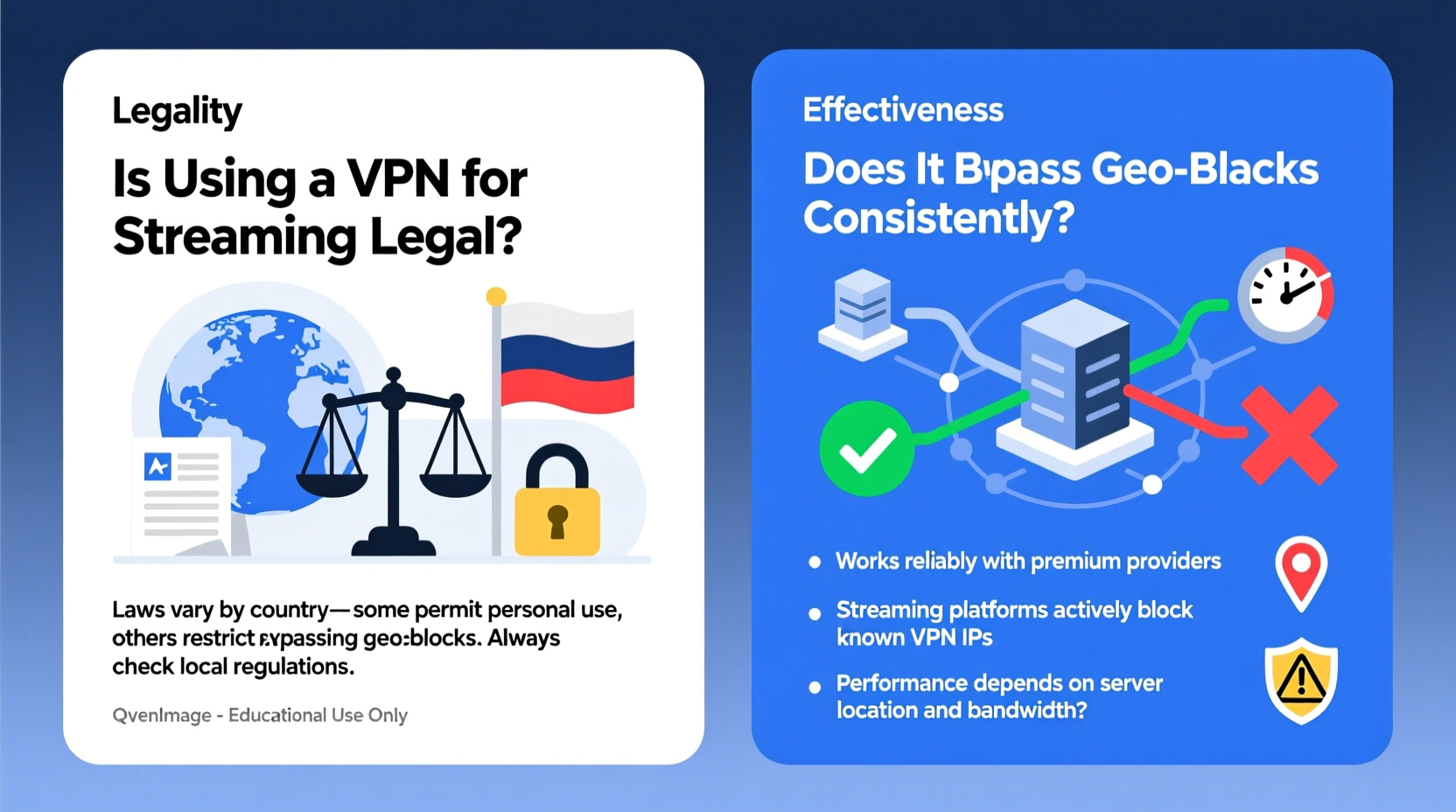
Is Using a VPN for Streaming Legal?
The legality of using a VPN for streaming hinges on two factors: your country’s laws and the streaming service’s terms of use.
In most democratic countries—including the U.S., Canada, the U.K., Germany, and Australia—using a VPN is entirely legal. Governments recognize legitimate privacy concerns, especially on public Wi-Fi or under surveillance-heavy regimes. However, legality doesn’t equate to compliance with service agreements.
Netflix, for instance, explicitly prohibits the use of proxies and unblockers in its Terms of Use. Section 4.3 states: “You agree not to access the Service through any means other than the devices and applications we offer.” Violating this rule may result in restricted access or account warnings, though permanent bans are rare.
“We do not ban members for using VPNs, but we do prevent members from viewing Netflix content through proxy or ‘unblocker’ services.” — Netflix Help Center
No known cases exist where individuals were prosecuted solely for using a VPN to stream content. The primary risk is service-level enforcement, not criminal liability. That said, downloading copyrighted material via torrenting through a VPN remains legally risky in many jurisdictions, regardless of encryption.
Country-Specific Considerations
While general use is safe in most places, certain countries impose strict controls:
- China: Only government-approved VPNs are legal; unauthorized tools can lead to fines.
- Russia: Bypassing state-imposed blocks (e.g., on social media) using a banned VPN can carry penalties.
- Iran and North Korea: All unauthorized circumvention tools are illegal.
For travelers or expats simply trying to watch their home country’s content library, risks remain minimal—provided they avoid accessing censored political or adult content.
Does a VPN Actually Bypass Geo-Blocks Consistently?
Effectiveness varies widely. While some users enjoy seamless access to foreign catalogs, others face persistent detection and blocking. The inconsistency stems from an ongoing technological arms race between streaming platforms and VPN providers.
Major services employ advanced detection methods:
- IP Blacklisting: Known data center IPs used by commercial VPNs are flagged and blocked.
- DNS Leak Detection: If DNS queries reveal your real location, the platform identifies proxy usage.
- Behavioral Analysis: Unusual patterns—like thousands of users logging in from the same IP—are red flags.
- Deep Packet Inspection (DPI): Used in restrictive regions to identify encrypted tunneling protocols.
Top-tier VPNs combat these measures with:
- Dedicated streaming servers optimized for specific platforms
- Dynamic IP rotation to avoid blacklists
- Split tunneling to route only streaming apps through the tunnel
- Stealth protocols that mimic normal web traffic
Real-World Performance Table
| VPN Provider | Netflix US Access | BBC iPlayer Reliability | Disney+ Japan Library | Detection Resistance |
|---|---|---|---|---|
| NordVPN | Yes (dedicated servers) | High | Yes | ★★★★☆ |
| ExpressVPN | Yes | Very High | Yes | ★★★★★ |
| Surfshark | Yes | Moderate | Limited | ★★★★☆ |
| Free VPN (e.g., Proton Free) | No | Low | No | ★☆☆☆☆ |
Note: Performance changes frequently. What works today may fail tomorrow as platforms update filters.
Mini Case Study: Accessing BBC iPlayer Abroad
James, a British expat living in Thailand, wanted to continue watching live Premier League matches broadcast on BBC Sport via iPlayer. He subscribed to a premium VPN known for UK server reliability. Initially, he connected successfully and streamed matches in HD. After three weeks, the service began displaying error code “BTP-1003,” indicating proxy detection.
He contacted customer support, which advised switching to a less congested London server and enabling DNS leak protection. After adjusting settings, access was restored. However, during peak viewing hours (e.g., FA Cup finals), buffering increased due to high server load.
This case illustrates two realities: top providers often restore access after detection, but performance fluctuates based on server demand and anti-VPN updates.
Step-by-Step Guide to Reliable Streaming with a VPN
If you decide to use a VPN for streaming, follow this proven sequence to maximize success:
- Choose a Reputable Provider: Prioritize services with documented success on major platforms (e.g., ExpressVPN, NordVPN).
- Select the Right Server: Use servers labeled “Streaming” or “Media.” Avoid overcrowded options during peak times.
- Enable Kill Switch & DNS Protection: Prevents leaks that expose your real location if the connection drops.
- Clear Browser Cache or App Data: Residual cookies may retain location history; clean slate improves compatibility.
- Test Before Subscription: Use money-back guarantees (most offer 30 days) to verify access to your desired service.
- Use Native Apps When Possible: Browser extensions are easier to detect; standalone apps offer better encryption.
- Update Regularly: Providers push updates to counter new blocking techniques—keep software current.
Common Pitfalls and What Not to Do
Even experienced users make mistakes that compromise access. Avoid these:
- Using free VPNs: Most are ineffective against modern geo-blocks and may sell your data.
- Ignoring IPv6 leaks: Some services use IPv6, which many VPNs don’t fully support—disable it manually if needed.
- Assuming one server fits all: A server that works for Netflix may fail for Hulu due to different detection systems.
- Skipping firmware updates: Outdated router-based VPNs lose compatibility over time.
Do’s and Don’ts Summary Table
| Action | Do | Don’t |
|---|---|---|
| Provider Choice | Pick one with strong streaming reputation | Go for unknown or free services |
| Connection Setup | Use app-based clients with kill switch | Rely solely on browser extensions |
| Troubleshooting | Switch servers and clear cache | Keep retrying the same failed setup |
| Security | Verify no DNS/IP leaks | Assume encryption equals invisibility |
Frequently Asked Questions
Can my ISP see I’m using a VPN to stream?
Your ISP can detect encrypted traffic to a VPN server but cannot see what you're doing online—including which sites you visit or what you stream. They’ll know you’re using a tunnel, but not the content inside it.
Will using a VPN slow down my streaming?
Yes, slightly. Encryption and distance to the server add latency. However, premium providers minimize speed loss—many still deliver 4K streaming with minimal buffering. Choose a nearby server for best results.
Has anyone ever been fined for using a VPN to stream?
There are no verified reports of individuals being fined or sued by content owners or governments solely for streaming geo-blocked shows via a VPN. Enforcement focuses on copyright infringement (e.g., piracy), not location spoofing for personal viewing.
Expert Insight: The Future of Geo-Blocking and Streaming Freedom
As global demand for uniform content access grows, experts predict a gradual shift away from strict regional licensing.
“The era of hyper-localized content libraries is unsustainable. As production becomes global—think Netflix originals filmed in Spain, starring Korean actors—the old model breaks down. We’re moving toward hybrid licensing, and eventually, region-free access.” — Dr. Lena Patel, Digital Media Policy Researcher, Oxford Internet Institute
Until then, consumers will continue seeking workarounds. Legislation lags behind technology, leaving gray areas that benefit cautious users.
Checklist: Is Your VPN Ready for Streaming?
- ✅ Offers servers in target countries (e.g., U.S., U.K., Japan)
- ✅ Has positive user reviews for specific platforms (Netflix, Hulu, etc.)
- ✅ Includes dedicated streaming or SmartDNS features
- ✅ Supports simultaneous connections across devices
- ✅ Provides 24/7 live chat support for troubleshooting
- ✅ Offers a 30-day money-back guarantee
- ✅ Blocks DNS, WebRTC, and IPv6 leaks
Conclusion: Balancing Practicality, Legality, and Expectations
Using a VPN for streaming sits in a gray zone—not illegal in most countries, but against the terms of service of major platforms. While enforcement is light, reliability is never guaranteed. Success depends on choosing the right provider, staying updated, and understanding that circumvention is a temporary fix in a constantly evolving landscape.
For travelers, expats, or fans of international content, a well-configured VPN remains one of the most effective tools available. Just remember: consistency requires maintenance, and legality should always be weighed against ethical consumption. Supporting creators through official channels—where possible—ensures the ecosystem thrives.




 浙公网安备
33010002000092号
浙公网安备
33010002000092号 浙B2-20120091-4
Comments
No comments yet. Why don't you start the discussion?