
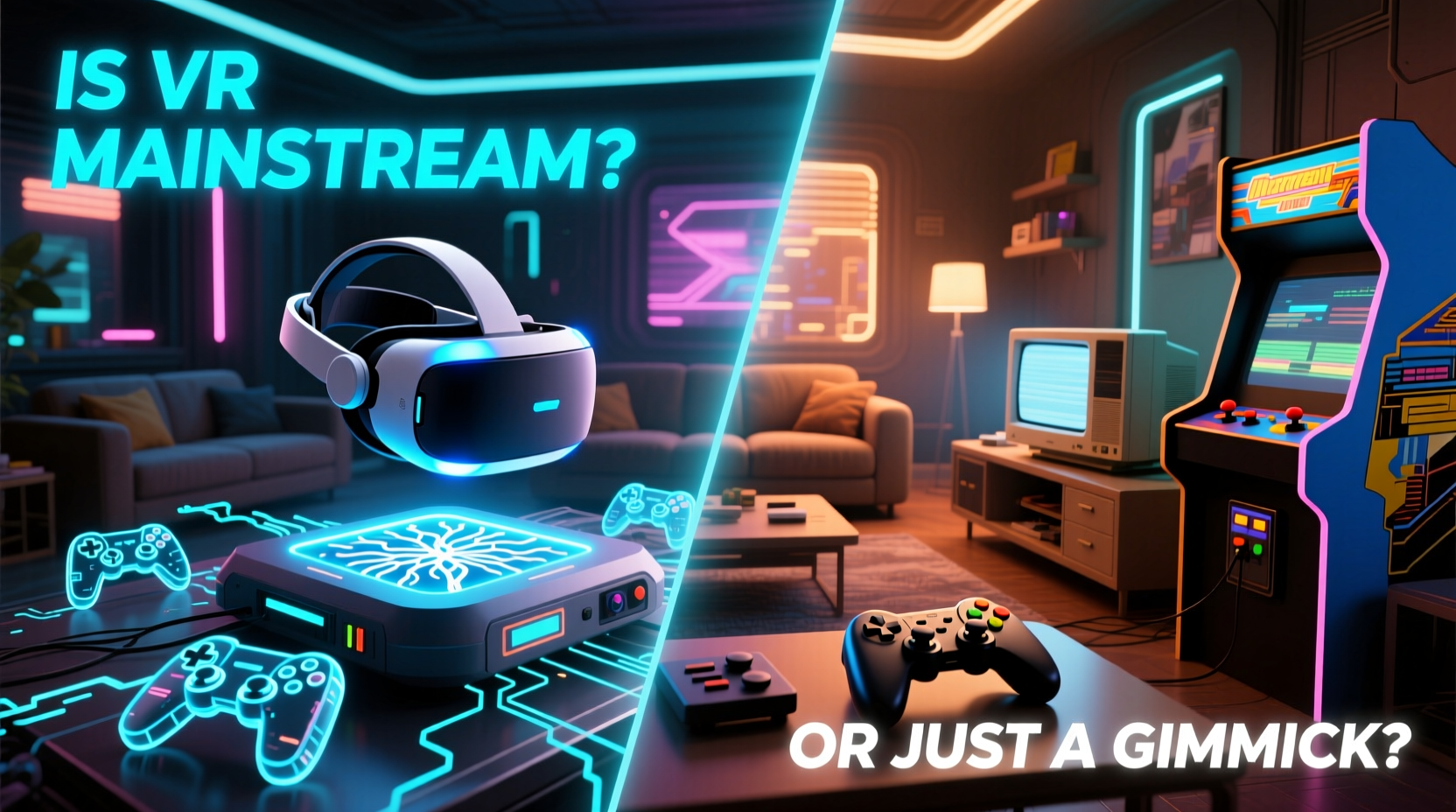
The debate between virtual reality (VR) gaming and traditional gaming has evolved from speculative curiosity to a legitimate industry discussion. A decade ago, VR was science fiction—something glimpsed in movies like *Ready Player One* or *The Matrix*. Today, millions own headsets, play immersive games, and attend virtual concerts. Yet, despite undeniable progress, many remain skeptical: Is VR gaming truly mainstream, or is it still a high-priced novelty?
This isn’t just about technology—it’s about accessibility, user experience, cultural integration, and long-term sustainability. To understand where VR stands today, we need to examine its trajectory, compare it directly with traditional gaming, and assess whether it has crossed the threshold from niche innovation to everyday entertainment.
The Evolution of VR Gaming: From Hype to Reality
VR’s journey began long before consumer headsets hit shelves. Early prototypes in the 1960s and 1990s promised immersion but failed due to technological limitations. The modern era reignited in 2012 when Palmer Luckey launched a Kickstarter for the Oculus Rift. That campaign raised over $2 million and caught Facebook’s attention—leading to a $2 billion acquisition in 2014.
Since then, VR has seen rapid advancements:
- Hardware improvements: Higher-resolution displays, inside-out tracking, wireless capabilities, and better ergonomics have made devices more comfortable and accessible.
- Software growth: Platforms like SteamVR, PlayStation VR, and Meta Quest Store now host thousands of titles, including AAA experiences like *Half-Life: Alyx* and fitness apps like *Supernatural*.
- Price drops: Entry-level headsets like the Meta Quest 3 start at $499, making VR more affordable than ever.
Despite these gains, adoption remains uneven. According to Statista, global VR headset shipments reached 8.8 million units in 2023—impressive, but dwarfed by over 25 million PlayStation 5 units sold in the same period. This disparity raises a critical question: Has VR achieved mainstream status, or is it still chasing relevance?
Mainstream Criteria: What Does It Mean to Be \"Mainstream\"?
To determine if VR gaming is mainstream, we must define what “mainstream” actually means in the context of consumer technology.
Mainstream adoption typically requires three key elements:
- Widespread accessibility: Available to the average consumer without requiring specialized knowledge, high costs, or technical setup.
- Cultural normalization: Accepted as a regular part of daily life or entertainment routines—not viewed as experimental or fringe.
- Sustainable ecosystem: Strong developer support, consistent content updates, and long-term platform viability.
Traditional gaming meets all three criteria. Consoles are in nearly every household with kids, PC gaming is a multi-billion-dollar industry, and mobile gaming reaches billions via smartphones. In contrast, VR still faces hurdles in each category.
For example, while standalone headsets reduce complexity, setting up room-scale tracking or managing storage across multiple platforms can deter casual users. Moreover, social stigma persists—some view VR as isolating or awkward, especially when worn in shared spaces.
“VR will be mainstream not when everyone owns a headset, but when people no longer feel the need to explain what they’re doing when they put one on.” — Dr. Sarah Thompson, Human-Computer Interaction Researcher, MIT Media Lab
VR vs Traditional Gaming: A Comparative Breakdown
To evaluate VR’s position, let’s compare it directly with traditional gaming across several dimensions.
| Category | Traditional Gaming | VR Gaming |
|---|---|---|
| Accessibility | Extremely high—games available on consoles, PCs, phones | Moderate—requires dedicated hardware; limited backward compatibility |
| Cost of Entry | $0–$700 (free mobile games to premium consoles) | $300–$1,500 (headset + compatible PC/console) |
| User Base Size | Over 3 billion globally | ~170 million active VR users (2024 estimate) |
| Content Variety | Massive library across genres and platforms | Growing, but still limited—especially in AAA titles |
| Physical Space Required | Minimal (controller + screen) | Significant (clear room for movement) |
| Social Integration | High (multiplayer, streaming, communities) | Emerging (VR chat, Meta Horizon Worlds), but fragmented |
| Longevity & Updates | Established franchises updated yearly | Inconsistent—many VR titles abandoned after launch |
The data shows that while VR excels in immersion and interactivity, it lags behind in convenience, reach, and consistency. Traditional gaming benefits from decades of infrastructure, brand loyalty, and economies of scale. VR, though innovative, hasn’t yet matched that foundation.
Where VR Shines: Niche Domains Driving Real Adoption
Even if VR hasn't gone fully mainstream, it's thriving in specific areas where its strengths outweigh its limitations.
Fitness and wellness have become unexpected success stories. Apps like *Les Mills Bodycombat* and *FitXR* combine rhythm-based gameplay with full-body workouts, attracting users who might never consider themselves \"gamers.\" These platforms report retention rates higher than most fitness apps—proving VR can deliver tangible lifestyle value.
Training and simulation represent another stronghold. Industries from aviation to healthcare use VR for safe, repeatable practice environments. Walmart uses VR to train employees in customer service scenarios, while surgeons rehearse complex procedures using haptic feedback systems.
In entertainment, VR concerts and social experiences are gaining traction. When Travis Scott hosted an in-game concert in *Fortnite*, it drew 12 million live viewers—a number some analysts believe could grow in true VR environments as bandwidth improves.
Mini Case Study: How One Family Embraced VR Beyond Gaming
The Rivera family in Austin, Texas, bought a Meta Quest 2 during the pandemic for their two children. Initially intended for gaming, they soon discovered non-gaming applications. Their daughter, Maya, used *Google Earth VR* for school geography projects, exploring ancient ruins in 3D. Their son, Leo, struggled with anxiety and found relief through guided meditation in *Tripp*, a mindfulness app.
Within months, the headset became a shared tool for education, relaxation, and even family game nights using *Keep Talking and Nobody Explodes*. While they still play console games weekly, VR carved out a unique role—one centered on connection and exploration rather than competition.
This case illustrates a broader trend: VR’s strongest path to mainstream acceptance may not be through replacing traditional gaming, but by offering complementary experiences that enrich daily life.
Barriers Preventing Full Mainstream Acceptance
Despite progress, several obstacles continue to limit VR’s widespread adoption.
Cost remains a primary concern. Even mid-tier setups exceed $500, and high-end systems like Valve Index approach $1,000. Add in accessories like finger-tracking gloves or base stations, and prices climb further—far beyond what most families spend on entertainment.
Motion sickness affects up to 40% of new users, according to studies published in *Cyberpsychology, Behavior, and Social Networking*. Symptoms range from dizziness to nausea, often triggered by latency or mismatched visual-vestibular signals. While newer headsets minimize this with higher refresh rates (90Hz+), the issue persists for sensitive individuals.
Content fragmentation also hinders growth. Developers must choose between platforms—Quest, PSVR2, PC VR—each with different specs and audiences. Cross-platform play is rare, limiting community size and discouraging investment.
Finally, **social perception** plays a role. Wearing a bulky headset in a living room feels awkward to many. Unlike watching TV or scrolling a phone, VR is inherently solitary—even when playing multiplayer games. Until design evolves toward subtler wearables (like AR glasses), this barrier will linger.
Checklist: Is VR Right for You?
Before investing in VR, consider the following:
- ✅ Do you have enough physical space for safe movement?
- ✅ Can your current PC or console support VR (if required)?
- ✅ Are you sensitive to motion or prone to dizziness?
- ✅ What type of experiences interest you most (gaming, fitness, education)?
- ✅ Have you tried VR firsthand before buying?
- ✅ Are you prepared for potential isolation during use?
The Future Outlook: Will VR Go Truly Mainstream?
Predictions vary widely. Some analysts project that by 2030, VR headsets could be as common as smartwatches, driven by advances in AI, lightweight optics, and augmented reality convergence. Apple’s Vision Pro, though expensive ($3,499), signals serious intent from major tech players to push spatial computing into the mainstream.
However, mass adoption depends on solving core challenges:
- Reducing cost through economies of scale
- Improving comfort and battery life
- Expanding compelling, cross-platform content
- Integrating seamlessly with existing digital ecosystems
One promising development is the rise of mixed reality (MR), blending real-world views with digital overlays. Games like *Moss: Book II* on PSVR2 showcase how MR can enhance immersion without complete environmental disconnection.
Additionally, cloud-based VR streaming—similar to Netflix for games—could eliminate the need for powerful local hardware. Services like NVIDIA CloudXR and upcoming offerings from Meta aim to make high-fidelity VR accessible via standard broadband connections.
FAQ
Is VR gaming more immersive than traditional gaming?
Yes, VR offers unparalleled immersion by placing players inside the game world. You don’t just control a character—you inhabit a body within the environment. However, this depth comes with trade-offs in comfort, session length, and accessibility.
Can VR replace traditional gaming entirely?
Unlikely in the near term. While VR excels in specific genres (rhythm, puzzle, horror), it struggles with fast-paced action or strategy games that require broad situational awareness. Most gamers will continue using both formats depending on mood and context.
Are there health risks associated with VR?
Extended use can cause eye strain, motion sickness, or musculoskeletal discomfort. Experts recommend taking breaks every 30 minutes, ensuring proper fit, and avoiding VR use in moving vehicles. Children under 12 should limit exposure due to ongoing visual development.
Conclusion: VR Isn’t Mainstream Yet—But It’s Getting Closer
VR gaming is no longer a gimmick. It delivers transformative experiences unmatched by flat screens—from walking on Mars to defusing bombs with friends across continents. Its impact is real, measurable, and growing.
Yet calling it “mainstream” would be premature. True mainstream status requires ubiquity, ease of use, and cultural invisibility—conditions VR hasn’t yet met. Instead, it occupies a powerful middle ground: a maturing technology with passionate users, expanding use cases, and genuine utility beyond entertainment.
The future of VR lies not in replacing traditional gaming, but in coexisting with it—offering deeper immersion when desired, stepping back when impractical. As hardware evolves and software matures, the line between virtual and traditional will blur. When that happens, VR won’t need to declare itself mainstream. We’ll simply stop questioning it.




 浙公网安备
33010002000092号
浙公网安备
33010002000092号 浙B2-20120091-4
Comments
No comments yet. Why don't you start the discussion?