
At first glance, a wallet chain and a keychain might seem interchangeable—one dangles from your pocket, the other from your belt loop. Both involve metal links, serve as accessories, and can carry functional items. But reducing a wallet chain to “just a keychain with extra steps” overlooks deeper distinctions in purpose, design, and cultural context. While they share mechanical similarities, their roles diverge significantly in utility, fashion, and personal expression.
The confusion arises because both items tether objects to the body. Yet their intended use, attachment points, and even social signaling vary. Understanding these nuances helps clarify whether wallet chains are redundant or uniquely valuable.
Functional Differences: What Each Is Designed to Do
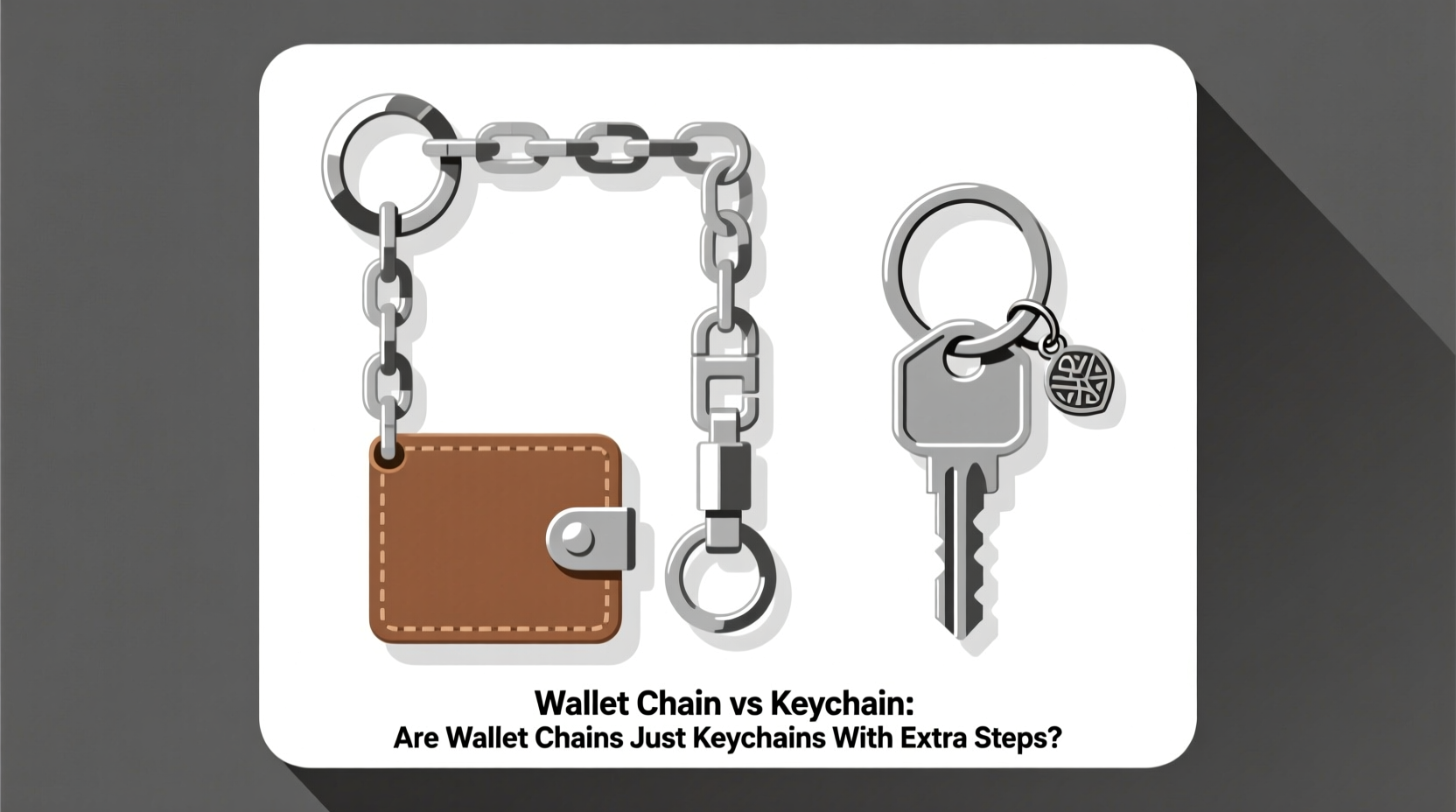
A keychain’s primary function is consolidation. It gathers multiple keys—house, car, office—into a single, portable unit. Most attach to a belt loop, bag, or pocket via a simple clip or ring. Its job ends at organization and accessibility.
In contrast, a wallet chain serves dual purposes: security and style. One end clips to a wallet—typically a slim bifold or money clip—and the other anchors to a belt loop, belt D-ring, or pants pocket. The core idea is theft prevention. In crowded environments like concerts, clubs, or public transit, pickpocketing remains a real concern. A wallet chain acts as a physical deterrent, making it harder for someone to slip a wallet out unnoticed.
This fundamental divergence means wallet chains aren’t just about carrying—they’re about anchoring. Keychains don’t typically secure the item they carry; you don’t fear your house key being stolen mid-walk. But wallets contain cash, cards, ID—high-value targets. The added “step” of clipping a wallet to your belt isn’t redundancy—it’s risk mitigation.
Design and Build: More Than Just Links
While both may use similar chain styles—ball chain, curb link, or cable—their construction reflects different demands.
| Feature | Wallet Chain | Keychain |
|---|---|---|
| Chain Strength | Reinforced, often 3–5mm thickness | Lightweight, decorative |
| Attachment Mechanism | Double-ended clips (wallet + belt) | Single ring or split ring |
| Security Lock | Many include locking clasps | Rarely locked |
| Weight Capacity | Designed for 200–400g (wallet + contents) | Typically under 100g |
| Material Quality | Stainless steel, titanium, anti-corrosion | Alloy, chrome-plated base metals |
The engineering reflects intent. Wallet chains must resist tugging and stress. Many feature locking mechanisms that require a pin or key to disconnect—preventing surreptitious removal. Keychains, meanwhile, prioritize convenience over resistance. They’re meant to be opened and reassembled frequently.
“Wallet chains evolved from practical necessity in high-risk environments. Their build isn’t overkill—it’s calibrated to prevent loss.” — Marcus Lin, Urban Gear Designer at Vault & Chain Co.
Cultural Significance and Style Evolution
The perception of wallet chains has shifted dramatically over time. Once associated with bikers, punks, and hip-hop artists in the '80s and '90s, they carried rebellious connotations. Wearing one signaled nonconformity, toughness, or affiliation with subcultures where personal gear was both valuable and vulnerable.
Today, wallet chains have been reclaimed by minimalist fashion enthusiasts and urban professionals. Brands like Bellroy, Totepack, and Ridge integrate sleek, low-profile chains into premium wallet designs. These versions emphasize discretion and modern aesthetics rather than overt edginess.
Keychains, on the other hand, have remained largely utilitarian. Even when adorned with charms or branded tags, they rarely carry symbolic weight. A custom keychain might express personality, but it doesn’t communicate identity in the way a wallet chain can.
So while a keychain says, “Here are my keys,” a wallet chain quietly announces, “I value what I carry—and I’m prepared.” That subtle distinction elevates it beyond mere function.
Real-World Use Case: The Festival-Goer’s Dilemma
Consider Alex, a 28-year-old who attends music festivals regularly. At last year’s summer event, he left his jacket in a crowded mosh pit during a headlining set. When he returned, the jacket was gone—and so was his unsecured wallet inside.
This year, he switched to a titanium wallet chain with a magnetic lock. He clipped one end to his slim aluminum wallet, the other to his belt’s D-ring. During another packed performance, he felt someone brush against his back pocket. This time, the wallet didn’t budge. Later, he noticed the clip had slight scratch marks—evidence of an attempted grab.
“It wasn’t just about losing money,” Alex said. “Losing my ID and credit cards would’ve ruined the trip. The chain bought me seconds—and saved the weekend.”
This scenario illustrates why wallet chains aren’t redundant. They solve a specific, high-stakes problem that keychains simply aren’t built for.
Step-by-Step: Choosing and Using a Wallet Chain Effectively
If you're considering a wallet chain, follow this sequence to ensure it works for your lifestyle:
- Assess your risk environment: Do you commute in dense cities? Attend large events? Work in crowded spaces?
- Select the right chain type: Ball chains are flexible but less durable; curb or rope chains offer better strength.
- Match it to your wallet: Ensure the clip fits securely. Some wallets have built-in loops for chains.
- Anchor properly: Attach the other end to a fixed point—belt D-ring is best. Avoid flimsy fabric loops.
- Test tension: Pull gently to confirm the chain holds without straining the attachment points.
- Maintain regularly: Check for wear, especially at the clasp. Clean with a microfiber cloth if exposed to sweat or rain.
FAQ: Common Questions About Wallet Chains vs Keychains
Can I use a keychain as a wallet chain in a pinch?
Technically, yes—but not safely. Most keychains aren’t built to withstand lateral pulling forces. A standard split ring can bend or snap under stress, leaving your wallet exposed. Purpose-built wallet chains use reinforced clasps and thicker gauge metal to resist tampering.
Do wallet chains damage pants or wallets?
Not if used correctly. High-quality chains have smooth, rounded clips that minimize abrasion. However, constant friction from a poorly positioned chain can wear fabric over time. Rotate attachment points occasionally and inspect for fraying.
Are wallet chains still in style?
Absolutely—but subtly. Modern interpretations favor minimalist designs: matte black chains, integrated clips, and compact profiles. They’re more common now in tech and streetwear circles than in traditional fashion, but their aesthetic credibility is growing.
Checklist: Is a Wallet Chain Right for You?
- ✅ Frequently carry valuable items (ID, cards, cash)
- ✅ Spend time in crowded public spaces
- ✅ Prefer slim, minimalist wallets
- ✅ Value both security and subtle style
- ✅ Willing to maintain hardware (cleaning, inspection)
- ❌ Prefer complete freedom of movement
- ❌ Rarely leave low-risk environments (office, home)
Conclusion: More Than Just Extra Steps
Calling a wallet chain “just a keychain with extra steps” misunderstands its role. Yes, both involve metal links and attachments. But purpose defines function. A keychain organizes. A wallet chain protects. One prevents lost keys; the other prevents identity theft, financial loss, and inconvenience.
The added complexity—a second clip, a locking mechanism, sturdier materials—isn’t redundancy. It’s specialization. Like comparing a seatbelt to a shoelace: both fasten, but only one is engineered for high-stakes scenarios.
If you move through dynamic environments where your belongings are at risk, a wallet chain isn’t an unnecessary accessory. It’s a small investment in autonomy and peace of mind. And in an age where personal security is increasingly fragmented, sometimes the strongest statement is made with a simple, well-placed chain.




 浙公网安备
33010002000092号
浙公网安备
33010002000092号 浙B2-20120091-4
Comments
No comments yet. Why don't you start the discussion?