
There’s a quiet frustration that comes with being unable to create—when ideas that once flowed now stall at the edge of thought. Whether you're a writer staring at a blank page, a designer struggling to sketch, or an entrepreneur brainstorming in circles, creative stagnation is not a personal failure. It’s a natural phase in the creative cycle. The key isn’t to wait for inspiration to strike; it’s to actively reengage with the process through deliberate, grounded actions. Recognizing that every creator faces these lulls—and learning how to move through them—is what separates consistent output from sporadic bursts of effort.
Understanding the Creative Rut
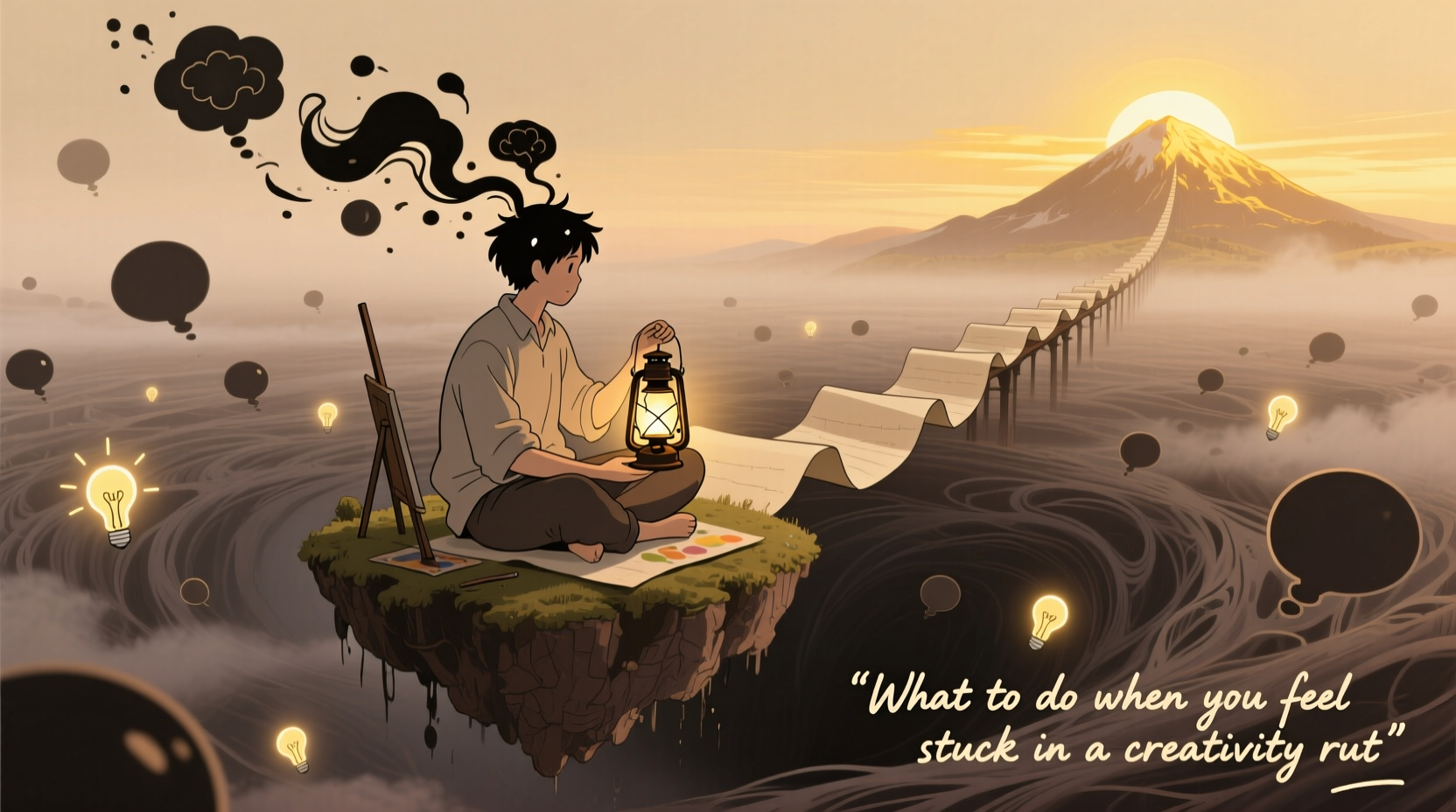
A creativity rut isn’t just about lacking ideas. It often stems from deeper causes: mental fatigue, fear of judgment, overcommitment, or even too much routine. Creativity thrives on novelty, emotional openness, and cognitive flexibility—all of which can be dulled by stress or burnout. When you’re stuck, your brain may be signaling the need for rest, reflection, or a shift in perspective rather than pushing harder.
Neuroscience supports this: the default mode network (DMN), active during daydreaming and mind-wandering, plays a crucial role in idea generation. Constant productivity pressures suppress this network, making original thinking harder. A rut, then, might not mean you’ve lost your ability—it could mean you’ve lost access to the mental space where ideas form.
Shift Your Environment to Spark New Thinking
Your surroundings shape your thoughts more than you realize. Working in the same chair, facing the same wall, following the same schedule can condition your brain into predictable patterns. To disrupt this inertia, change one element of your environment deliberately.
- Work in a different room or outdoor space
- Reorganize your desk or workspace
- Switch from digital to analog tools (e.g., pen and paper instead of typing)
- Visit a museum, park, or unfamiliar neighborhood
Environmental shifts don’t have to be dramatic. Even small changes—like sitting backward in your chair or listening to a new genre of music—can prompt fresh neural connections. The goal is to interrupt autopilot and invite curiosity.
“Creativity is intelligence having fun.” — Albert Einstein
Break Through with Structured Constraints
Paradoxically, freedom can stifle creativity. An open-ended canvas—write anything, design everything, build whatever—often leads to paralysis. Imposing constraints forces resourcefulness. Limitations narrow focus and reduce decision fatigue, making it easier to begin.
Try these constraint-based exercises:
- The 10-Minute Sprint: Write, draw, or prototype something in exactly ten minutes. No editing. Just output.
- One Word Prompt: Pick a random word (e.g., “bridge,” “moss,” “echo”) and build a concept around it.
- Medium Swap: If you usually write, try expressing the same idea as a diagram. If you paint, describe your next piece in poetic prose first.
Constraints aren’t meant to limit quality—they’re designed to bypass perfectionism and get you creating again.
Mini Case Study: The Illustrator Who Redefined Her Process
Lena, a freelance illustrator, found herself avoiding her tablet for weeks after receiving critical feedback on a client project. She felt uninspired and doubted her style. Instead of forcing illustrations, she imposed a rule: for one week, she would only draw with a single black pen on index cards, limiting each piece to five minutes. No digital tools, no color, no revisions.
The simplicity removed pressure. Without the option to edit endlessly, she focused on gesture and spontaneity. By day four, she began enjoying the process again. One of her quick sketches—a cat curled inside a coffee cup—later became the basis for a popular print series. The constraint didn’t just restart her creativity; it helped her rediscover joy in imperfection.
Reconnect with Inspiration—Without Comparison
Seeking inspiration is natural, but consuming others’ work while in a rut can backfire. Scrolling through polished portfolios or best-selling novels often amplifies self-doubt. The remedy isn’t isolation—it’s intentional, non-competitive engagement with sources of wonder.
Instead of studying finished masterpieces, explore the raw materials behind them:
- Read artist interviews focusing on struggle and process, not success
- Listen to ambient sounds from nature or cities to stimulate subconscious associations
- Collect physical objects—an old button, a leaf, a ticket stub—that evoke memory or emotion
- Keep an “ugly idea” journal where nothing is too silly or incomplete
Inspiration rarely comes from looking at more art. It comes from living deeply and noticing widely.
Step-by-Step Guide to Restarting Your Creative Flow
When you’re deep in a rut, action—not motivation—is the catalyst for change. Follow this six-step sequence to rebuild momentum:
- Pause and Acknowledge: Name the rut without judgment. Say aloud: “I’m feeling stuck right now, and that’s okay.” This reduces shame and opens space for change.
- Change Physical State: Stand up, stretch, take a walk, or splash cold water on your face. Movement signals your brain that a transition is happening.
- Set a Micro-Goal: Commit to creating for five minutes or producing one flawed draft. Lower the bar so low that resistance crumbles.
- Use a Prompt or Template: Borrow a structure (e.g., “Write a letter to your younger self” or “Design a product for cats”). Templates remove the burden of starting from nothing.
- Engage in Analog Play: Doodle, collage, or rearrange words on paper. Hands-on activity engages different parts of the brain than digital work.
- Reflect and Record: Afterward, jot down one thing that felt interesting, even if the output was weak. This trains your brain to notice progress.
Repeat this process daily for a week. You don’t need breakthroughs—just consistency. Momentum builds gradually, like a flywheel.
Common Pitfalls and How to Avoid Them
Even with good intentions, people often deepen their rut by falling into counterproductive habits. Below is a comparison of common behaviors and better alternatives.
| What Not to Do | Better Approach |
|---|---|
| Waiting for motivation before starting | Start before you feel ready—even for two minutes |
| Consuming endless tutorials instead of doing | Learn just enough to act, then apply immediately |
| Editing while creating | Separate drafting and refining into distinct sessions |
| Comparing early work to others’ finished products | Compare your current work to your past work only |
| Working through exhaustion | Rest intentionally—sleep, walk, nap—to restore cognitive capacity |
“The most dangerous thought you can have as a creative person is that you are less creative than someone else.” — Elizabeth Gilbert
Create a Personal Creativity Checklist
Use this checklist weekly to assess and adjust your creative rhythm. Print it or save it digitally for regular review.
- ✅ Did I create something—even small or imperfect—this week?
- ✅ Did I step away from screens for unstructured thinking time?
- ✅ Did I expose myself to a new experience, place, or conversation?
- ✅ Did I avoid self-criticism during the initial creation phase?
- ✅ Did I preserve one idea, sketch, or sentence worth revisiting?
- ✅ Did I rest when mentally fatigued instead of pushing through?
Checking off even three items indicates you’re nurturing your creative ecosystem. Perfection isn’t the goal—continuity is.
FAQ
How long does a creativity rut typically last?
There’s no fixed timeline. Some ruts lift in days; others persist for months. Duration depends on underlying causes—burnout may require weeks of rest, while a simple lack of stimulus might resolve in hours. What matters most is response: passive waiting extends the rut; active engagement shortens it.
Is it normal to feel guilty when I’m not creating?
Many creatives tie their worth to productivity, but creativity isn’t linear. Periods of stillness are part of the process. Guilt often masks fear of irrelevance. Reframe rest as preparation. Ideas incubate beneath the surface. Trust that input—reading, walking, observing—counts as creative work.
Can collaboration help when I’m stuck alone?
Yes. Explaining your block to someone else often reveals solutions. Even casual conversations can spark connections. Try co-working with a peer (in person or virtually) or joining a low-pressure creative group. Shared energy lowers the stakes and reignites playfulness.
Conclusion: Move First, Understand Later
When you feel stuck, the instinct is to analyze—why am I blocked? What’s wrong with me? But insight follows action, not the other way around. You don’t need to understand the rut to escape it. You need to make a mark, write a sentence, hum a melody. Start small, start messy, start before you’re ready.
Creativity isn’t a constant flame—it’s a campfire that needs tending. Some days you add wood; other days you let it smolder. The act of returning, again and again, is what keeps it alive. Your voice, your vision, your contribution matters—not because it’s perfect, but because it’s yours.




 浙公网安备
33010002000092号
浙公网安备
33010002000092号 浙B2-20120091-4
Comments
No comments yet. Why don't you start the discussion?