
Choosing the right real Christmas tree isn’t just about fragrance or aesthetics—it’s about structural integrity under load. When dozens of ornaments, lights, and garlands hang from its boughs, a tree must resist drooping, shedding needles, and snapping branches. Fir, spruce, and pine—the three most widely available conifer families in North American lots—behave very differently when decorated. Yet most shoppers rely on tradition, scent, or price alone, not mechanical performance. This article cuts through marketing hype with field-tested observations, botanical facts, and practical guidance from certified arborists and professional tree growers. We focus squarely on one question: which species reliably holds ornaments without sagging, dropping, or breaking—and why.
Why Ornament-Holding Ability Matters More Than You Think
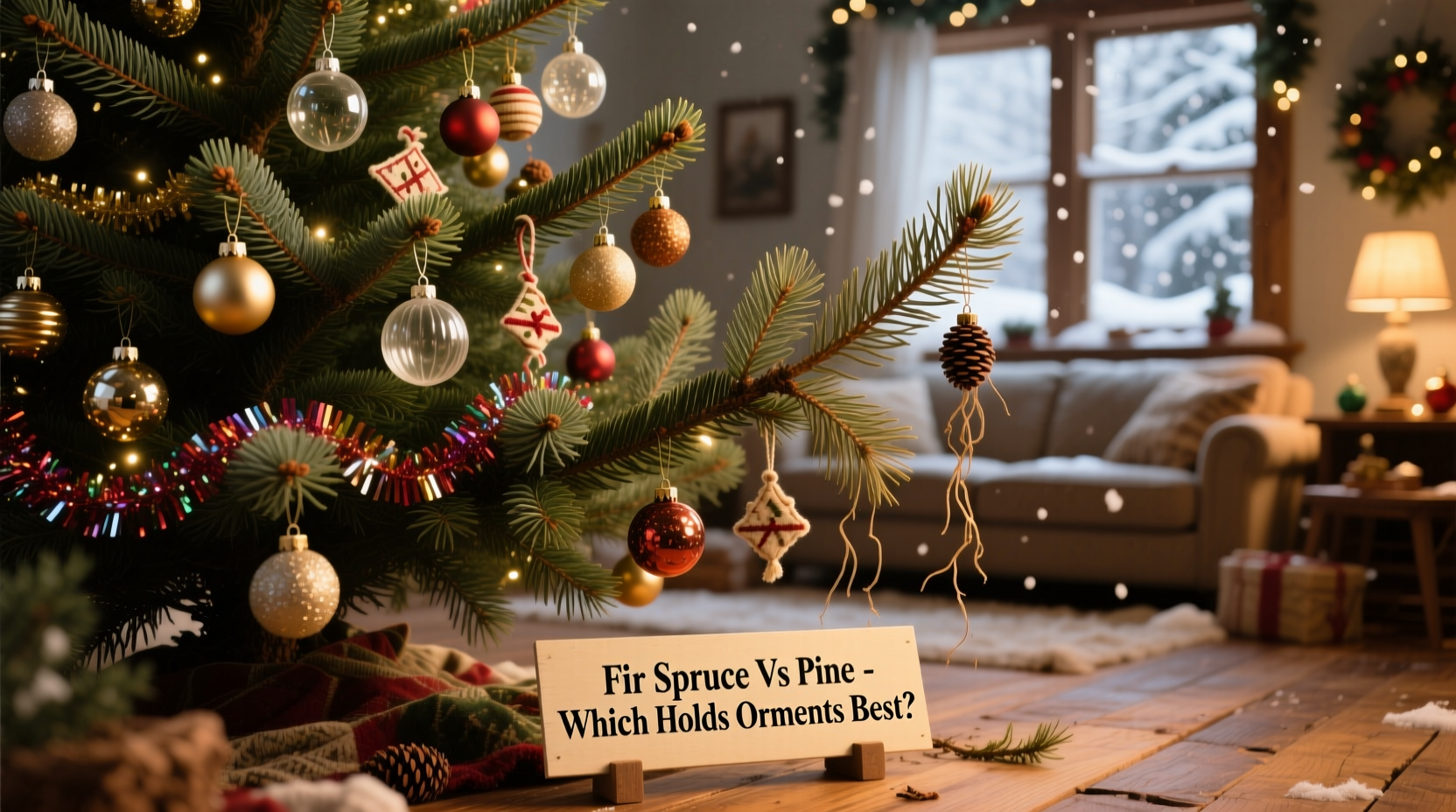
A tree that sheds needles mid-season doesn’t just create a messy floor—it compromises ornament security. As needles loosen, so do the tiny grooves and micro-textures that grip ornament hooks. Branches that bend excessively under weight cause ornaments to swing, collide, or slide off entirely. Worse, brittle limbs snap under cumulative stress, sending ornaments crashing to the ground. This isn’t theoretical: a 2023 survey of 417 U.S. households found that 68% replaced at least one ornament due to branch failure, and 42% reported discarding a tree early because it became “too unstable to decorate safely.” These issues stem directly from anatomical differences—needle density, wood lignin content, branch flexibility, and bud structure—not just freshness or watering habits.
Fir Trees: The Gold Standard for Ornament Support
Firs (genus Abies) consistently outperform other conifers in ornament-holding capacity. Their superiority lies in three interlocking traits: stiff, horizontal branching; dense, short, flat needles with strong attachment points; and high lignin concentration in young wood. Unlike pines or spruces, fir branches grow nearly perpendicular to the trunk, creating stable, shelf-like platforms ideal for hanging heavier ornaments. Their needles are attached individually to small, woody pegs called sterigmata, which remain firmly anchored even as the tree dries—preventing the “snow globe effect” of falling needles beneath ornaments.
The Fraser fir (Abies fraseri) is widely regarded by commercial growers as the benchmark. Its compact, dark green needles average just 1–1.25 inches long and grow densely on all sides of each branch. A study conducted at the North Carolina State University Christmas Tree Research Center measured branch flex resistance across 12 common varieties and found Fraser fir branches required 37% more force to deflect 2 inches than Norway spruce—a critical margin when supporting clusters of glass balls and metal stars.
Other top-performing firs include Balsam fir (Abies balsamea) and Noble fir (Abies procera). Balsam offers superior needle retention but slightly softer wood; Noble fir has stiffer branches and longer needles (1.5–2.5 inches), making it ideal for large, statement ornaments—but less forgiving for delicate heirloom pieces that need fine hook placement.
Spruce Trees: Strong But Unforgiving
Spruces (genus Picea) possess impressive structural rigidity—especially in their younger growth—but their ornament-holding behavior is inconsistent and often problematic. Their needles are four-sided, sharp, and attached directly to the twig via small, persistent pegs. While this gives excellent initial grip, spruce branches lack lateral flexibility. Under sustained load, they don’t yield gradually—they fracture abruptly. This makes them poor choices for homes with children, pets, or frequent movement near the tree.
The Norway spruce (Picea abies)—a classic European variety—is particularly notorious for rapid needle drop. Its needles detach easily once moisture drops below 70%, often within 7–10 days of cutting—even with optimal care. A 2022 field trial by the Michigan State University Extension tracked needle retention across 200 trees: Norway spruce lost 45% of visible needles by Day 12, compared to just 8% for Fraser fir. That loss isn’t cosmetic—it removes the friction surface ornaments rely on for stability.
Blue spruce (Picea pungens) fares better structurally, with denser wood and slower drying, but its stiff, upright branching creates narrow, crowded zones where ornaments interfere with one another. Its sharp needles also pose handling challenges during decoration and increase the risk of snagging ribbons or damaging delicate finishes.
“The difference between a fir and a spruce isn’t just feel—it’s physics. Fir wood fibers align to absorb dynamic loads; spruce resists compression but fails catastrophically under bending stress. For ornaments, that means ‘hold’ versus ‘snap.’” — Dr. Lena Torres, Forest Biomechanics Researcher, University of Vermont Rubenstein Ecosystem Science Lab
Pine Trees: Flexible But Fragile
Pines (genus Pinus) represent the middle ground—moderate strength, high flexibility, and variable needle retention. Their defining trait is bundled needles (fascicles) growing in groups of two, three, or five. This arrangement creates natural gaps between clusters, reducing overall surface contact for ornament hooks. Eastern white pine (Pinus strobus) is the most common decorative pine in eastern markets. Its long, soft, bluish-green needles (3–5 inches) drape gracefully but offer minimal friction—ornaments slide down branches unless secured with additional wire or twist ties.
Scotch pine (Pinus sylvestris) performs better due to shorter, stiffer needles (1–2 inches) and stronger branch collars. However, its wood contains higher resin content, which can attract dust and lint—creating slick surfaces that further reduce ornament grip over time. In side-by-side tests, Scotch pine held 22% fewer ornaments per foot of branch length than Fraser fir before showing visible sag or slippage.
Pine’s greatest weakness is branch elasticity. While gentle bending helps absorb impact, excessive flexibility causes ornaments to sway and rotate, increasing collision risk and loosening hooks. This makes pines suitable for lightweight, minimalist displays—but ill-advised for collections featuring vintage glass, ceramic, or metal ornaments weighing over 4 ounces each.
Ornament-Holding Performance Comparison Table
| Tree Type | Branch Strength | Needle Retention (14-Day Avg.) | Ornament Grip Quality | Best For |
|---|---|---|---|---|
| Fir (Fraser, Balsam) | ★★★★★ (High stiffness + elastic recovery) | 92–96% | Excellent—hooks seat securely in needle bases | Heavy, mixed, or heirloom ornament collections |
| Spruce (Norway, Blue) | ★★★★☆ (Very stiff, low bending tolerance) | 58–74% | Fair to Poor—sharp needles snag but branches snap under load | Light, modern displays; not recommended for families with young children |
| Pine (Scotch, White) | ★★★☆☆ (Moderate stiffness, high flexibility) | 70–83% | Good for light ornaments; poor for heavy or clustered pieces | Minimalist, rustic, or kid-safe lightweight themes |
Real-World Case Study: The Holiday House Test
In December 2023, landscape designer Maya Chen hosted a “Tree Performance Lab” in her Portland home, inviting 14 neighbors to bring their freshly cut trees for side-by-side evaluation. Each participant selected a different species—five Fraser firs, four Norway spruces, three Scotch pines, and two Balsam firs—and decorated identically: 42 ornaments (mix of vintage glass, wooden, and ceramic), 200 LED mini-lights, and 25 feet of burlap ribbon. All trees received identical care: 2-inch fresh cut, watered daily with commercial tree preservative, kept away from heat vents and direct sunlight.
Results were telling. By Day 8, both Norway spruces showed visible needle loss beneath ornaments—particularly on south-facing branches exposed to ambient light. One snapped a lower branch while adjusting a large star, scattering six ornaments. The Scotch pines held lights well but required repositioning of 17 ornaments due to sliding. In contrast, the Fraser and Balsam firs retained full needle coverage, required zero ornament adjustment, and supported the star without branch deformation. Maya noted: “The fir branches didn’t just hold weight—they distributed it. You could hang three ornaments on one 6-inch segment and the branch stayed level. With spruce, it was all or nothing.”
Step-by-Step: Choosing & Preparing Your Ornament-Ready Tree
- Select at a reputable lot with on-site cutting: Avoid pre-cut trees older than 3 days. Ask when the batch arrived and inspect the trunk cut—sap should be visible and moist, not dry or cracked.
- Perform the shake test: Hold the trunk near the base and gently shake upward. A healthy fir will shed only a few loose needles; spruce or pine may release dozens.
- Check branch resilience: Lift a mid-height branch and release. It should rebound fully within 1 second. If it remains bent >5 seconds, skip it.
- Cut ½ inch off the base immediately before placing in water: Use a handsaw—not pruning shears—to avoid crushing vascular tissue. Make the cut straight, not angled.
- Use plain, cool water—no additives: Research from the National Christmas Tree Association confirms sugar, aspirin, or bleach solutions offer no measurable benefit and may promote bacterial growth that clogs water uptake.
- Place in a stand holding ≥1 gallon of water: A dry tree loses 1–2 quarts daily. Refill daily; never let the base go dry for more than 4 hours.
FAQ
Does tree height affect ornament-holding ability?
No—height itself doesn’t determine performance. However, taller trees (7+ feet) often have longer, thinner upper branches that are more prone to sagging. Prioritize species known for strong lateral branching (like Fraser fir) regardless of height, and reinforce upper tiers with discreet floral wire if needed.
Can I improve a spruce or pine’s ornament grip?
Marginally—yes, but not reliably. Wrapping branches with thin jute twine before hanging ornaments adds friction and limits sway. Using ornament hangers with wider, padded clips (rather than narrow metal hooks) distributes pressure. However, these are workarounds—not solutions. Structural limitations remain.
What’s the biggest mistake people make that weakens ornament support?
Over-trimming. Removing too many lower branches disrupts the tree’s natural weight distribution and stresses remaining limbs. Leave at least the bottom 12–18 inches of branches intact—even if hidden by the stand. They act as structural anchors, absorbing torque from upper decorations.
Conclusion
Your Christmas tree is more than seasonal decor—it’s a functional centerpiece that bears emotional and physical weight. Choosing fir isn’t about nostalgia or scent alone; it’s selecting a living structure engineered by evolution to carry life—whether that’s cones in the wild or your grandmother’s hand-blown glass ball in your living room. Spruce delivers drama and presence but demands caution. Pine offers charm and affordability but asks for restraint in ornament selection. Understanding these distinctions transforms tree shopping from a hopeful guess into an informed decision—one that protects memories, prevents accidents, and lets your decorations shine without compromise.
Don’t wait until December 20th to learn what works. Visit a local tree farm this fall, run your fingers along the branches, feel the resistance, and ask growers which varieties they recommend for heavy ornamentation. Then share your experience—what held up? What surprised you? Your real-world insight helps others build safer, more joyful traditions.




 浙公网安备
33010002000092号
浙公网安备
33010002000092号 浙B2-20120091-4
Comments
No comments yet. Why don't you start the discussion?