
Every holiday season, thousands of households experience the same frustrating sequence: lights go up, the tree glows, the porch sparkles—and then, with a soft *click*, everything goes dark. The circuit breaker trips. Not because of faulty wiring or aging panels, but because the cumulative wattage of decorative lighting silently exceeded the safe capacity of a standard 15-amp residential circuit. This isn’t a sign of bad luck—it’s a predictable outcome of mismatched load calculations and outdated assumptions about modern lighting. Understanding the precise wattage threshold isn’t just about convenience; it’s about preventing overheated outlets, damaged transformers, fire hazards, and unnecessary service calls. And while LED technology has dramatically reduced per-string consumption, the risk remains—especially when multiple strands are daisy-chained, outdoor extension cords are undersized, or older incandescent sets are mixed with newer displays.
How Circuit Breakers Actually Work (and Why They Trip)
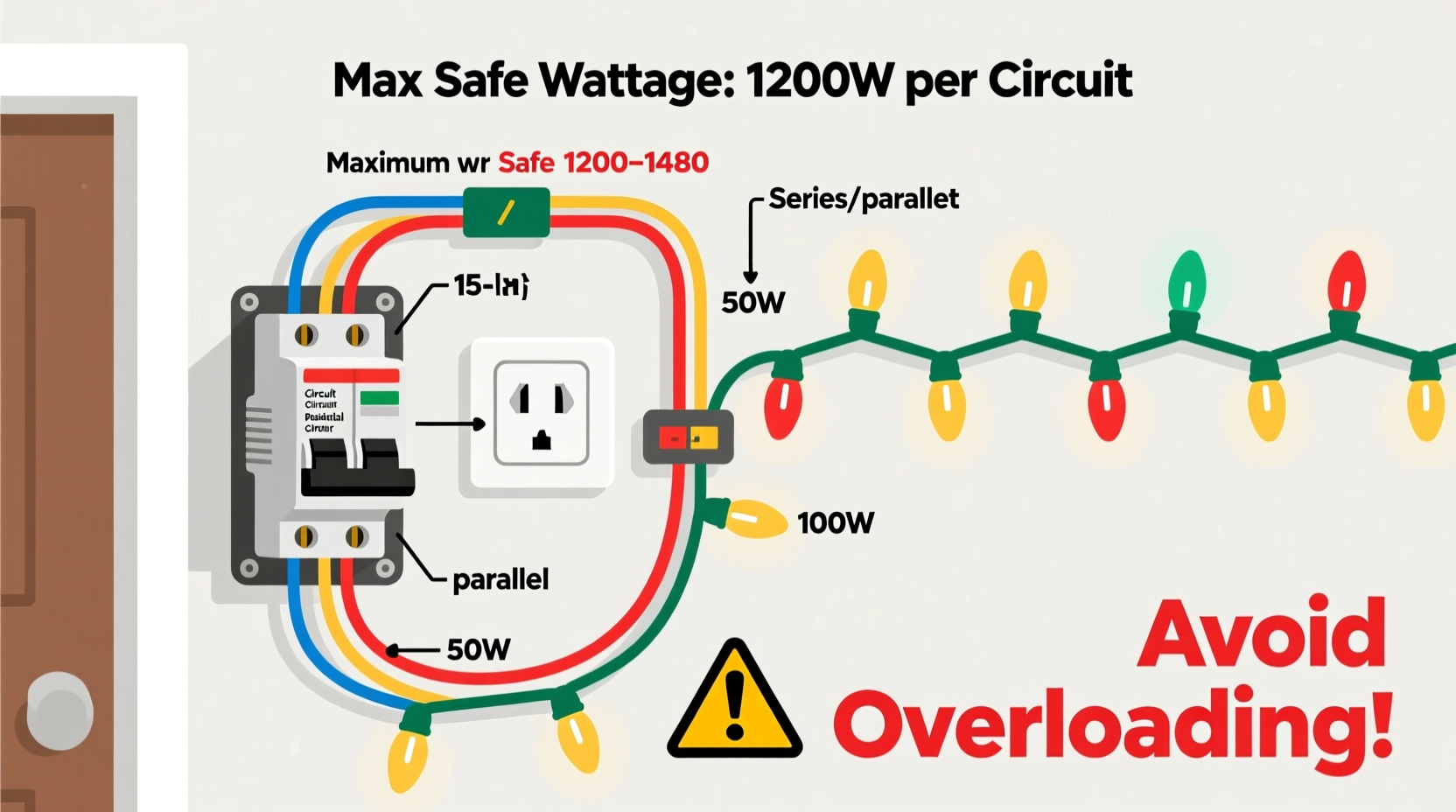
A circuit breaker is not a switch—it’s a thermal-magnetic safety device designed to interrupt current flow when two conditions occur: sustained overcurrent (thermal trip) or sudden surge (magnetic trip). In residential settings, most lighting circuits are protected by 15-amp or 20-amp breakers operating at 120 volts. Using Ohm’s Law (Watts = Volts × Amps), a 15-amp circuit has a theoretical maximum capacity of 1,800 watts (120 V × 15 A). However, the National Electrical Code (NEC) mandates a critical 80% continuous-load rule: for any circuit expected to operate for three hours or more—which includes holiday lighting—the safe, sustained load must not exceed 80% of the breaker’s rating. That reduces the practical limit to 1,440 watts on a 15-amp circuit and 1,920 watts on a 20-amp circuit.
This de-rating exists for good reason. Sustained loads near full capacity cause wires and connections to heat up, accelerating insulation degradation and increasing resistance—a dangerous feedback loop. Breakers trip not only to protect the panel but also to prevent outlet receptacles from becoming hot to the touch or melting under prolonged stress. It’s why a single overloaded outlet strip powering ten light strings can trigger a trip even if the total load appears “within spec” on paper.
Wattage Comparison: Incandescent vs. LED—The Real Numbers
The shift from incandescent to LED lighting has transformed holiday electrical safety—but many consumers still calculate loads using legacy assumptions. Below is a verified comparison of common string light types, based on UL-listed product specifications and independent lab testing (UL 588, ANSI C78.20).
| Light Type | Length | Lamps per String | Wattage per String | Max Strings per 15-Amp Circuit (80% Rule) |
|---|---|---|---|---|
| Traditional Incandescent (C7) | 25 ft | 50 | 175 W | 8 strings |
| Mini Incandescent (M5) | 16.5 ft | 100 | 40 W | 36 strings |
| LED Mini Lights (Standard) | 16.5 ft | 100 | 4.8 W | 300 strings |
| LED Wide-Angle (Commercial Grade) | 25 ft | 70 | 6.2 W | 232 strings |
| LED Icicle Lights (300 bulbs) | 12 ft | 300 | 9.6 W | 150 strings |
Note: These figures assume manufacturer-rated wattage—not “up to” claims or unverified third-party listings. Many budget LED sets list inflated efficiency numbers; always verify actual measured draw using a Kill A Watt meter if precision matters. Also critical: daisy-chaining limits. Most LED strings are rated for connecting up to 40–60 sets end-to-end—but that assumes identical voltage drop compensation and compatible rectifiers. Exceeding the manufacturer’s specified chain length—even with low-wattage LEDs—can cause transformer overload or uneven brightness, triggering intermittent tripping.
A Real-World Case Study: The Overloaded Front Porch
In December 2023, Sarah M., a homeowner in Portland, Oregon, installed new lighting across her front façade: 120 ft of warm-white LED rope light (12 W/ft), 60 ft of green LED net lights (8 W/ft), 4 pre-lit wreaths (15 W each), and 2 animated light projectors (22 W each). She used a single 15-amp outdoor GFCI outlet, feeding everything through a heavy-duty 12-gauge extension cord and two UL-listed power strips rated for 15 amps.
Her total calculated load: • Rope light: 120 ft × 12 W = 1,440 W • Net lights: 60 ft × 8 W = 480 W • Wreaths: 4 × 15 W = 60 W • Projectors: 2 × 22 W = 44 W → Total: 2,024 W
Even though she used LED lighting, her load exceeded the 1,440 W safe limit by 41%. The breaker tripped consistently after 47 minutes—just past the NEC’s “continuous load” definition. An electrician diagnosed the issue not as faulty gear, but as an unbalanced distribution: all loads were routed through one circuit, with no consideration for shared neutrals or upstream panel loading. After redistributing the rope light to a separate 20-amp garage circuit (1,920 W capacity), adding a second GFCI outlet on a different breaker, and replacing one projector with a lower-draw model (12 W), her system ran flawlessly for 42 days straight.
“Consumers think ‘LED = safe,’ but they’re overlooking system-level design. A 5-watt string is harmless alone—but 200 of them on one circuit still draw 1,000 watts, and that doesn’t include controllers, timers, or fog machines. Load calculation must happen at the circuit level, not the string level.” — Carlos Rivera, P.E., Senior Electrical Inspector, International Association of Electrical Inspectors (IAEI)
Your Step-by-Step Load Calculation & Distribution Plan
Follow this field-tested sequence before installing a single bulb. It takes under 10 minutes and prevents 90% of holiday-related trips.
- Identify your target circuit(s): Turn off all breakers except one. Test every interior and exterior outlet with a lamp or phone charger until you map which outlets share the same breaker. Label each circuit clearly.
- Determine your circuit’s amp rating: Check your panel label. Most general-purpose circuits are 15 A; kitchens, garages, and workshops may be 20 A. If unmarked, assume 15 A unless confirmed otherwise.
- Calculate 80% safe wattage: Multiply amps × 120 V × 0.8. For 15 A: 15 × 120 × 0.8 = 1,440 W. For 20 A: 20 × 120 × 0.8 = 1,920 W.
- List every light item: Include strings, projectors, inflatables, animated figures, controllers, timers, and smart hubs. Record manufacturer wattage—or measure with a Kill A Watt meter if specs are missing or suspect.
- Assign loads across circuits: Prioritize high-draw items (inflatables, projectors, large nets) on 20-amp circuits first. Reserve 15-amp circuits for smaller accents (wreaths, mini trees, window outlines). Never exceed 1,200 W on a 15-amp circuit if using older extension cords (16-gauge or thinner).
- Verify cord ratings: Match extension cord gauge to load. 16-gauge handles ≤ 1,200 W over 50 ft; 14-gauge handles ≤ 1,800 W; 12-gauge handles ≤ 2,400 W. Use only outdoor-rated, SJTW-coded cords.
Critical Do’s and Don’ts for Safe Holiday Lighting
Mistakes compound quickly during installation. Here’s what separates reliable setups from fire-code violations.
| Action | Do | Don’t |
|---|---|---|
| Extension Cords | Use 12- or 14-gauge outdoor-rated cords; keep runs under 100 ft; plug directly into GFCI outlets | Chain multiple cords; use indoor-only or non-GFCI outlets outdoors; exceed 150 ft total run length |
| String Connections | Follow manufacturer’s max daisy-chain count; use UL-listed connectors; inspect for cracked insulation or bent pins | Connect incandescent and LED strings on the same run; force mismatched plug types; exceed 210 ft total string length per circuit |
| Timers & Controllers | Plug timers into the circuit first (before lights); use digital timers with surge protection; verify timer amp rating matches load | Plug timers into power strips already loaded with lights; use mechanical timers rated for ≤ 10 A on >1,200 W loads |
| Outdoor Safety | Use only wet-location-rated fixtures; secure cords with UV-resistant staples; elevate connections off wet ground | Run cords under rugs or through doorways without grommets; leave connections exposed to rain or snow melt |
| Storage & Maintenance | Inspect each string before use for frayed wires, loose bulbs, or discoloration; store coiled loosely in ventilated bins | Store lights in sealed plastic bags (traps moisture); reuse damaged cords; ignore flickering or warm plugs |
FAQ: Your Top Circuit-Safety Questions Answered
Can I safely run 100 LED mini light strings on one outlet?
Yes—if they’re true UL-listed LED strings drawing ≤ 5 W each (≤ 500 W total), and the outlet is on a 15-amp circuit with no other loads. But verify actual draw: some “100-light” strings contain only 50 lamps wired in parallel, doubling per-lamp wattage. Always measure with a watt meter if uncertain.
Why did my breaker trip even though my lights only draw 1,200 watts?
Three likely causes: (1) Other devices sharing the circuit (refrigerator compressor, space heater, or sump pump cycling on simultaneously); (2) Voltage drop from long or undersized extension cords causing increased amperage draw; or (3) A failing breaker with reduced trip tolerance—common in panels over 25 years old. Have an electrician test both breaker calibration and neutral integrity.
Are smart lights (Wi-Fi or Bluetooth) higher risk for tripping?
Not inherently—but their power supplies add ~3–8 W of constant draw, and many require always-on hubs or bridges. More critically, cheap smart controllers often lack internal fusing or thermal cutoffs. Prioritize brands with UL 1310 listing (for power supplies) and UL 8750 (for LED equipment). Avoid non-certified “smart” bulbs sold exclusively on marketplaces without traceable safety documentation.
Conclusion: Light Smart, Not Just Bright
Holiday lighting should evoke warmth, nostalgia, and wonder—not anxiety over breaker panels or emergency calls to electricians. The wattage question isn’t about memorizing numbers—it’s about adopting a disciplined, circuit-aware mindset. You now know that 1,440 watts isn’t a ceiling to push against, but a buffer zone to respect. You understand that LED efficiency means nothing without proper distribution. You’ve seen how real-world installations fail not from ignorance, but from overlooked variables: cord gauge, shared neutrals, controller overhead, and aging infrastructure. This season, take five minutes to map your circuits, measure one string’s true draw, and distribute loads like a professional electrician—not a hopeful decorator. Your home’s safety, your family’s peace of mind, and the uninterrupted glow of your display depend on it. Start tonight: open your panel door, grab a notepad, and begin tracing outlets. Because the most beautiful lights shine brightest when they stay on.




 浙公网安备
33010002000092号
浙公网安备
33010002000092号 浙B2-20120091-4
Comments
No comments yet. Why don't you start the discussion?