
In the fast-paced world of digital communication, abbreviations and acronyms have become second nature. From \"LOL\" to \"BRB,\" these shorthand expressions help us type faster and keep conversations flowing. But when a new or unfamiliar acronym appears—like \"whi\"—it can cause confusion. Is it a typo? A slang term? Or a regional expression? Understanding what \"whi\" means in texting is essential for staying in the loop, especially as informal language evolves across platforms like Snapchat, Instagram, and WhatsApp.
This guide breaks down the meaning of \"whi,\" explores its possible origins, and provides a comprehensive look at how it fits into modern texting culture. Alongside this, you’ll find a reference list of related acronyms, practical tips for interpreting ambiguous messages, and insights from communication experts on how digital language shapes our interactions.
What Does “whi” Mean in Texting?
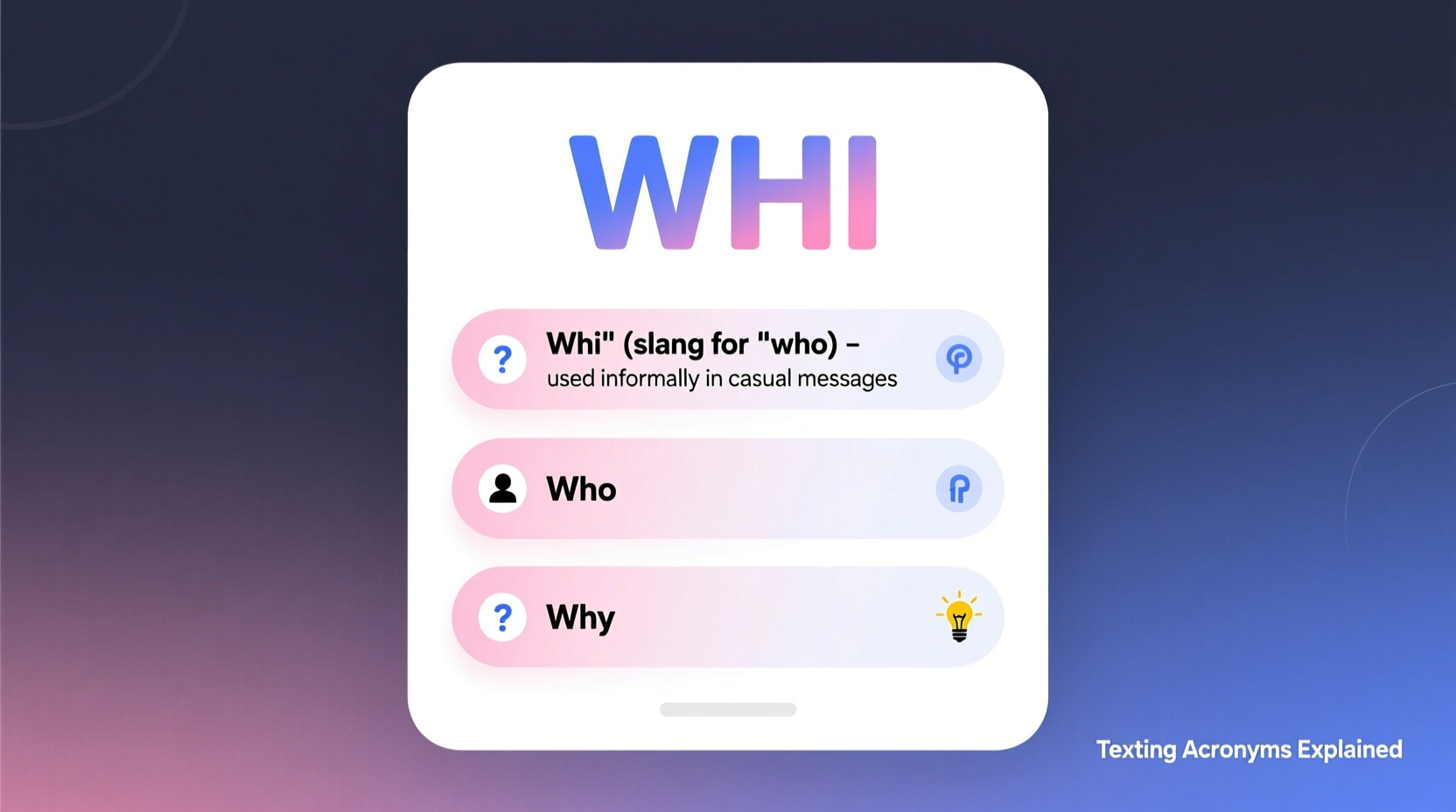
At first glance, “whi” appears incomplete—missing the final letter of common words like “why” or “which.” However, in casual texting, users often drop letters for speed, leading to shortened forms. In most cases, “whi” is a typo or phonetic abbreviation of “why.” It’s used interchangeably with “why” in informal chats, particularly among younger demographics who prioritize typing efficiency over spelling accuracy.
For example:
- “Whi u late?” = “Why are you late?”
- “Whi did he say that?” = “Why did he say that?”
While not officially recognized in standard dictionaries, “whi” has gained traction in text-based conversations where brevity is key. It’s more commonly seen in quick replies, social media comments, and group chats than in formal messaging or professional correspondence.
Origins and Evolution of Texting Acronyms
The use of abbreviated language in digital communication dates back to the early days of SMS, when character limits and predictive text encouraged users to shorten words. Over time, these shortcuts evolved into a cultural shorthand, especially with the rise of smartphones and instant messaging apps.
Acronyms like “LOL” (laugh out loud), “SMH” (shaking my head), and “ICYMI” (in case you missed it) have become embedded in everyday language. Similarly, “whi” follows this trend—not as a standardized acronym, but as a product of linguistic adaptation in informal settings.
Linguists note that such variations often emerge from phonetic spelling, autocorrect errors, or generational speech patterns. For instance, some speakers pronounce “why” as “whai” or “wai,” which may influence how they spell it in texts. This fluidity reflects how language naturally shifts in response to technology and social behavior.
“Digital communication rewards speed and familiarity. Abbreviations like ‘whi’ aren’t mistakes—they’re adaptations to a faster conversational rhythm.” — Dr. Lena Torres, Sociolinguist at Boston University
Common Texting Acronyms and Their Meanings
To better understand where “whi” fits into the broader landscape of texting language, here’s a reference table of frequently used acronyms and their definitions:
| Acronym | Meaning | Example Use |
|---|---|---|
| LOL | Laugh out loud | “That meme was hilarious LOL” |
| BRB | Be right back | “BRB, grabbing food” |
| SMH | Shaking my head | “He forgot his keys again… SMH” |
| ICYMI | In case you missed it | “ICYMI, the concert sold out” |
| NGL | Not gonna lie | “NGL, I was impressed” |
| TBH | To be honest | “TBH, I didn’t expect that” |
| AFK | Away from keyboard | “AFK for 10 mins” |
While “whi” doesn’t appear in formal acronym lists, it functions similarly to these entries—conveying meaning quickly in a context-dependent way.
How to Interpret Ambiguous Texts: A Step-by-Step Guide
Receiving a confusing message like “whi” can disrupt communication. To decode unclear texts effectively, follow this five-step process:
- Assess the context. Look at the full message and recent conversation history. Is the tone questioning or surprised? That supports “whi” meaning “why.”
- Check for typos. Consider whether the sender might have mistyped “why” or “which.” Autocorrect errors are common.
- Consider the relationship. Close friends or peers are more likely to use informal shorthand. Colleagues or formal contacts probably wouldn’t use “whi.”
- Look for patterns. Has the person used similar abbreviations before? If they often write “u” instead of “you,” “whi” fits their style.
- Ask for clarification. If still unsure, respond with a light-hearted “Did you mean ‘why’?” to confirm without embarrassment.
This method reduces misunderstandings and keeps conversations flowing smoothly—even when faced with cryptic abbreviations.
Real-Life Example: Decoding a Confusing Message
Sarah received a text from her friend Mia: “whi didn’t u tell me earlier??” At first, Sarah paused—was “whi” a new slang term? A typo? She recalled that Mia often uses shorthand like “rn” (right now) and “idk” (I don’t know). Given the tone and structure, Sarah inferred “whi” meant “why.” She replied, “Sorry! Forgot to check my phone,” and the conversation continued without issue.
This scenario illustrates how familiarity with texting norms and contextual awareness can prevent miscommunication—even with non-standard spellings.
Frequently Asked Questions
Is “whi” an official acronym?
No, “whi” is not an officially recognized acronym. It’s typically a phonetic or typographical variation of “why,” used informally in texting and social media.
Can “whi” mean something else besides “why”?
In rare cases, “whi” could be a typo for “which” or part of a username, hashtag, or brand name. However, in conversational texting, it almost always stands in for “why.”
Should I use “whi” in professional messages?
No. While acceptable among friends or in casual group chats, “whi” is too informal and ambiguous for emails, work messages, or academic writing. Always use proper spelling in professional contexts.
Checklist: Best Practices for Using Texting Acronyms
- ✅ Use acronyms only with people familiar with your communication style.
- ✅ Avoid abbreviations in formal or professional messages.
- ✅ Be mindful of context—what makes sense to one person may confuse another.
- ✅ Don’t assume everyone knows niche or emerging slang.
- ✅ When in doubt, spell it out.
Conclusion: Mastering the Language of Digital Communication
Language is always evolving, and texting is no exception. What starts as a typo or playful abbreviation—like “whi”—can become part of everyday digital dialogue. Understanding these nuances helps you communicate more effectively, avoid misunderstandings, and stay connected in a world where messages move at lightning speed.
As new terms emerge, the key is balance: embrace convenience without sacrificing clarity. Whether you're decoding a cryptic text or choosing your own words, thoughtful communication builds stronger connections. Stay curious, stay adaptable, and don’t hesitate to ask, “What do you mean by that?”—even if the message just says “whi.”




 浙公网安备
33010002000092号
浙公网安备
33010002000092号 浙B2-20120091-4
Comments
No comments yet. Why don't you start the discussion?