
In an era where digital identity is as valuable as physical assets, account compromise attacks have become one of the most insidious threats in cybersecurity. Unlike traditional malware or ransomware, which often trigger immediate alarms, compromised accounts operate under the radar—mimicking legitimate behavior while quietly exfiltrating data, escalating privileges, or launching further attacks. The challenge isn’t just stopping these breaches; it’s recognizing them before they cause irreversible damage. What makes these attacks so difficult to detect? The answer lies in their design: they exploit trust, blend into normal activity, and evolve faster than many defenses can adapt.
The Illusion of Legitimacy: Why Normal Behavior Hides Malicious Activity
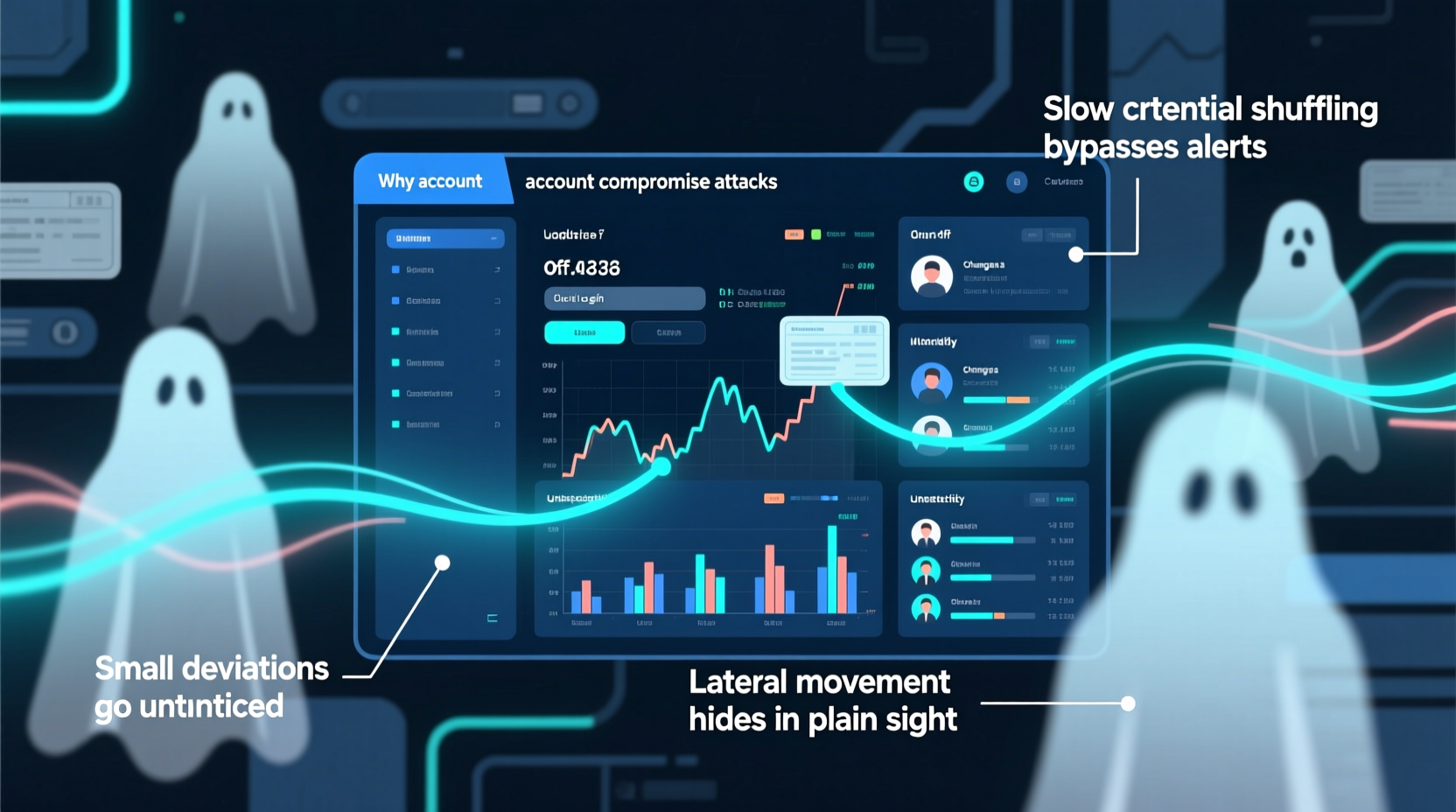
One of the primary reasons account compromise attacks evade detection is that attackers use valid credentials. Once a hacker gains access through phishing, credential stuffing, or social engineering, they log in just like any authorized user. This means their traffic doesn’t trigger perimeter-based alerts. Firewalls, intrusion detection systems (IDS), and even endpoint protection tools may not flag anything suspicious because, from a technical standpoint, everything appears normal.
For example, if an attacker logs into a corporate email account from a device with the correct IP geolocation and at a typical working hour, automated systems see no red flags. They’re not brute-forcing passwords or scanning networks—they’re reading emails, downloading files, and replying to messages, all actions indistinguishable from regular user behavior.
Advanced Evasion Tactics Used by Attackers
Modern attackers don’t rush. After gaining access, they often enter a reconnaissance phase, carefully mapping out the environment without triggering alerts. They avoid sudden privilege escalation or mass data downloads. Instead, they move laterally across systems using stolen session tokens, pass-the-hash techniques, or OAuth token abuse—all methods designed to maintain persistence while minimizing noise.
Some attackers employ time-delayed actions, spreading malicious activities over weeks or months. For instance, an attacker might download only a few sensitive documents per week, staying below detection thresholds set by data loss prevention (DLP) tools. Others manipulate multi-factor authentication (MFA) fatigue attacks, bombarding users with push notifications until they accidentally approve access.
“Attackers aren’t breaking in anymore—they’re logging in. And once inside, they act like ghosts.” — Kevin Mandia, CEO of Mandiant
Limitations of Traditional Security Tools
Many organizations rely on signature-based detection, rule-based monitoring, or static thresholds to identify threats. However, these approaches struggle with adaptive adversaries. Signature-based systems fail against zero-day exploits or novel attack vectors. Rule-based engines generate high false-positive rates, leading to alert fatigue. And threshold-based triggers (e.g., “more than 50 files downloaded”) can be easily bypassed by slow, deliberate data exfiltration.
Moreover, security information and event management (SIEM) systems often lack context. A single failed login might seem insignificant, but when correlated with multiple low-volume anomalies across departments, it could indicate a coordinated campaign. Without advanced analytics and machine learning, such patterns remain invisible.
| Security Tool | Strengths | Weaknesses Against Account Compromise |
|---|---|---|
| Firewall | Blocks unauthorized network access | Cannot detect authenticated insider threats |
| Antivirus | Detects known malware signatures | Ineffective against credential theft or living-off-the-land attacks |
| SIEM | Aggregates logs for analysis | Limited real-time behavioral insight; high false positives |
| MFA | Adds authentication layer | Vulnerable to MFA fatigue, phishing proxies, and token theft |
Behavioral Biometrics and User Entity Analytics: A New Frontier
To combat stealthy account compromises, forward-thinking organizations are turning to User and Entity Behavior Analytics (UEBA). These systems establish baselines of normal user behavior—typing speed, mouse movements, typical login times, frequently accessed resources—and flag deviations.
For example, if an employee who usually works from 9 AM to 5 PM suddenly accesses financial records at 3 AM from a foreign country, UEBA systems can raise an alert. Similarly, if a user starts accessing HR databases despite having no historical connection to that department, the system recognizes this as anomalous.
However, even UEBA has limitations. Sophisticated attackers study target behavior before acting. In some cases, they’ll observe a user’s routine for days via compromised devices before making a move. Additionally, remote work and flexible schedules make it harder to define “normal” behavior, increasing the risk of false positives.
Mini Case Study: The Silent Breach at Finova Credit Union
In 2022, Finova Credit Union experienced a prolonged data breach that went undetected for nearly four months. An attacker had obtained an employee’s credentials through a phishing campaign and used them to access customer loan applications. Because the login originated from a familiar region and occurred during business hours, no alerts were triggered.
The attacker slowly exported small batches of personally identifiable information (PII), never exceeding 200 records per day—well below the DLP threshold. It wasn’t until a customer reported fraudulent loan activity that internal investigators traced the source back to a seemingly legitimate staff account. Forensic analysis revealed the original credentials had been sold on a dark web marketplace after a third-party service breach.
This case highlights how layered trust, lack of behavioral monitoring, and insufficient anomaly thresholds allowed a serious compromise to persist unnoticed.
Step-by-Step Guide to Improving Detection Capabilities
While no system is foolproof, organizations can significantly reduce the window of exposure by adopting a proactive detection strategy. Here’s a practical sequence to enhance visibility into potential account compromises:
- Implement Multi-Factor Authentication (MFA): Use phishing-resistant methods like FIDO2 security keys instead of SMS-based codes.
- Enable Logging and Monitoring: Ensure all authentication attempts, file accesses, and administrative actions are logged centrally.
- Deploy UEBA Solutions: Integrate tools that analyze user behavior for subtle deviations.
- Conduct Regular Access Reviews: Audit user permissions quarterly to remove unnecessary privileges.
- Simulate Phishing Campaigns: Train employees to recognize social engineering attempts through controlled tests.
- Use Threat Intelligence Feeds: Monitor known compromised credentials databases (e.g., Have I Been Pwned) to identify exposed accounts.
- Establish Incident Response Playbooks: Define clear steps for investigating suspicious logins or data access spikes.
Frequently Asked Questions
Can MFA prevent all account compromise attacks?
No. While MFA greatly improves security, attackers use techniques like MFA fatigue, man-in-the-middle phishing proxies, or SIM swapping to bypass it. Phishing-resistant MFA (e.g., hardware tokens) offers stronger protection than app- or SMS-based methods.
How do attackers maintain access after compromising an account?
They often create backdoor accounts, install persistent apps with API access, or steal refresh tokens. Some configure mail forwarding rules to silently siphon communications without altering primary content.
Are personal accounts also at risk?
Yes. Personal email, social media, and banking accounts are prime targets. Reused passwords and lack of MFA make individuals vulnerable, especially when linked to other services through single sign-on.
Action Plan: Strengthening Your Defense Posture
Account compromise attacks thrive in environments where trust is assumed and behavior goes unmonitored. The key to detection isn’t just better tools—it’s shifting from a perimeter-focused mindset to continuous verification. Organizations must assume breaches will happen and focus on early identification and rapid response.
Start by auditing your current authentication practices. Are you enforcing strong password policies? Is MFA enabled across critical systems? Do you monitor for anomalous access patterns? Then, invest in solutions that provide contextual awareness—not just raw logs, but intelligent insights that connect the dots between seemingly unrelated events.
Individuals should take responsibility too. Use unique passwords for every account, enable MFA wherever possible, and stay vigilant about unsolicited login prompts. Cybersecurity is no longer just an IT issue—it’s a shared responsibility.




 浙公网安备
33010002000092号
浙公网安备
33010002000092号 浙B2-20120091-4
Comments
No comments yet. Why don't you start the discussion?