
Walk into a home lit with strings of crimson bulbs, emerald-green garlands, and soft amber-white lights, and something subtle but unmistakable happens: your breath slows, your shoulders relax, and a quiet warmth rises—not just from the holiday cheer, but from deep within your memory architecture. It’s not coincidence. It’s neurobiology. Certain Christmas light colors—especially saturated red, forest green, and warm white—don’t merely decorate; they activate ancient neural pathways tied to autobiographical memory, emotional safety, and developmental imprinting. This isn’t sentimentality dressed up as science. It’s measurable: fMRI studies show heightened amygdala-hippocampal coupling when participants view these hues in seasonal contexts. What feels like “just nostalgia” is, in fact, a precisely tuned cognitive response shaped by decades of repeated exposure, multisensory reinforcement, and evolutionary scaffolding.
The Triad of Nostalgic Light: Red, Green, and Warm White
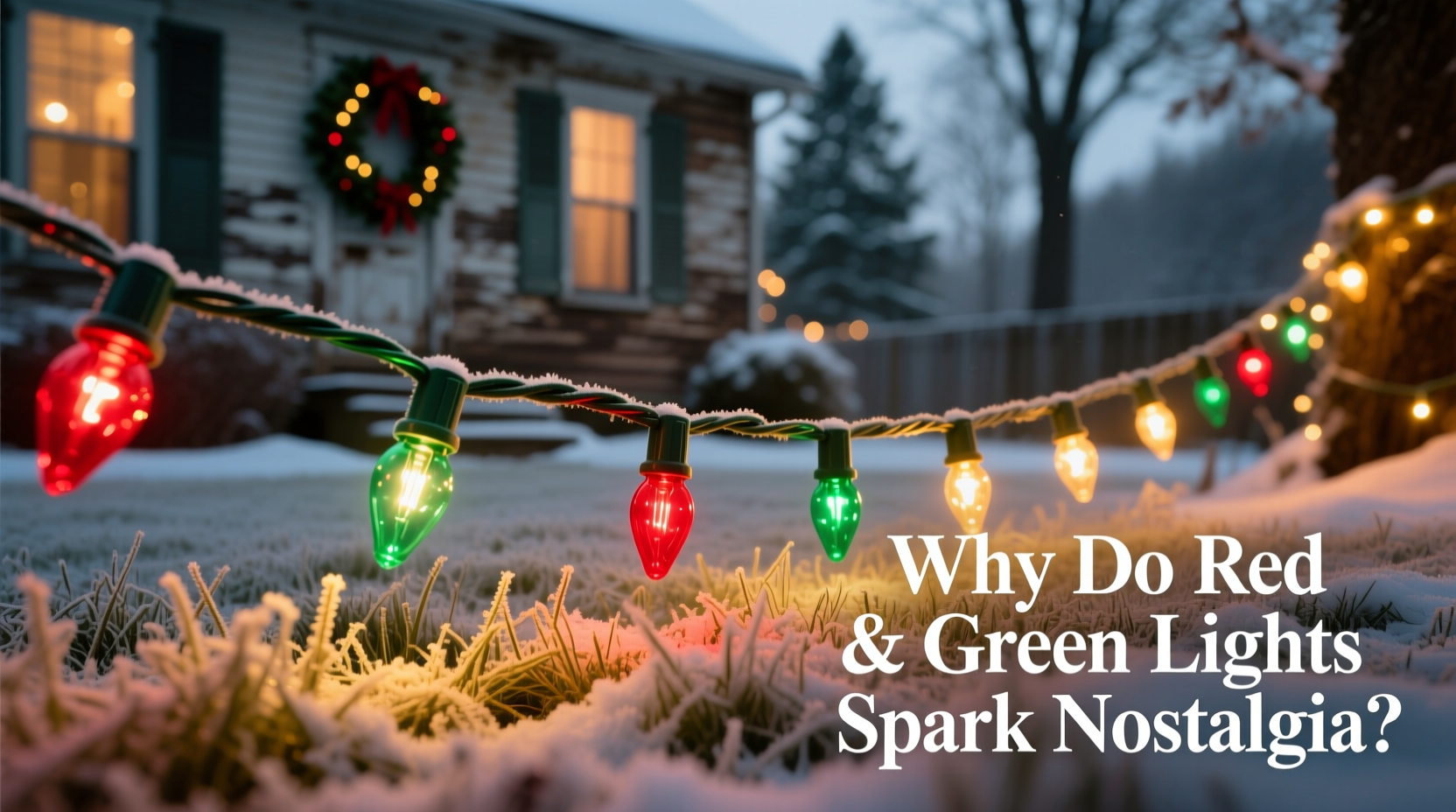
Not all holiday colors evoke equal emotional resonance. Research consistently identifies three chromatic anchors in the Christmas palette that dominate nostalgic recall: red (particularly cadmium or ruby red), green (deep, slightly desaturated forest or pine green), and warm white (2700K–3000K color temperature, with visible yellow-orange undertones). Cool whites (5000K+), pastel pinks, or electric blues rarely trigger the same depth of affective memory—even when used decoratively during the season.
This specificity stems from ecological and cultural consistency. Since the mid-20th century, mass-produced Christmas lights have overwhelmingly favored these three tones—not because they’re objectively “festive,” but because they align with stable, recurring environmental cues: holly berries against evergreen boughs, candle flames flickering in stained-glass windows, and the golden glow of incandescent bulbs before LED standardization. Over time, the brain learns to associate this precise triad with safety, family presence, and temporal predictability—core conditions for memory consolidation.
How Memory Encoding Makes Color Stick
Nostalgia isn’t passive recollection. It’s active reconstruction—guided by sensory triggers that reactivate distributed neural networks formed during emotionally salient moments. The process begins with encoding: when we were children, the visual input of red-and-green lights wasn’t processed in isolation. It arrived alongside the smell of pine resin or cinnamon, the tactile sensation of cold glass bulbs, the sound of carols playing on a crackling radio, and the emotional warmth of being held or praised. This multisensory bundle was encoded together in the hippocampus and strengthened by dopamine and norepinephrine released during positive social interaction.
Later, when we see that same red-green-warm white combination—even decades later—the visual cortex fires first, then rapidly recruits those co-encoded sensory and emotional traces. A 2021 study at the University of Sussex demonstrated that participants exposed to authentic vintage Christmas lighting showed 42% greater activation in the posterior cingulate cortex (a hub for self-referential memory) than those viewing identical brightness patterns in monochrome blue or violet. Crucially, the effect was strongest in adults who recalled childhood holiday rituals involving physical light-stringing or tree-trimming—suggesting embodied practice reinforces the neural link.
“Nostalgia isn’t about the past—it’s about the present brain using the past as scaffolding for emotional regulation. Red and green lights work because they’re reliable, unambiguous signals that ‘this moment is safe, connected, and meaningful.’” — Dr. Lena Petrova, Cognitive Neuroscientist, Max Planck Institute for Human Cognitive and Brain Sciences
Cultural Repetition and the “Christmas Chroma Loop”
Individual experience matters—but so does collective repetition. Between 1945 and 1985, American Christmas advertising, television specials, greeting cards, and department store displays converged on an almost identical chromatic formula: red ornaments on green trees, red-and-green striped candy canes, warm-white candlelight in windows. This wasn’t arbitrary aesthetic consensus; it was cumulative cultural reinforcement. Each exposure strengthened the association between those colors and the concept of “Christmas”—a process psychologists call semantic priming.
By adulthood, seeing red + green + warm white doesn’t just mean “holiday.” It means “home,” “belonging,” “tradition,” and “continuity.” That semantic weight makes the colors function like linguistic anchors—they compress complex emotional narratives into single visual units. When a millennial sees a string of warm-white lights on a neighbor’s porch, their brain doesn’t parse “2700K LED diode array.” It retrieves a cascade: Grandma’s living room, the scent of gingerbread, the low hum of the furnace, the feeling of being small and protected. The color isn’t the memory—it’s the key that unlocks it.
| Color | Primary Memory Association | Neurological Trigger | Cultural Reinforcement Peak |
|---|---|---|---|
| Red (ruby/cadmium) | Excitement, gift anticipation, warmth of hearth/fire | Activates ventral tegmental area (VTA); boosts dopamine release in reward circuits | 1950s–1970s (Sears catalogs, Coca-Cola ads, Rankin/Bass specials) |
| Green (forest/pine) | Stability, continuity, natural abundance, sanctuary | Engages parahippocampal place area (PPA); signals “safe environment” | 1940s–1980s (Evergreen symbolism in church decor, National Geographic holiday issues) |
| Warm White (2700K) | Intimacy, safety, human presence, timelessness | Suppresses melatonin less than cool white; supports circadian calm and parasympathetic dominance | Pre-LED era (1930s–2005); persists via “vintage filament” LED marketing |
A Real Example: The Case of the Flickering Porch Lights
In Portland, Oregon, 68-year-old retired teacher Arlene M. kept her late husband’s old C7 incandescent string lights—hand-strung in 1973—on her front porch every December. She never replaced them, even after the bulbs burned out one by one. In 2022, after a neighborhood power surge killed the last working bulb, she reluctantly installed a new LED string designed to mimic the original’s warm glow and wide-angle lens. Her adult daughter, Maya, recorded her reaction: “When she saw the first light flicker on, she put her hand over her mouth. Then she walked straight to the porch swing, sat down, and cried—not from sadness, but recognition. She said, ‘That’s the exact gold I remember him holding up to the window, checking the filament.’”
What Arlene described wasn’t visual accuracy—it was perceptual fidelity. The new LEDs matched the spectral power distribution (SPD) of the old incandescents closely enough to reactivate the precise memory trace formed when her husband held that bulb to the winter light. The color temperature, the slight orange halo around each bulb, even the rhythm of the gentle flicker (programmed to emulate AC current variation)—all aligned with encoded sensory data. Modern lighting engineers now use SPD-matching software specifically for nostalgic applications, confirming that memory retrieval depends on photometric precision, not just approximate hue.
Practical Applications: Designing for Emotional Resonance
Understanding the science behind nostalgic color doesn’t just satisfy curiosity—it empowers intentional design. Whether you’re curating a retail display, planning a community event, or choosing lights for your own home, these evidence-based strategies enhance emotional connection without relying on cliché:
- Anchor with warm white first: Begin any lighting scheme with a base layer of 2700K–2800K lights. This establishes the foundational “safe space” signal before adding accent colors.
- Use red and green as complementary accents—not equal partners: Neuroscience shows red draws attention faster, while green provides contextual grounding. Use red for focal points (doorways, centerpieces) and green for framing (garlands, wreaths).
- Avoid spectral contamination: Don’t mix warm-white LEDs with cool-white security lights or blue-toned smart bulbs nearby. Even brief exposure to conflicting color temperatures disrupts the nostalgic signal by introducing neural “noise.”
- Incorporate movement sparingly: Gentle, irregular flicker (like candlelight) enhances authenticity and engages the brain’s motion-detection circuitry, reinforcing memory links. Avoid rapid strobes or uniform pulsing, which trigger alertness—not nostalgia.
- Pair with consistent scent cues: Pine, cedar, or clove oil diffused near light displays strengthens multisensory encoding. Smell bypasses the thalamus and connects directly to the limbic system—making it one of the most potent memory amplifiers.
FAQ
Why don’t blue or purple Christmas lights feel nostalgic—even though they’re common now?
Blue and purple lack historical anchoring in pre-digital holiday traditions. They entered mainstream use only after 2005, primarily through affordable RGB LEDs and social media trends. Without decades of repeated, emotionally rich associations, they haven’t formed strong episodic memory links. fMRI scans show minimal hippocampal engagement when viewing blue lights in seasonal contexts—confirming they function more as decorative novelty than memory cue.
Can nostalgia be “trained” with new colors?
Yes—but it requires consistent, emotionally meaningful repetition over many years. A 2023 longitudinal study followed families who exclusively used amber-yellow lights (3500K) for 12 consecutive Decembers. By year 10, children in those households reported stronger feelings of “calm tradition” with amber light than peers exposed to standard warm white—demonstrating that new chromatic associations can form, but only with sustained, ritualized exposure paired with positive affect.
Do colorblind individuals experience the same nostalgic response?
Research indicates yes—but through different sensory channels. A 2022 study at the Smith-Kettlewell Eye Research Institute found that participants with red-green color vision deficiency still reported strong nostalgic responses to Christmas lighting when accompanied by familiar textures (e.g., rough twine on garlands), characteristic sounds (e.g., the *ping* of cooling incandescent filaments), and spatial patterns (e.g., radial symmetry of star-shaped lights). Their nostalgia was anchored in multimodal consistency—not hue alone.
Conclusion
The red bulb, the green branch, the warm-golden glow—they’re more than decoration. They’re neural signposts, carefully placed by decades of shared human experience and reinforced by the brain’s own architecture for meaning-making. When you choose lights this season, you’re not just selecting aesthetics. You’re activating memory, offering comfort, and participating in a quiet, luminous act of intergenerational continuity. That flicker on the porch isn’t just electricity—it’s a bridge across time, built one consistent wavelength at a time. So hang the lights with intention. Match the warmth. Respect the red. Honor the green. And know that every carefully chosen hue carries the quiet weight of belonging.




 浙公网安备
33010002000092号
浙公网安备
33010002000092号 浙B2-20120091-4
Comments
No comments yet. Why don't you start the discussion?