
The circle is one of the most fundamental shapes in nature and mathematics. From planetary orbits to wheels, from clocks to compasses, circular forms dominate both science and daily life. Yet few stop to ask: why exactly does a full circle measure 360 degrees? It’s a number that feels arbitrary—why not 100, or 400, or even 365 like the days in a year? The answer lies at the intersection of ancient astronomy, Babylonian mathematics, and the practical needs of early civilizations. Understanding why we use 360 degrees reveals not just a quirk of history, but a brilliant convergence of observation, calculation, and utility.
The Origins in Ancient Mesopotamia
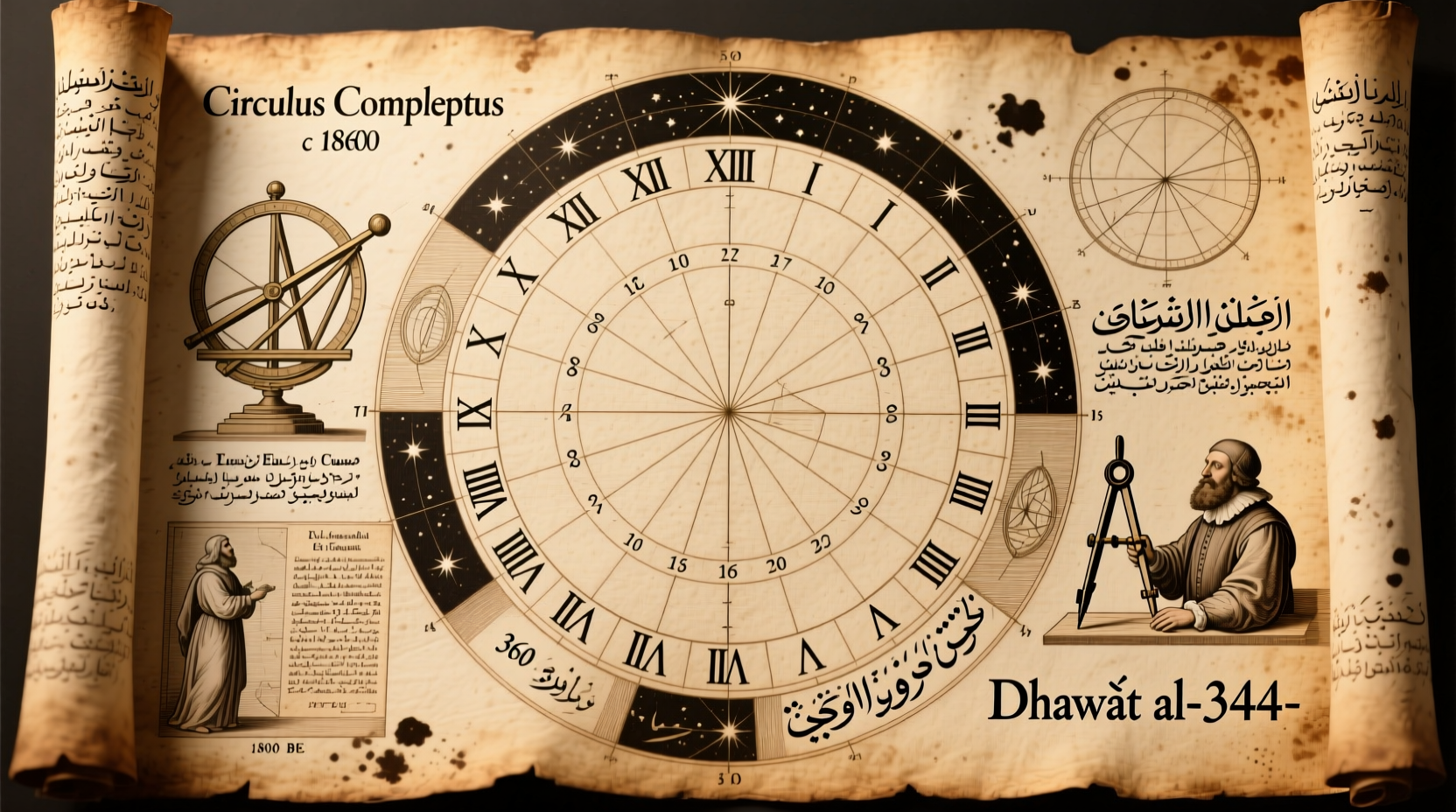
The story begins over 4,000 years ago in Mesopotamia, where the Sumerians and later the Babylonians developed one of the earliest known advanced mathematical systems. Unlike modern societies, which use a base-10 (decimal) system derived from our ten fingers, the Babylonians used a base-60 (sexagesimal) numeral system. This choice was not random—it stemmed from the fact that 60 is a highly composite number, meaning it has many divisors: 1, 2, 3, 4, 5, 6, 10, 12, 15, 20, 30, and 60. This made arithmetic operations like division far more manageable without fractions.
Astronomy played a central role in Babylonian society. Priests tracked celestial movements to create calendars, predict seasonal changes, and interpret omens. They observed that the Sun appeared to complete a full circuit across the sky in approximately 360 days—close enough to the actual solar year of about 365.25 days that 360 became a convenient approximation. By dividing the circular path of the Sun into 360 equal parts, each part represented one day’s journey. Thus, the concept of dividing a circle into 360 degrees likely emerged from this astronomical model.
Mathematical Advantages of 360
While 360 may have originated from observational astronomy, its staying power comes from its mathematical convenience. A key reason for its adoption and persistence is its divisibility. Consider how easily 360 can be split into common geometric fractions:
- Half of 360 = 180° (a straight line)
- One-third = 120° (equilateral triangle interior angle)
- One-fourth = 90° (right angle)
- One-sixth = 60° (hexagon internal angle)
- One-eighth = 45°
- One-twelfth = 30°
This makes 360 ideal for constructing polygons, measuring angles in architecture, navigation, and trigonometry. Compare this to 100 degrees in a circle: 100 doesn’t divide evenly by 3 or 6, creating awkward fractional results. The number 360, by contrast, simplifies calculations and allows for precise subdivisions without recurring decimals.
“The choice of 360 degrees was not accidental. It was a stroke of genius—a number that balanced astronomical observation with mathematical elegance.” — Dr. Alan F. Zundel, Historian of Mathematics
Adoption by Greek and Islamic Scholars
The Babylonian system did not remain isolated. It was adopted and refined by later civilizations, most notably the Greeks. Around the 3rd century BCE, astronomers like Hipparchus of Nicaea used Babylonian data to develop early trigonometric tables. He divided the circle into 360 parts and applied this framework to calculate chords—precursors to modern sine functions. Ptolemy, in his seminal work Almagest (2nd century CE), formalized this system and used 360-degree circles to map the heavens with remarkable accuracy.
Centuries later, Islamic mathematicians preserved and expanded upon these traditions during the Golden Age of Islam. Scholars such as Al-Khwarizmi and Al-Biruni used the 360-degree system in astronomical calculations and instrument design. Their works were eventually translated into Latin and became foundational texts in medieval European universities, cementing the 360-degree standard in Western science.
Alternative Systems: Radians and Gradians
Despite its dominance, the 360-degree system is not the only way to measure angles. In higher mathematics, particularly calculus and physics, the radian is the preferred unit. One radian is defined as the angle subtended at the center of a circle by an arc equal in length to the radius. Since the circumference of a circle is \\(2\\pi r\\), a full circle equals \\(2\\pi\\) radians—approximately 6.283 radians. While less intuitive for everyday use, radians simplify equations involving derivatives and integrals of trigonometric functions.
Another alternative is the gradian (or gon), used primarily in surveying and some European countries. In this system, a right angle is 100 gradians, making a full circle 400 gradians. Though decimal-friendly, it never gained widespread adoption outside niche fields.
| System | Full Circle | Right Angle | Primary Use |
|---|---|---|---|
| Degrees | 360° | 90° | Everyday geometry, navigation, education |
| Radians | \\(2\\pi \\approx 6.283\\) | \\(\\pi/2 \\approx 1.571\\) | Advanced mathematics, physics |
| Gradians | 400 gon | 100 gon | Surveying, some engineering |
Timeline of Angular Measurement Development
The evolution of angular measurement reflects broader advances in human knowledge. Here's a concise timeline highlighting key milestones:
- c. 1800 BCE: Babylonians use a base-60 system and approximate the solar year as 360 days, laying the foundation for 360-degree circles.
- c. 250 BCE: Greek astronomer Hipparchus adopts the 360-degree system for chord tables and celestial mapping.
- 150 CE: Ptolemy publishes the Almagest, standardizing the 360-degree circle in astronomical models.
- 8th–10th century CE: Islamic scholars refine trigonometry using degrees, preserving and expanding Greek and Babylonian knowledge.
- 17th century: Mathematicians like Roger Cotes and Leonhard Euler promote the radian as a natural unit for calculus.
- 19th century: The gradian is introduced with the metric system but sees limited adoption.
- 20th century–present: Degrees remain dominant in education and navigation; radians rule in theoretical sciences.
Frequently Asked Questions
Why didn't we switch to 400 degrees when the metric system was introduced?
The metric system did inspire the gradian (400 per circle), but degrees were already deeply embedded in global navigation, cartography, and education. Changing such a fundamental unit would have required massive retraining and recalibration of instruments, so the transition never occurred.
Is 360 divisible by all numbers up to 10?
Almost. 360 is divisible by 1, 2, 3, 4, 5, 6, 8, 9, and 10—but not by 7. This near-perfect divisibility is one reason it remains useful despite its historical origins.
Do any cultures use different circle measurements?
Yes. Some Indigenous and ancient cultures used different divisions based on lunar cycles or religious symbolism. However, due to globalization and scientific standardization, the 360-degree system is now nearly universal.
A Modern Perspective: Why 360 Still Matters
In today’s digital world, where computers process angles in radians and GPS uses decimal degrees, the legacy of 360 persists. Pilots navigate using 360-degree headings. Engineers design gears and mechanisms calibrated in degrees. Students learn geometry using protractors marked in 360 increments. Even smartphone orientation sensors report rotation in degrees.
The endurance of 360 degrees is a testament to the power of practical design. It was born from observation, shaped by mathematical necessity, and sustained by cultural continuity. While radians offer theoretical purity, degrees offer accessibility. As long as humans need to visualize and communicate angles intuitively, 360 will remain relevant.
Conclusion
The 360-degree circle is more than a convention—it’s a bridge between ancient wisdom and modern science. Its roots stretch back to Babylonian stargazers who saw the sky as a great wheel turning once a year. Its survival owes much to its unmatched practicality in dividing space and time. Whether you're measuring a slice of pie or plotting a spacecraft’s trajectory, the 360-degree system quietly supports your work.




 浙公网安备
33010002000092号
浙公网安备
33010002000092号 浙B2-20120091-4
Comments
No comments yet. Why don't you start the discussion?