
The Glock pistol has become a fixture in law enforcement, military units, and civilian self-defense arsenals worldwide. Since its introduction in 1982, the Austrian-made firearm has earned a reputation for near-indestructible reliability under extreme conditions. But what exactly makes a Glock so dependable? It’s not just marketing hype or brand loyalty—it’s a combination of thoughtful design, advanced materials, and rigorous testing that sets the Glock apart from most other handguns on the market.
This article breaks down the engineering principles, manufacturing choices, and operational history that explain why Glocks consistently perform when it matters most.
The Simplicity of Design: Less Is More
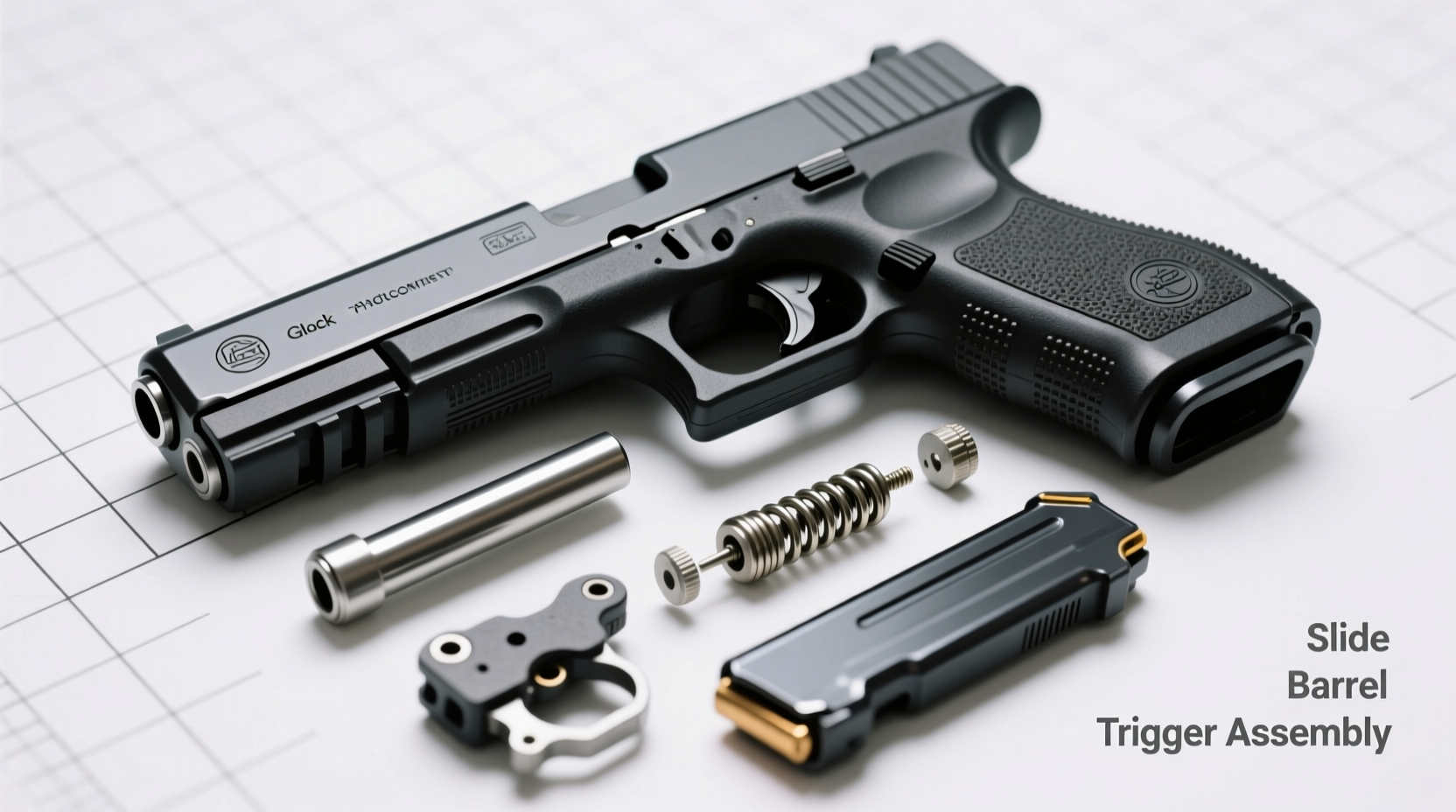
At the heart of the Glock’s reliability is an intentionally minimalist design philosophy. Unlike many traditional pistols with external hammers, safety levers, and complex disassembly procedures, the Glock uses a striker-fired system with no external safety controls. This simplification reduces potential points of failure.
The trigger mechanism operates on a \"safe action\" system—a series of internal safeties built directly into the trigger and firing pin. These include:
- Firing Pin Safety: Prevents the pin from moving unless the trigger is fully depressed.
- Drop Safety: Ensures the pistol won’t discharge if dropped.
- Trigger Safety: A small lever inside the trigger prevents accidental pulls.
Because these safeties are passive—meaning they function automatically without user input—they eliminate the risk of human error during high-stress situations.
Advanced Polymer Frame: Lightweight and Durable
One of the most revolutionary aspects of the original Glock 17 was its use of polymer (specifically, a reinforced nylon called \"Polymer 2\") for the frame. At the time, most service pistols used steel or aluminum frames. The switch to polymer reduced weight by nearly 30%, improved corrosion resistance, and allowed for greater design flexibility.
Polymer frames don’t rust, are highly resistant to impact, and absorb recoil better than metal. They also allow for overmolding, which gives Glock its signature ergonomic grip texture—no separate checkering or stippling required.
Critics once questioned the strength of plastic frames, but decades of field use have proven their durability. Glocks have been submerged in mud, dropped from heights, and fired tens of thousands of rounds with minimal frame wear.
“Glock’s polymer frame isn’t just about saving weight—it’s about creating a more resilient platform that performs in environments where steel would fail.” — Col. Robert Young, Retired USMC Armorer
The Role of the Austro-Dornier Barrel and Locking System
Glock uses a modified version of the short-recoil Browning tilting barrel system, but with a critical innovation: the barrel is made from high-grade steel with a proprietary nitriding process known as Lothar-Werk Melonite treatment. This creates a surface hardness exceeding 65 HRC, making it extremely resistant to wear and corrosion.
The locking mechanism relies on two rectangular lugs at the top of the barrel that lock into the slide. After firing, the barrel moves rearward slightly before unlocking—ensuring consistent extraction and ejection. The simplicity and precision of this system contribute significantly to long-term reliability.
Unlike some competitors that use roll pins or complex locking inserts, Glock’s barrel assembly involves minimal parts and requires no headspacing adjustments. This means less maintenance and fewer opportunities for mechanical issues.
Real-World Testing: Case Study from Law Enforcement
In 2016, the Los Angeles County Sheriff’s Department conducted a side-by-side reliability test between the Glock 22 (.40 S&W) and two other major brands used in their fleet. Officers were instructed to fire 5,000 rounds per firearm without cleaning or lubrication. All guns were exposed to sand, water, and extreme temperature cycles.
Results:
| Firearm Model | Stoppages | Most Common Issue |
|---|---|---|
| Glock 22 | 3 | Minor extraction delay |
| Brand X Full-Size | 14 | Failure to feed |
| Brand Y Compact | 22 | Slide jam due to carbon buildup |
The Glock outperformed both competitors significantly. One deputy noted: “I carried my Glock through three floods, a desert patrol, and didn’t clean it for six weeks. It never missed a beat.”
This kind of real-world resilience is not accidental—it’s engineered into every component.
Maintenance Requirements: What You Need to Know
While Glocks are famously low-maintenance, they still require basic care to ensure peak performance. However, compared to other semi-automatics, their upkeep is remarkably simple.
A typical maintenance routine includes:
- Field strip the pistol (trigger pull + takedown lever).
- Clean the barrel, chamber, and slide rails with a bore brush and patch.
- Wipe down the frame and check for debris in the rail channels.
- Lubricate key contact points: slide rails, barrel hood, and trigger mechanism.
- Reassemble and perform a dry-fire check.
Many users report going 5,000+ rounds between full cleanings with no issues—though regular light maintenance is still recommended.
Manufacturing Precision and Quality Control
Glock’s factory in Deutsch-Wagram, Austria, employs computer-controlled machining and laser inspection systems to maintain tight tolerances across all components. Each part is serialized and tracked through the production line, ensuring consistency.
Crucially, Glock uses a \"match-grade\" approach to barrel and slide fitment. While the pistol isn’t marketed as a competition firearm, the precision of the slide-to-frame interaction reduces wobble and enhances cycling consistency.
Moreover, every completed pistol undergoes a live-fire test before leaving the factory. If a round fails to cycle properly during this phase, the unit is rejected and disassembled for review. This level of quality control is rare among mass-produced handguns.
Common Myths About Glock Reliability
Despite its reputation, several myths persist about the Glock’s operation and limitations:
- Myth: Glocks can \"cook off\" if left in hot cars.
Truth: Modern ammunition is far more heat-resistant than urban legends suggest. There are no verified cases of a Glock discharging due to ambient heat alone. - Myth: The trigger is too stiff or dangerous.
Truth: The 5.5–6 lb trigger pull is consistent and predictable, favored by professionals for controlled accuracy. - Myth: Plastic guns can be smuggled through airports.
Truth: Glocks contain enough metal to be easily detected by scanners. This myth originated in the 1980s and has long been debunked.
FAQ
How many rounds can a Glock last before needing major service?
With proper maintenance, most Glock models can exceed 100,000 rounds. Many police departments retire them after 50,000 rounds as a precaution, even though the pistols often show minimal wear.
Can I use +P ammunition in my Glock?
Yes, most full-size Glocks (Gen 3 and later) are rated for +P ammunition. However, extended use of +P loads will accelerate wear on springs and extractors, so rotate them with standard pressure rounds for longevity.
Do Glocks need to be lubricated?
Yes. While Glocks are more forgiving than other pistols, lack of lubrication increases friction and wear. Focus on the barrel hood, slide rails, and trigger bar for optimal performance.
Checklist: Maximizing Your Glock’s Reliability
To keep your Glock performing like new, follow this practical checklist:
- ✅ Clean after every range session or duty shift
- ✅ Replace recoil spring every 5,000 rounds
- ✅ Inspect extractor and firing pin safety regularly
- ✅ Use high-quality ammunition for training and defense
- ✅ Store in a dry environment with moisture-absorbing packs
- ✅ Practice dry-firing to ensure trigger function
Conclusion
The reliability of the Glock pistol isn’t magic—it’s the result of deliberate engineering, superior materials, and relentless real-world validation. From its polymer frame to its triple-safety trigger system, every feature serves a purpose: to function when needed, without fail.
Whether you're a concealed carrier, law enforcement officer, or home defender, understanding what makes the Glock tick empowers you to maintain it properly and trust it completely. In a world where equipment failures can have life-or-death consequences, the Glock’s track record speaks for itself.




 浙公网安备
33010002000092号
浙公网安备
33010002000092号 浙B2-20120091-4
Comments
No comments yet. Why don't you start the discussion?