
The scent of rain on dry soil—petrichor—is one of nature’s most universally cherished aromas. At the heart of this phenomenon lies a compound called geosmin, responsible for the distinct earthy smell that rises from the ground after rainfall. What makes this odor so evocative is not just its familiarity, but our extraordinary sensitivity to it. Humans can detect geosmin at concentrations as low as 5 parts per trillion—comparable to spotting a single drop of ink in 20 Olympic-sized swimming pools. This acute sensitivity raises a compelling question: why did evolution equip us with such a finely tuned radar for an obscure soil compound?
The Science Behind Geosmin
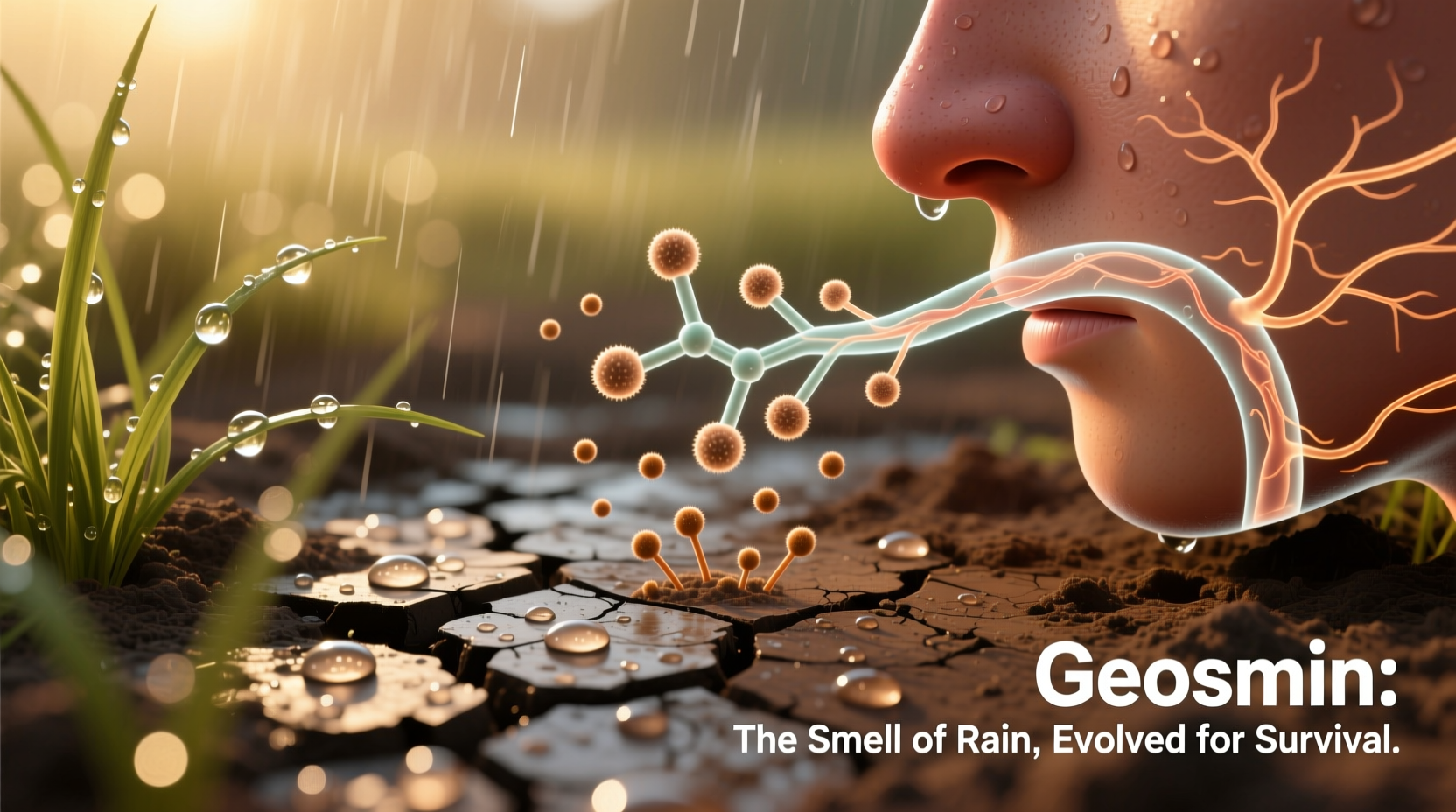
Geosmin, derived from the Greek words *geo* (earth) and *smin* (smell), is a bicyclic alcohol produced primarily by soil-dwelling bacteria, especially *Streptomyces coelicolor*. These microbes are prolific decomposers, breaking down organic matter in the soil and releasing geosmin as a metabolic byproduct. When rain falls on dry ground, tiny air bubbles trap the volatile geosmin molecules and carry them into the air through aerosols—microscopic droplets that disperse the scent widely.
Our ability to perceive geosmin is rooted in the olfactory system. The human nose contains around 400 types of odorant receptors, each tuned to specific molecular structures. Research has shown that a single receptor, OR5AN1, is exquisitely specialized for detecting geosmin. This specificity suggests evolutionary pressure favoring individuals who could sense this compound with high accuracy.
An Evolutionary Advantage Rooted in Survival
One leading theory posits that human sensitivity to geosmin evolved as a survival mechanism. In ancestral environments, locating fresh water sources was critical. Since geosmin is released when moisture interacts with soil rich in microbial life—often near groundwater or moist terrain—detecting its scent could have guided early humans toward hydration. Unlike many other odors, geosmin reliably indicates biological activity in soil, which correlates with fertile land and available water.
A 2021 study published in Proceedings of the National Academy of Sciences found that even fruit flies and moths possess dedicated neural pathways for geosmin detection, avoiding it because it signals microbial competition for food. In contrast, humans appear uniquely drawn to it—a preference that may reflect deep-seated ecological intelligence.
“Geosmin sensitivity isn’t random—it’s a finely honed adaptation. For early humans, smelling earth after rain wasn’t poetic; it was practical.” — Dr. Lena Moretti, Olfactory Ecologist, University of Oslo
Psychological and Emotional Resonance
Beyond survival, geosmin elicits strong emotional responses. Surveys across cultures consistently show that people describe the smell of petrichor as calming, nostalgic, or uplifting. Functional MRI studies reveal that exposure to geosmin activates brain regions associated with memory (the hippocampus) and emotion (the amygdala), particularly when linked to childhood recollections of rain or nature.
This emotional imprint may reinforce the evolutionary benefit. If the scent of rain motivates movement toward water sources—not just physically but psychologically—then those who find it pleasant would be more likely to follow it. The pleasure we derive from geosmin may be nature’s way of rewarding adaptive behavior.
Why We Love the Smell of Rain: A Psychological Breakdown
- Memory Association: Early life experiences with rain create lasting positive imprints.
- Rarity: Geosmin is most intense after prolonged dry periods, making it a novel, attention-grabbing stimulus.
- Natural Cleanliness: Rain purifies the air, reducing pollutants and allergens, which subconsciously enhances perceived freshness.
Geosmin in Food and Water: When Sensitivity Becomes a Problem
While geosmin’s presence in nature is welcome, it can be undesirable in consumables. Beets, some freshwater fish (like carp), and occasionally tap water can carry a muddy off-flavor due to geosmin contamination. This presents a paradox: we’re wired to appreciate geosmin in the wild, yet reject it in food.
Water treatment plants struggle to remove geosmin because it’s chemically stable and occurs at trace levels. Activated carbon filtration and ozone treatment are effective but costly. Consumers often report “musty” complaints long before any health risk exists—proof of just how sensitive we are.
| Source | Geosmin Concentration (ppt) | Human Perception Threshold | Typical Reaction |
|---|---|---|---|
| Post-rain air | 5–50 ppt | 5 ppt | Pleasant, earthy |
| Freshwater reservoirs | 10–100 ppt | 5 ppt | Complaints of mustiness |
| Beets | ~30 ppt | 5 ppt | Mixed (earthy vs. muddy) |
| Bottled spring water | Below 1 ppt | 5 ppt | No detection |
How to Harness Geosmin Awareness: A Practical Guide
Understanding your sensitivity to geosmin isn’t just academic—it can enrich your connection with nature and inform everyday decisions. Here’s how to make the most of this innate sensory skill:
- Observe seasonal patterns: Track when geosmin is strongest in your region—usually during early rainy seasons.
- Use it as a mindfulness cue: Pause and inhale deeply when you notice petrichor. It can serve as a natural grounding exercise.
- Evaluate water quality: If your tap water smells persistently earthy, consider testing or using carbon filters.
- Enhance garden experiences: Plant after a dry spell to maximize the release of geosmin and enjoy the full sensory effect.
- Teach children about ecology: Use the smell of rain to explain soil biology and microbial ecosystems.
Mini Case Study: Urban Foragers and Geosmin Detection
In Portland, Oregon, a community group known as “Rain Seekers” uses geosmin sensitivity to locate wild edible mushrooms after dry spells. Members report that the smell helps them identify micro-environments where moisture has recently penetrated the forest floor—prime conditions for morel and chanterelle growth. One member, Javier Ruiz, explained: “I don’t need a hygrometer. I just sniff the air after the first drizzle. If I get that deep earthy kick, I know it’s time to go.” Their success rate in finding mushrooms increased by nearly 40% after incorporating scent-based scouting.
Frequently Asked Questions
Can animals detect geosmin too?
Yes. Camels can detect geosmin from miles away, helping them locate oases in deserts. Some insects avoid it, recognizing it as a sign of microbial competition. Elephants and rodents also show behavioral responses, suggesting widespread biological relevance.
Is geosmin harmful to humans?
No. Geosmin is non-toxic, even at high concentrations. Its presence in water or food affects only taste and smell, not safety. However, persistent geosmin in water may indicate underlying issues like algal blooms or bacterial overgrowth.
Why do some people not notice the smell of rain?
While most people can detect geosmin, individual variation in the OR5AN1 receptor gene may reduce sensitivity. Additionally, urban dwellers with limited exposure to natural soil may not recognize the scent, even if their nose can detect it.
Conclusion: Reconnect With Your Senses
Human sensitivity to geosmin is far more than a curious quirk—it’s a living relic of our evolutionary past, a bridge between biology and emotion, and a testament to how deeply attuned we are to the natural world. In an age dominated by artificial scents and digital distractions, taking a moment to breathe in the earth after rain reconnects us with ancient instincts and forgotten wisdom. That simple, earthy aroma carries millions of years of adaptation in a single breath.




 浙公网安备
33010002000092号
浙公网安备
33010002000092号 浙B2-20120091-4
Comments
No comments yet. Why don't you start the discussion?