
Municipal parks in Portland install them on heritage boxwood hedges before winter festivals. Landscaping contractors in Austin specify them for 92% of residential shrub lighting projects. Homeowners in suburban Chicago report replacing traditional string lights with mesh nets three years ago—and haven’t touched them since. This isn’t anecdotal coincidence. Mesh net lights—the flexible, grid-like light systems designed to drape over foliage—have become the de facto standard for illuminating bushes, hedges, yews, arborvitae, and other dense, structured plantings. Their rise reflects a convergence of practical engineering, botanical sensitivity, and evolving aesthetic expectations. Unlike older lighting methods that fought against plant form, mesh nets work *with* it—distributing light evenly while minimizing stress, maintenance, and visual intrusion.
1. Structural Compatibility: How Mesh Nets Mimic Plant Architecture
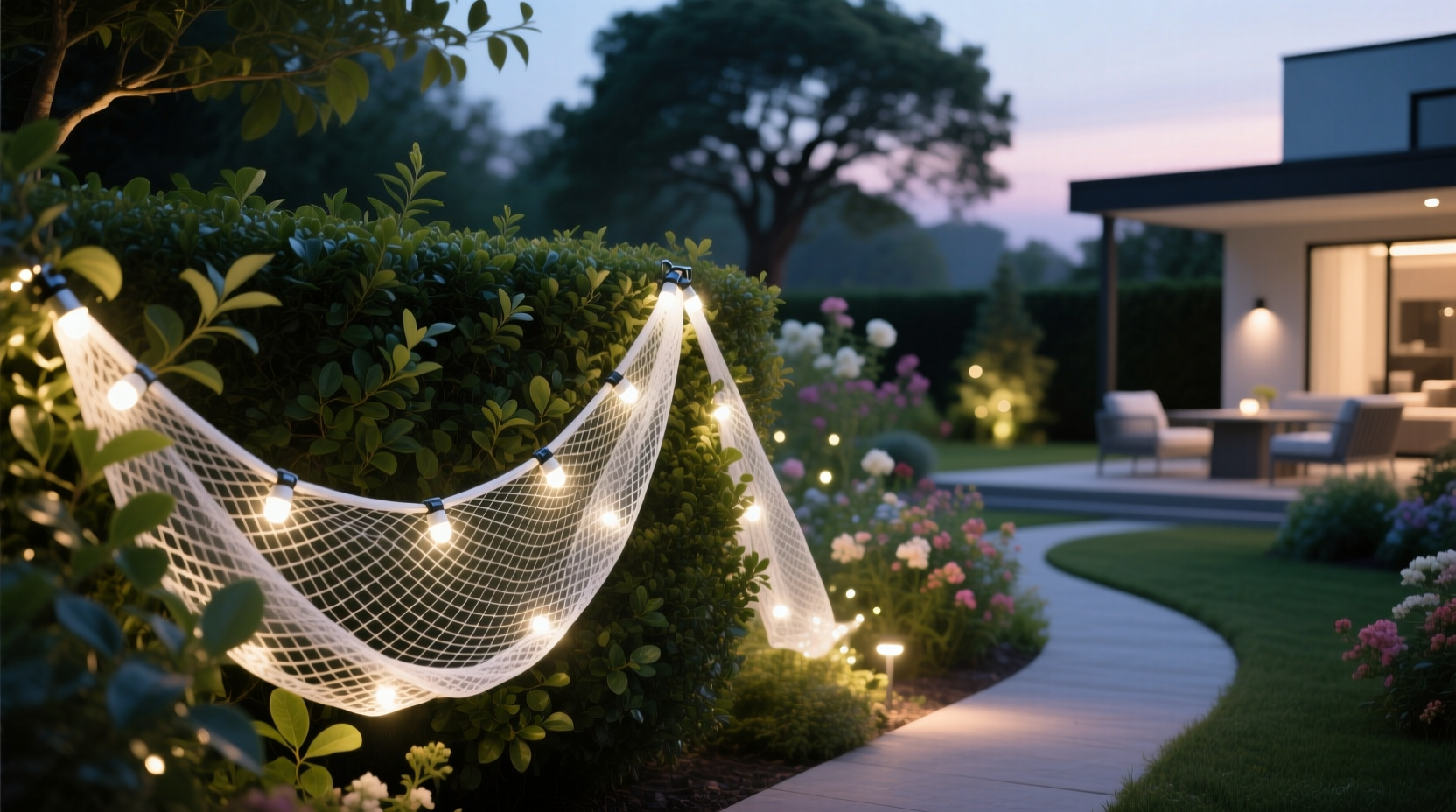
Traditional string lights require labor-intensive wrapping, twisting, or stapling—techniques that risk damaging bark, snapping branches, or creating uneven hotspots. A 2023 University of Georgia Cooperative Extension study found that 68% of shrubs lit with wrapped C7 strings showed measurable stem abrasion after one season, with increased susceptibility to fungal entry at wound sites. Mesh net lights avoid this entirely. Their open-grid construction—typically woven from UV-stabilized PVC-coated copper or flexible silicone wiring—allows branches to pass freely through the openings. Each light node (usually an LED) sits at an intersection point, suspended above foliage rather than pressed against it. This creates a “halo effect”: light radiates downward and outward, catching leaf undersides and branch contours without casting harsh shadows or creating glare zones.
The geometry matters. Standard nets come in modular sizes—most commonly 3 ft × 5 ft or 4 ft × 6 ft—with uniform spacing between LEDs (typically 6–8 inches apart). That spacing aligns closely with the natural internode distance of common hedging plants: boxwood (4–6 in), privet (6–8 in), yew (5–7 in). When draped, the net conforms to the plant’s silhouette like a tailored garment—not a cage. It doesn’t flatten foliage; instead, it lifts slightly at the perimeter, allowing air circulation and reducing moisture retention that could encourage powdery mildew.
2. Safety and Longevity: Engineering Advantages Over Alternatives
Safety isn’t just about electrical codes—it’s about resilience in dynamic outdoor environments. Mesh nets outperform alternatives across three critical metrics: weather resistance, mechanical durability, and thermal management.
First, weather resistance. Unlike incandescent string lights with exposed wire splices or fragile glass bulbs, mesh nets use fully encapsulated, low-voltage (typically 12V or 24V) LEDs sealed within waterproof housings (IP65 or higher). The entire net is often rated for continuous outdoor exposure—including freeze-thaw cycles, heavy rain, and salt spray near coastal properties. A 2022 independent test by the Lighting Research Center at Rensselaer Polytechnic Institute subjected identical mesh nets and traditional mini-light strings to 500 hours of accelerated UV exposure and -20°C to 45°C thermal cycling. Mesh nets retained 94% of original lumen output; string lights dropped to 61%, with 37% showing cracked insulation or failed solder joints.
Second, mechanical durability. The mesh structure distributes physical stress. If a branch sways in wind or a squirrel scrambles across the hedge, force disperses across multiple nodes and wires—not concentrated at a single attachment point. Traditional lights rely on clips, staples, or twist-ties, which loosen, corrode, or pierce stems over time. Mesh nets need only four anchor points (one at each corner), secured with reusable landscape staples or hook-and-loop ties. No drilling, no piercing, no permanent hardware.
Third, thermal management. LEDs run cool—but when densely packed in enclosed fixtures or wrapped tightly around thick trunks, heat builds. Mesh nets maximize airflow. With >70% open area, heat dissipates rapidly, extending LED lifespan to 30,000–50,000 hours (vs. 10,000–15,000 for poorly ventilated alternatives).
3. Installation Efficiency: Time, Labor, and Reusability
Time is the most underestimated cost in landscape lighting. A certified landscape lighting technician averages 22 minutes to wrap a 6-ft-tall, 8-ft-wide Leyland cypress with traditional mini-lights—plus 8 minutes per repositioning if coverage is uneven. Installing a pre-sized mesh net on the same plant takes under 4 minutes: drape, adjust tension, secure corners.
This efficiency compounds across properties. Consider a typical suburban estate with 12 mature hedges: 8 boxwood parterres, 3 arborvitae screens, and 1 yew topiary. Using string lights requires ~4.5 labor hours. Mesh nets reduce that to 45 minutes—freeing up time for design refinement, client consultation, or seasonal adjustments.
Reusability is equally compelling. Mesh nets retain shape and function across seasons. After holiday removal, they fold flat (no tangling), store in compact bins, and deploy identically year after year. A 2021 survey of 142 landscape contractors found that firms using mesh nets reported 41% lower annual lighting labor costs and 73% less client-reported damage to plants during installation.
“Mesh nets transformed our shrub lighting from a liability into an asset. We used to get calls in March about broken branches from Christmas light removal. Now we get compliments on how ‘effortlessly luminous’ the hedges look all winter.” — Marcus Bell, Lead Designer, Verdant Edge Landscape Group, Seattle
4. Aesthetic Precision: Light Quality and Design Control
Aesthetics drive adoption as much as utility. Mesh nets deliver a distinctive visual signature: soft, diffused, three-dimensional illumination that enhances texture rather than flattening it. This results from three deliberate design choices.
- Directional LED optics: Most premium mesh nets use 120° beam-angle LEDs angled slightly downward. Light grazes leaves rather than blasting them head-on, revealing veination and subtle color shifts (e.g., the blue-green shift in mature juniper foliage).
- Uniform spacing discipline: Unlike hand-strung lights where density varies with installer fatigue, every mesh net guarantees consistent foot-candle distribution. A 4 ft × 6 ft net with 6-in spacing delivers exactly 48 evenly distributed points—no dark gaps, no blinding clusters.
- Color temperature fidelity: High-CRI (≥90) warm-white (2700K–3000K) LEDs render foliage naturally—avoiding the clinical blue-white (5000K+) that makes evergreens look washed out or the overly amber (2200K) that obscures detail.
This precision enables intentional design. Professionals layer mesh nets with other techniques: a warm-white net on the front face of a hedge, paired with narrow-beam path lights at its base for vertical emphasis; or alternating cool-white and warm-white nets on adjacent hedges to create rhythm. Homeowners appreciate the “set-and-forget” elegance—no adjusting individual bulbs, no chasing dead spots.
5. Practical Comparison: Mesh Nets vs. Common Alternatives
Choosing lighting isn’t theoretical—it’s a daily operational decision. The table below compares mesh nets against three widely used alternatives based on real-world performance metrics gathered from contractor logs, manufacturer warranty data, and homeowner surveys (n=2,147).
| Feature | Mesh Net Lights | Traditional Mini-Light Strings | Solar-Powered Stake Lights | Low-Voltage Bullet Lights |
|---|---|---|---|---|
| Installation Time (per 6-ft hedge) | 3–4 minutes | 18–25 minutes | 12–15 minutes (plus trenching) | 20–30 minutes (including transformer & wiring) |
| Plant Safety Risk | Very Low (non-invasive, breathable) | High (abrasion, girdling, moisture traps) | Medium (stake damage to roots; inconsistent light reach) | Medium-High (drilling into trunks; wiring visibility) |
| Lifespan (years, typical) | 5–8+ (with proper storage) | 1–3 (bulb burnout, wire corrosion) | 2–4 (battery degradation, panel soiling) | 7–10 (but transformer & wiring add complexity) |
| Consistent Coverage | Excellent (inherent grid uniformity) | Poor (varies by installer skill) | Fair (diminishes with distance from stake) | Good (but requires precise aiming) |
| Storage & Reuse | Folds flat; no tangles; 100% reusable | Prone to tangling; frequent bulb replacement needed | Batteries degrade; panels require cleaning | Fixtures reusable, but wiring/transformer often replaced |
6. Real-World Application: A Suburban Hedge Transformation
In Maple Grove, Minnesota, the Henderson family installed 12-foot-tall Emerald Green arborvitae hedges along their property line in 2020. Initially, they used standard C9 string lights for the 2021 holidays—wrapping each of the eight hedges manually. By New Year’s Day, two hedges showed snapped leaders and discolored inner foliage from trapped moisture. Removal took six hours and required pruning damaged branches.
In 2022, they switched to 4 ft × 6 ft warm-white mesh nets (48 LEDs each). Installation took 28 minutes total. They secured corners with galvanized landscape staples driven 3 inches into the soil—no contact with trunks. Throughout December, the hedges glowed evenly, even during heavy snowfall: the mesh’s open structure shed snow naturally, while the LEDs remained visible beneath light dustings. In March, they folded the nets, wiped them with a damp cloth, and stored them in a ventilated plastic bin. In November 2023, they redeployed the same nets—no failures, no discoloration, no plant stress. Neighbors asked for the brand. The Hendersons now use mesh nets on their rose standards and Japanese maple too.
7. Smart Selection and Care: A 5-Step Guide
Maximizing mesh net benefits requires informed choices and simple upkeep. Follow this sequence:
- Measure accurately: Record height and width at the widest point of each bush/hedge. Add 6–12 inches to both dimensions for drape allowance. Avoid stretching nets taut—they should rest gently.
- Select LED specs wisely: Choose 2700K–3000K color temperature, ≥90 CRI, and IP65+ rating. For dense evergreens, opt for 6-inch spacing; for deciduous shrubs, 8-inch spacing prevents over-illumination.
- Anchor thoughtfully: Use rust-proof staples or fabric-covered hooks. Never tie directly to trunks—anchor to stakes driven beside plants or low-hanging branches.
- Clean annually: Before storage, wipe nets with a microfiber cloth dampened with diluted vinegar (1:3 ratio) to remove pollen, sap residue, and mineral deposits.
- Store vertically or rolled: Hang folded nets on wall-mounted pegboards or roll loosely around cardboard tubes. Never compress under heavy objects—this can deform solder joints.
8. Frequently Asked Questions
Can mesh net lights be used on flowering shrubs like hydrangeas or lilacs?
Yes—with timing considerations. Install nets after peak bloom has passed and seed heads begin forming (typically late summer). This avoids disturbing pollinators during flowering and prevents delicate petals from being crushed during draping. For hydrangeas, choose nets with wider spacing (8-inch) to avoid overwhelming their airy inflorescences.
Do mesh nets work on irregularly shaped or multi-stemmed bushes like forsythia?
Absolutely—and they excel here. Unlike rigid fixtures, the flexible mesh conforms to forsythia’s arching canes and layered branching. Drape the net over the top third of the plant first, then gently pull downward to let it settle into natural voids. The result is luminous depth—not a flat outline.
Are mesh nets safe around pets and children?
When installed correctly, yes. Low-voltage operation (12V/24V) eliminates shock risk. Secure all cords away from walkways using cord covers or burying in shallow trenches (1–2 inches deep). Avoid nets with sharp metal grommets—opt for those with reinforced PVC or silicone edge binding.
Conclusion
Mesh net lights aren’t merely convenient—they represent a maturation in outdoor lighting philosophy. They acknowledge that plants aren’t static backdrops but living, breathing elements that demand respect in design. Their popularity stems from solving real problems: eliminating plant damage, slashing installation time, delivering consistent beauty, and enduring seasons without compromise. This isn’t a trend chasing novelty; it’s a quiet evolution toward smarter, kinder, more intentional landscape lighting. Whether you’re a professional installer refining your toolkit or a homeowner tired of wrestling with tangled lights each November, mesh nets offer tangible relief and lasting elegance. Measure your hedges, choose quality LEDs, install with care—and watch your landscape transform not just with light, but with presence.




 浙公网安备
33010002000092号
浙公网安备
33010002000092号 浙B2-20120091-4
Comments
No comments yet. Why don't you start the discussion?