
Every holiday season, millions of households face the same decision: buy a traditional artificial tree and string their own lights, or invest in a prelit model that promises instant sparkle with minimal effort. While prelit trees often carry a steeper price tag—sometimes double that of unlit versions—many consumers wonder whether the added cost is justified. Are prelit trees truly better, or are they just a marketing gimmick capitalizing on convenience? The answer lies in understanding the engineering, materials, labor, and long-term usability behind these popular holiday staples.
The True Cost Behind the Price Tag
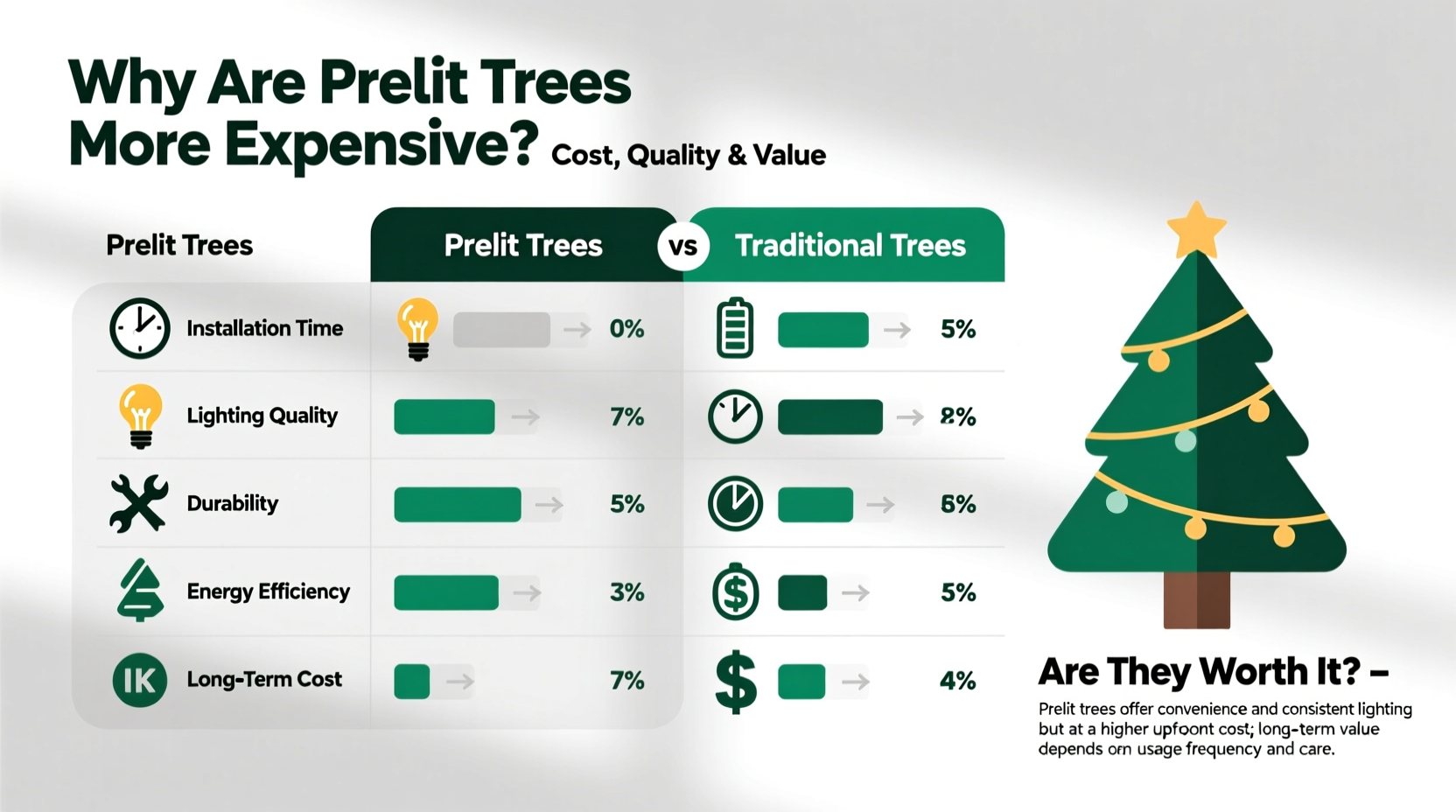
Prelit trees aren’t simply artificial trees with lights glued on—they’re engineered systems. Manufacturers integrate LED strings directly into the branches during assembly, using specialized wiring, connectors, and branch designs that accommodate lighting without compromising aesthetics. This integration requires precision and additional components, which drives up manufacturing costs.
One major factor is the type of lights used. Most modern prelit trees use LED bulbs instead of incandescent ones. LEDs are more energy-efficient, last longer (up to 40,000 hours), and generate less heat, making them safer around flammable materials like tinsel or dried-out natural trees. However, quality LED strings with steady illumination, uniform color temperature, and shatter-resistant casings are significantly more expensive to produce than basic bulb sets.
Beyond the lights themselves, there’s the complexity of design. Branches must be molded or wired to conceal strands while allowing for realistic shaping. Lights are often grouped in sections with independent fuses or circuits so that if one section fails, the rest remain lit. Some high-end models even feature remote controls, timer functions, or multi-mode lighting effects (twinkle, fade, steady-on). All these features add layers of electronics and quality control that contribute to the final price.
Convenience vs. Customization: Weighing the Trade-offs
The primary appeal of a prelit tree is convenience. For many families, especially those with busy schedules or limited storage space, the idea of unpacking a tree already dressed in lights is a major time-saver. No more untangling hundreds of bulbs, testing strands, or struggling to evenly distribute light across dense branches. With a prelit tree, setup can take as little as 20 minutes—just unfold, plug in, and enjoy.
This convenience comes at the cost of customization. With a traditional tree, you can choose the number of light strands, their color (warm white, cool white, multicolor), brightness, and even special effects like chasing or dimming. You can layer different types of lighting—fairy lights on inner branches, C7 bulbs on the perimeter—for a professionally decorated look. Prelit trees lock you into a single lighting scheme, usually 500 to 700 warm white or multicolor LEDs, evenly spaced but not always adjustable in intensity or pattern.
Additionally, most prelit trees use permanent wire gauges and connection points that don’t support adding extra strands easily. While some models allow you to daisy-chain additional lights through an outlet jack, others lack this feature entirely. If you love changing your holiday theme annually—from rustic farmhouse to icy glam—this lack of flexibility may feel limiting.
“Prelit trees are ideal for people who prioritize ease over expression. They solve a real pain point: holiday fatigue.” — Daniel Reyes, Home Decor Strategist at Seasonal Living Co.
Are Prelit Trees Actually Better? A Performance Comparison
To determine whether prelit trees are “better,” we need to define what “better” means. For some, it’s longevity. For others, it’s appearance, safety, or ease of use. Let’s break down key performance metrics in a direct comparison.
| Feature | Prelit Tree | Traditional Tree + Lights |
|---|---|---|
| Setup Time | 15–30 minutes | 60–90+ minutes |
| Light Uniformity | Evenly distributed by design | Depends on user skill; often uneven |
| Lifespan of Lights | 3–7 years (if LEDs); non-replaceable in many models | Replaceable strands; individual bulbs last 1–5 years |
| Safety | LEDs run cooler; fused circuits reduce fire risk | Risk increases with older incandescent strands or overloaded outlets |
| Customization | Low – fixed color, brightness, layout | High – mix colors, effects, densities |
| Storage | More complex due to integrated wires; risk of snagging | Trees and lights stored separately; easier to manage |
| Initial Cost | $150–$400+ | $50–$150 (tree) + $20–$100 (lights) |
From this comparison, it’s clear that prelit trees excel in consistency, safety, and speed. But they fall short in modularity and repairability. A single burned-out circuit in a low-end prelit tree can render half the tree dark—and replacing the entire string may require disassembling sections of the trunk, which few users are equipped to do.
Real-World Example: The Thompson Family’s Holiday Upgrade
The Thompsons of Columbus, Ohio, spent nearly a decade assembling a 7.5-foot artificial tree each December. They owned three strands of 300-count incandescent lights, which took over an hour to wrap evenly. By year five, two strands had failed, and finding matching replacements proved impossible. One Christmas Eve, their youngest child accidentally pulled a wire loose inside the trunk, causing half the tree to go dark. With guests arriving in two hours, they resorted to draping fairy lights haphazardly—a fix that lasted only until New Year’s.
The following October, they invested $280 in a high-quality prelit tree with replaceable LED sections and a remote control. Setup took 22 minutes. Over the next four years, one light section dimmed, but the manufacturer sent a free replacement strand. “It’s not as flashy as our old setup,” said Sarah Thompson, “but we haven’t stressed about lights since. That peace of mind was worth every penny.”
Their experience reflects a growing trend: consumers trading creative control for reliability, especially as holiday traditions evolve around time scarcity and shared household responsibilities.
How to Choose a High-Quality Prelit Tree: A Buyer’s Checklist
Not all prelit trees are created equal. Many budget models cut corners on wiring, bulb quality, and structural integrity. To ensure you’re getting true value, follow this checklist before purchasing:
- Check for replaceable light strings: Look for models where individual sections can be unplugged and swapped out.
- Verify LED type: Opt for trees labeled “replaceable LED bulbs” rather than “permanent LEDs.”
- Examine the warranty: Reputable brands offer 2–5 year warranties covering light failure.
- Test branch flexibility: Bend a sample branch—if it cracks or feels brittle, it won’t survive multiple seasons.
- Look for UL certification: Ensures electrical safety standards are met.
- Consider light density: Aim for at least 400–500 lights per foot of tree height for full coverage.
- Evaluate folding mechanism: Hinged branches should open smoothly without requiring manual adjustment.
Long-Term Value: When a Prelit Tree Pays for Itself
At first glance, a $300 prelit tree seems extravagant compared to a $100 unlit tree and $50 in lights. But consider long-term usage. A well-made prelit tree can last 7–10 years with proper care, amortizing the cost to about $30–$40 per holiday season. Compare that to replacing lower-quality light strands every 2–3 years ($25–$50 each time) and spending 60–90 minutes annually on setup, and the savings in both money and time become apparent.
Moreover, high-end prelit trees often use premium materials—thicker PVC needles, metal-reinforced trunks, and commercial-grade wiring—that resist shedding and tangling far better than entry-level trees. These trees maintain their fullness and shape over multiple seasons, avoiding the “ratty Charlie Brown tree” effect that plagues cheaper models.
There’s also an intangible benefit: reduced holiday stress. For caregivers, working parents, or individuals managing seasonal depression, minimizing setup friction can improve overall well-being. In this sense, a prelit tree isn’t just a purchase—it’s a form of emotional labor reduction.
Frequently Asked Questions
Can I add more lights to a prelit tree?
Yes, but carefully. Use only low-voltage, battery-operated fairy lights or plug-in strands rated for indoor use. Avoid wrapping additional cords tightly around branches, as this can damage internal wiring. Never overload power strips or extension cords.
What happens when a section of lights goes out?
If the tree is under warranty, contact the manufacturer—they often provide free replacement sections. If out of warranty, you may need to splice in a new strand or live with partial lighting. Some DIYers replace faulty sections with compatible third-party LED strings, though this voids any remaining warranty.
Are prelit trees safe around pets and kids?
Modern prelit trees using LEDs are generally safe. The bulbs stay cool to the touch, reducing burn risk. Wires are typically embedded within central trunks or thick branches, minimizing exposure. However, supervise young children and pets during setup, as chewed cords—even low-voltage ones—can pose hazards.
Final Verdict: Are Prelit Trees Worth It?
Prelit trees are more expensive because they deliver something valuable: predictability. They eliminate the frustration of tangled wires, burnt-out bulbs, and uneven lighting. For households that value consistency, safety, and time efficiency, they are absolutely better—provided you invest in a quality model.
They’re not ideal for decorators who change themes yearly or want maximum control over lighting design. But for the majority of consumers—especially those building sustainable holiday routines—a prelit tree represents a smart, long-term upgrade. The initial cost is higher, but the cumulative savings in time, effort, and repeated purchases make it a worthwhile investment.
Ultimately, the best tree is the one that enhances your holiday experience without becoming a burden. If setting up lights feels like a chore rather than a tradition, a prelit tree isn’t just convenient—it’s a meaningful improvement to your seasonal joy.




 浙公网安备
33010002000092号
浙公网安备
33010002000092号 浙B2-20120091-4
Comments
No comments yet. Why don't you start the discussion?