
Rats have long been misunderstood. Often dismissed as pests or lab subjects, these small mammals possess cognitive abilities that rival those of much larger-brained animals. Far from being mere scavengers, rats demonstrate advanced learning, memory, empathy, and even metacognition—the ability to think about thinking. Scientists studying animal intelligence increasingly recognize rats as one of the most intelligent rodents on the planet. Their adaptability, social complexity, and problem-solving skills reveal a level of mental sophistication that challenges long-held assumptions about brain size and intelligence.
The Cognitive Architecture of Rat Intelligence
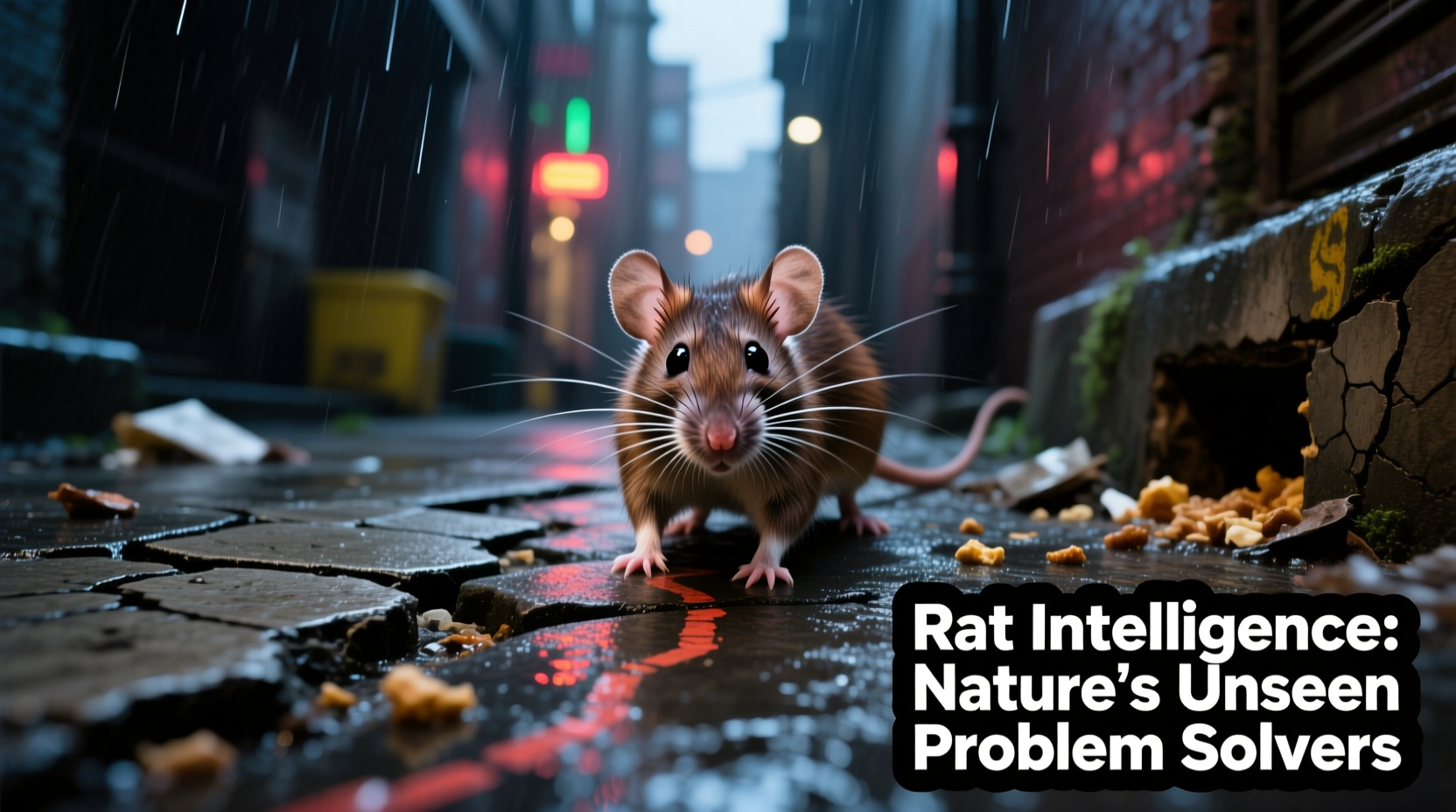
Rat brains may be tiny—about the size of a grape—but they are remarkably efficient. The neocortex, responsible for higher-order thinking in mammals, is well-developed in rats relative to their body size. They excel in spatial navigation, associative learning, and pattern recognition. One key factor behind their intelligence is neuroplasticity: the brain's ability to reorganize itself by forming new neural connections. Rats continuously adapt their behavior based on experience, which allows them to thrive in diverse environments—from urban sewers to laboratory mazes.
In controlled experiments, rats learn complex tasks with astonishing speed. For example, in radial arm mazes, they can remember which arms contain food and avoid revisiting empty ones, demonstrating both working memory and strategic planning. These abilities are not instinctual but learned through trial, error, and observation.
Problem-Solving and Tool Use in Rats
Rats are natural innovators. In one landmark study at the University of Chicago, researchers trained rats to use small tools—like sticks—to retrieve food placed out of reach. Not only did the rats learn how to manipulate the tools effectively, but they also showed foresight by selecting the correct tool before beginning the task.
This kind of flexible thinking extends to real-world scenarios. Urban rats navigate subway systems, avoid traps, and exploit human waste patterns with precision. They learn from failure and adjust strategies accordingly. A rat encountering a closed trash bin today might return tomorrow having figured out how to pry the lid open using leverage from nearby objects.
Such behaviors indicate more than basic conditioning—they suggest an internal model of cause and effect. As Dr. Kelly Lambert, a behavioral neuroscientist specializing in rodent cognition, explains:
“Rats don’t just react to their environment; they actively interpret it. Their decisions reflect cost-benefit analyses similar to those seen in primates.” — Dr. Kelly Lambert, University of Richmond
Social Learning and Emotional Intelligence
Intelligence isn't just about solving puzzles—it also involves understanding others. Rats exhibit striking social awareness. In a famous experiment known as the \"rat empathy test,\" scientists placed one rat in a cage with a trapped companion. Over time, the free rat learned how to open the door and release the other—even when no reward was offered. When given the option between freeing a peer or accessing a food treat, many rats chose to help first.
This altruistic behavior suggests emotional depth and possibly empathy. Rats also communicate distress through ultrasonic vocalizations and respond to the emotional states of others. They form bonds, groom each other, and show signs of grief when a companion dies.
Moreover, rats engage in social learning. Juvenile rats observe older individuals navigating obstacles or finding food sources and replicate those actions. This cultural transmission of knowledge enhances survival across generations—a hallmark of intelligent species.
A Comparison of Rat Cognition vs. Other Animals
| Ability | Rats | Pigeons | Dogs | Chimpanzees |
|---|---|---|---|---|
| Spatial Memory | Excellent (maze navigation) | Good (navigation) | Fair (route recall) | Excellent |
| Tool Use | Observed in labs | Limited | Rare | Advanced |
| Social Empathy | Strong evidence | Minimal | High | Very High |
| Learning Speed | Very Fast | Moderate | Fast | Very Fast |
| Metacognition | Yes (decline tests) | No clear evidence | Possible | Confirmed |
Metacognition: Do Rats Know What They Know?
Perhaps the most compelling evidence of rat intelligence is their capacity for metacognition—the ability to assess their own knowledge. In experiments where rats must choose whether to take a memory test or decline it for a smaller guaranteed reward, they consistently opt out when uncertain. This self-monitoring mirrors human decision-making under uncertainty.
For instance, after hearing a tone sequence, a rat might be asked to classify it as “short” or “long.” If allowed to decline the trial, rats avoid attempting classification when the duration is ambiguous. This shows they aren’t just responding automatically—they’re evaluating confidence levels, much like humans do before answering a tough question.
This kind of introspective capability was once thought exclusive to primates and dolphins. Its presence in rats forces us to reconsider the evolutionary roots of self-awareness.
Real-World Applications: Rats That Save Lives
The practical implications of rat intelligence are already being harnessed. In Tanzania and Cambodia, African giant pouched rats—trained by nonprofit APOPO—are used to detect landmines and tuberculosis. With their acute sense of smell and high trainability, these rats scan large areas quickly and accurately.
In one case study, Magawa, a Gambian pouched rat, cleared over 147,000 square meters of land and detected 71 landmines and unexploded ordnance during his career. He was awarded the PDSA Gold Medal, the animal equivalent of a military honor, for his life-saving work.
These rats succeed not because they follow simple cues, but because they maintain focus, discriminate subtle scents, and make rapid decisions under pressure—cognitive feats requiring attention, memory, and motivation.
Actionable Checklist: Understanding and Respecting Rat Intelligence
- Recognize that rats are capable of learning, memory, and emotional bonding.
- Avoid using harmful poisons; opt for humane deterrents if dealing with wild populations.
- Enrich pet rat environments with puzzles, tunnels, and interactive toys.
- Observe rat behavior closely—you may witness problem-solving in real time.
- Support ethical research and organizations using rats for humanitarian purposes (e.g., APOPO).
Frequently Asked Questions
Can rats recognize individual humans?
Yes, rats can distinguish between different people based on scent, voice, and facial features. Pet rats often develop strong attachments to their caregivers and respond differently to strangers.
Are some rat species smarter than others?
While most studies focus on Norway rats (Rattus norvegicus) and black rats (Rattus rattus), there’s no conclusive evidence that one species is significantly more intelligent than another. However, individual variation in learning speed and curiosity exists, much like in humans.
Do rats dream?
Evidence suggests they do. During REM sleep, rats replay neural activity from waking experiences—such as running through a maze—indicating they may be consolidating memories or even “rehearsing” past events in their dreams.
Conclusion: Rethinking the Rat Mind
The notion that rats are “just” pests is outdated and scientifically inaccurate. Their cognitive abilities—including memory, empathy, tool use, and self-awareness—place them among the most intelligent animals studied. Whether navigating city streets or assisting in humanitarian missions, rats prove that intelligence comes in all sizes.
Understanding rat intelligence doesn’t just satisfy curiosity—it fosters compassion. It challenges us to treat these animals with greater respect, whether as pets, research subjects, or cohabitants in shared environments. The next time you see a rat, consider not just its survival instincts, but the complex mind behind its quick movements and watchful eyes.




 浙公网安备
33010002000092号
浙公网安备
33010002000092号 浙B2-20120091-4
Comments
No comments yet. Why don't you start the discussion?