
The term \"Karen\" has evolved from a simple first name into a widely recognized cultural label, often used to describe a specific type of entitled or demanding behavior—typically associated with a middle-aged, white woman. While some use it humorously or critically, others argue it has become a harmful stereotype. To understand why people are called \"Karens,\" it's essential to explore its linguistic roots, social evolution, and the broader implications of labeling individuals this way.
The Rise of the \"Karen\" Stereotype
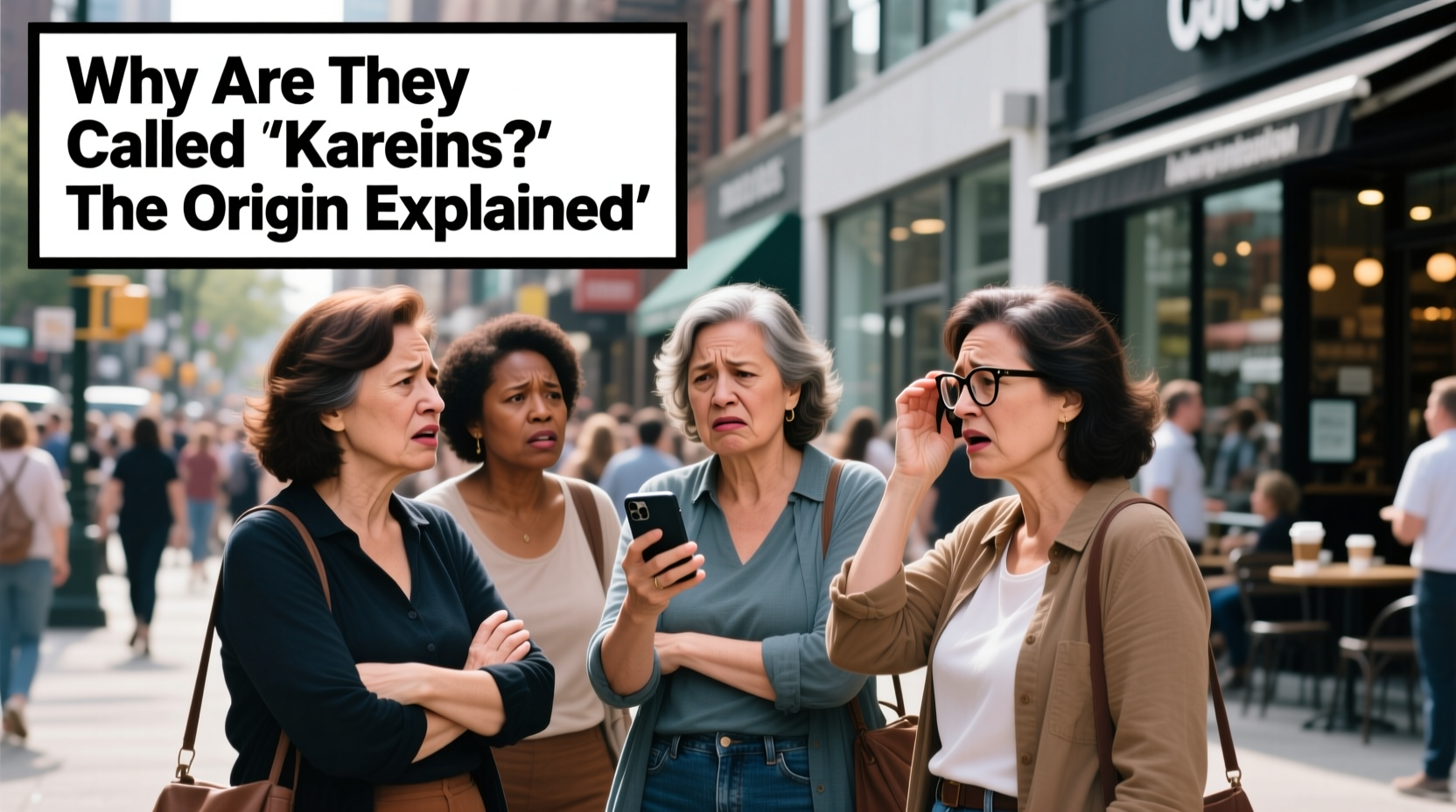
The modern usage of \"Karen\" as a pejorative emerged in the early 2010s on internet forums like Reddit, particularly in subreddits such as r/MurderedByWords and r/EntitledPeople. These communities shared stories of confrontational interactions, often involving women who demanded to \"speak to the manager\" over minor issues. Over time, the name \"Karen\" became shorthand for someone perceived as privileged, aggressive, and dismissive of authority unless it serves their interests.
Unlike generic insults, \"Karen\" carries layered social commentary. It references not just individual behavior but systemic patterns related to race, class, and gender. The archetype typically includes characteristics like:
- Demanding special treatment
- Invoking privilege (often racial or economic)
- Disregarding public health rules or social norms
- Using emotional manipulation or threats
One of the most iconic visual markers associated with the stereotype is the \"bob cut\" hairstyle with highlights—a look that became symbolic in memes and viral videos. Though exaggerated, this image helped cement \"Karen\" in popular culture.
Etymological Origins and Timeline
Despite its current negative connotation, \"Karen\" is a legitimate Scandinavian name derived from \"Karin,\" a variant of \"Katherine,\" meaning \"pure.\" It was especially popular in the United States during the 1950s and 60s. So how did a common name become a derogatory label?
A clear timeline helps clarify the shift:
- Late 2000s–Early 2010s: Isolated online mentions of \"Karen\" in relation to entitled behavior begin appearing on parenting forums and Facebook threads.
- 2013: A notable post on Reddit’s r/IAmA features a man describing his ex-wife “Karen” as manipulative and selfish, sparking discussion.
- 2017: The meme format “I want to speak to the manager” becomes linked with the name “Karen,” accelerating its spread.
- 2018–2020: Viral videos show women named or resembling the \"Karen\" archetype calling police on Black individuals engaged in everyday activities—barbecuing, birdwatching, selling water.
- 2020: During the George Floyd protests, “Karen” enters mainstream media as a symbol of racialized entitlement.
By 2021, Merriam-Webster added \"Karen\" to its dictionary as “an average middle-class white woman who is angry or demanding, especially one who uses her privilege to get her way.” This formal recognition marked the term’s transition from internet slang to sociocultural lexicon.
Cultural Context and Systemic Implications
The \"Karen\" phenomenon cannot be separated from deeper societal structures. Many experts argue that the label reflects real patterns of racial and gendered power dynamics.
“Calling someone a ‘Karen’ is less about the name and more about calling out abuse of privilege—especially when it targets marginalized communities.” — Dr. Naomi Reed, Sociologist at University of Illinois
Historically, white women have wielded disproportionate influence through institutions—from housing policies to law enforcement. Incidents where white women call the police on Black people for mundane actions echo earlier historical precedents, such as the false accusation made by Carolyn Bryant against Emmett Till in 1955.
In this light, \"Karen\" functions as a cautionary archetype. It highlights how seemingly small acts—like reporting a child’s lemonade stand or complaining about noise—can carry significant consequences when rooted in racial bias.
Do’s and Don’ts When Using the Term \"Karen\"
| Do’s | Don’ts |
|---|---|
| Use the term to critique harmful behaviors, not identities | Assume all assertive women are \"Karens\" |
| Recognize the role of systemic privilege in conflicts | Mock someone based solely on appearance or name |
| Call out misuse of authority or racism constructively | Use the term as a blanket insult to silence dissent |
| Engage in dialogue about class and race privilege | Ignore intersectionality—some women face both privilege and oppression |
Real-World Example: The Central Park Incident
In May 2020, a video went viral showing Amy Cooper, a white woman, calling 911 on Christian Cooper (no relation), a Black birdwatcher in New York’s Central Park. After he asked her to leash her dog—required by park rules—she responded by saying, “I’m going to tell them there’s an African American man threatening my life.”
The incident sparked national outrage and became a textbook example of the \"Karen\" behavior: weaponizing race under stress. Although she later apologized and lost her job, the case illustrated how digital documentation can expose patterns of racial intimidation—and why labels like \"Karen\" gain traction in public discourse.
This wasn’t just about one person’s reaction. It reflected broader concerns about who feels entitled to invoke law enforcement and who bears the risk when they do.
Is the Term Harmful or Helpful?
Opinions are divided. Supporters argue that \"Karen\" gives voice to marginalized experiences, naming a pattern that might otherwise go unchallenged. Critics warn it risks devolving into sexist or ageist mockery, potentially silencing legitimate complaints from women.
Moreover, using a female name as a slur raises concerns about gendered language. Names like \"Kevin\" or \"Chad\" have been proposed as male equivalents for obnoxious behavior, but none have achieved the same cultural penetration.
The danger lies in oversimplification. Not every woman who files a complaint is a \"Karen.\" Conversely, not every \"Karen\" behavior comes from malice—sometimes it stems from fear, ignorance, or lack of self-awareness.
Frequently Asked Questions
Can men be \"Karens\"?
While the term specifically refers to a female archetype, men can exhibit similar behaviors—such as misusing privilege or making unreasonable demands. However, these actions are often described differently (e.g., \"toxic masculinity\" or \"entitled customer\") and don't carry the same cultural shorthand. Some suggest terms like \"Ken\" or \"Carl\" as male parallels, though they haven’t gained widespread usage.
Is it racist or sexist to call someone a Karen?
It depends on context. If used to describe a pattern of racially charged entitlement—especially involving law enforcement—it can highlight real social issues. But if used to mock any woman who speaks up, it reinforces sexist tropes. Intent and impact matter. Generalizations based on gender or race risk perpetuating harm, even when critiquing injustice.
Are people actually named Karen offended by the term?
Many are. Surveys and anecdotal reports indicate that women named Karen report increased teasing, workplace discomfort, or reluctance to introduce themselves. Some parents have stopped naming their daughters Karen due to stigma. Language evolves, but personal names hold emotional weight, and their transformation into insults can feel dehumanizing.
Conclusion: Moving Beyond Labels
Understanding why people are called \"Karens\" requires more than tracing internet memes. It demands reflection on privilege, accountability, and the ways language shapes perception. The term originated as a critique of real social problems—but like any label, it can be misused.
Instead of defaulting to \"Karen\" as an insult, consider addressing the behavior directly: Was someone abusing power? Disregarding rules? Acting with racial bias? Naming those actions precisely leads to more productive conversations than relying on stereotypes.




 浙公网安备
33010002000092号
浙公网安备
33010002000092号 浙B2-20120091-4
Comments
No comments yet. Why don't you start the discussion?