
The question of why a U.S. president cannot serve three terms touches on one of the most foundational principles in American democracy: the peaceful transfer of power. Unlike some nations where leaders hold office for decades, the United States enforces strict term limits to prevent the concentration of power and protect democratic integrity. The answer lies not in tradition or political custom, but in a specific amendment to the Constitution ratified after one president served an unprecedented four terms.
The Historical Precedent: Franklin D. Roosevelt’s Four Terms
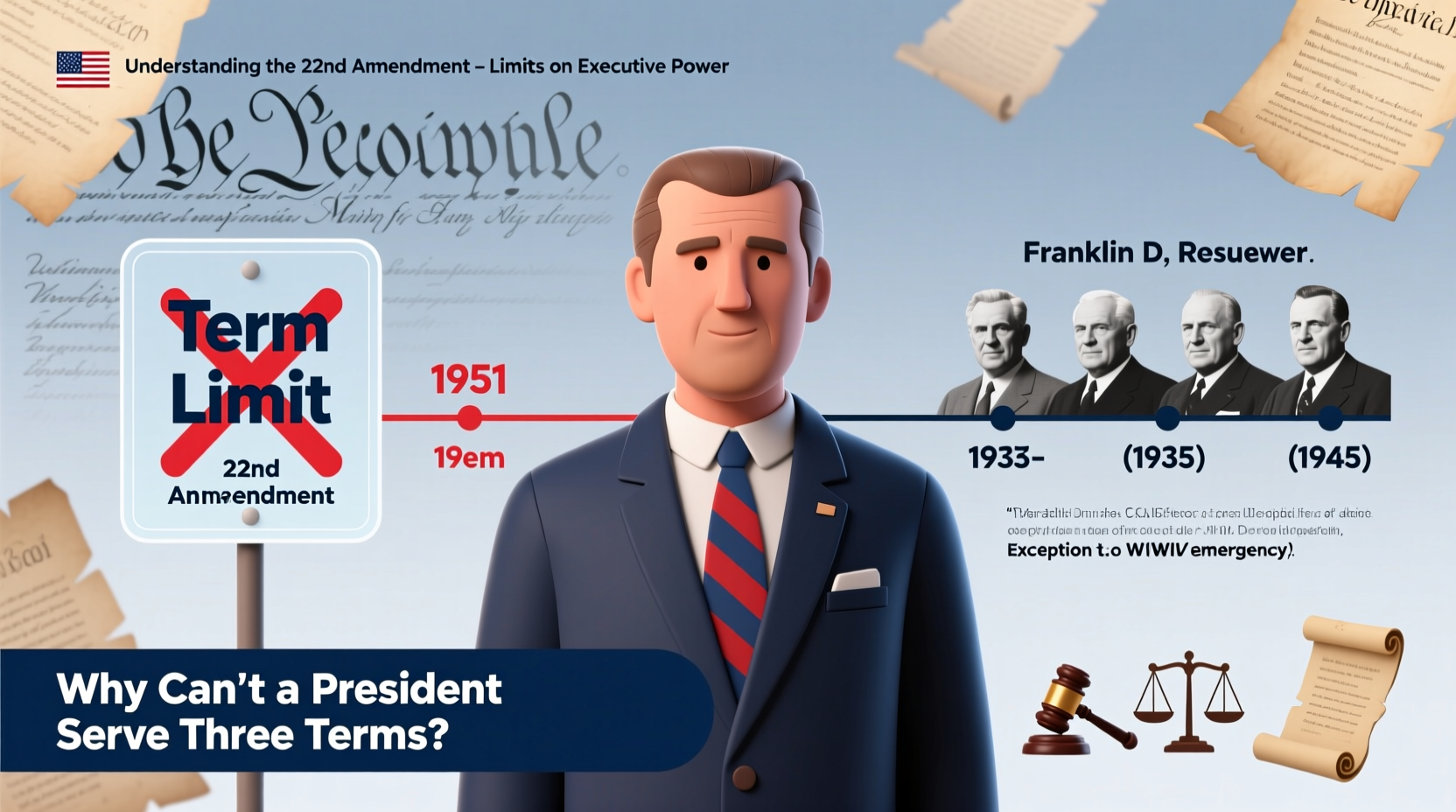
Prior to 1951, there was no constitutional limit on how many times a president could be elected. This absence stemmed from George Washington’s decision to step down after two terms, establishing a precedent that lasted nearly 150 years. While not legally binding, every president respected this unwritten rule—until Franklin D. Roosevelt.
Elected during the Great Depression in 1932, Roosevelt led the nation through economic collapse and later World War II. Voters re-elected him in 1936, 1940, and 1944, making him the only president to serve more than two terms. His leadership during crisis earned public support, but his extended tenure raised concerns about executive overreach.
Roosevelt died in April 1945, just months into his fourth term. His prolonged presidency prompted lawmakers to formalize term limits, ensuring no future president could accumulate similar power.
“Four terms, or more if he wants them, would permit personal dictatorship.” — Senator William Langer, advocating for the 22nd Amendment
The 22nd Amendment: Codifying Term Limits
In response to Roosevelt’s lengthy service, Congress proposed the 22nd Amendment in 1947. It was ratified by the states on February 27, 1951, officially limiting presidential tenure:
- A person can be elected president no more than twice.
- If someone assumes the presidency with less than two years remaining in another president’s term, they may still run for two full terms.
- If they serve more than two years of another’s term, it counts as one full term toward their limit.
This means a vice president who ascends due to death, resignation, or removal can serve up to ten years: the remainder of the previous term plus two full elected terms—if the original term had fewer than two years left.
Why Term Limits Matter: Safeguarding Democracy
The framers of the Constitution were deeply wary of centralized power. Although they did not impose term limits initially, they built checks and balances to prevent autocracy. Over time, experience showed that even democratic leaders could become entrenched, weakening accountability.
Term limits reinforce several key democratic values:
- Preventing Power Accumulation: Long-serving leaders may appoint loyalists across government branches, undermining independence.
- Encouraging Fresh Leadership: Regular turnover brings new ideas and responsiveness to evolving public needs.
- Reducing Political Entrenchment: Incumbents with long tenures often dominate fundraising and media, making competition unfair.
- Upholding Institutional Norms: Peaceful transitions affirm that no individual is indispensable to governance.
Countries without term limits have frequently seen democratic backsliding. In contrast, the U.S. model emphasizes institutional continuity over individual leadership.
Could the 22nd Amendment Be Repealed?
Theoretically, yes—but practically, it’s highly unlikely. Repealing the 22nd Amendment would require a two-thirds vote in both the House and Senate, followed by ratification by three-fourths of state legislatures (38 out of 50). Given widespread public support for term limits, such an effort faces immense political hurdles.
Some conservative voices, including former President Donald Trump, have floated the idea of a third term—either through repeal or constitutional convention. However, legal scholars universally agree that no sitting president can extend their own term without violating the Constitution.
| Scenario | Eligibility Under 22nd Amendment |
|---|---|
| Elected twice | Cannot run again |
| Serves 1 year of predecessor's term, then elected twice | Can run a third time |
| Serves 3 years of predecessor's term, then elected once | Cannot run again (counts as two terms) |
| Never served, seeking first election | Eligible for two terms |
Real Example: The Case of Grover Cleveland
An interesting historical nuance involves Grover Cleveland, the only U.S. president to serve two non-consecutive terms. Elected in 1884 and defeated in 1888, he won again in 1892. Though he served as both the 22nd and 24th president, he only held office for two terms—and thus did not violate any rules.
This case illustrates that the Constitution restricts the number of terms, not the sequence. Had the 22nd Amendment existed at the time, Cleveland still would have been eligible for re-election in 1892 because he hadn’t yet served two full terms.
Common Misconceptions About Presidential Eligibility
Several myths persist about how term limits work:
- Myth: A former two-term president can return after a break.
Fact: The 22nd Amendment permanently bars anyone who has served two elected terms from running again. - Myth: The Vice President can serve eight years if they take over mid-term.
Fact: Only if they served fewer than two years of the prior term. Otherwise, they’re limited to one additional election. - Myth: State governors can serve unlimited terms, so why not the president?
Fact: Governors are subject to state constitutions; federal executives follow national law. Twenty-one states do impose gubernatorial term limits.
Frequently Asked Questions
Can a president serve more than eight years?
Yes, under specific conditions. If a vice president takes over with less than two years remaining in a term, they can be elected twice afterward, serving up to ten years total. But they cannot be elected more than twice.
Has anyone tried to repeal the 22nd Amendment?
Yes, multiple proposals have been introduced in Congress, particularly during popular presidencies. None have gained enough traction to reach a vote in both chambers, let alone secure state ratification.
What happens if a president tries to stay in office beyond two terms?
It would constitute a constitutional violation. The courts, Congress, and military leadership would likely intervene to enforce the rule of law. Such an act would be considered an attempted self-coup.
Conclusion: Preserving Democratic Norms
The prohibition against a third presidential term is more than a legal technicality—it’s a safeguard rooted in history and democratic principle. The 22nd Amendment exists because Americans learned from Roosevelt’s era that even well-intentioned leaders can unintentionally weaken institutions through prolonged control.
Democracy thrives not on charismatic permanence, but on renewal, accountability, and trust in systems larger than any individual. By respecting term limits, the United States reinforces the idea that leadership is a temporary stewardship, not a lifelong entitlement.




 浙公网安备
33010002000092号
浙公网安备
33010002000092号 浙B2-20120091-4
Comments
No comments yet. Why don't you start the discussion?