
For centuries, humans have looked to the skies with envy. Birds soar effortlessly, insects dart through the air, and even seeds glide on the wind. Yet, despite our intelligence, technology, and ambition, we cannot fly under our own power. The dream of human flight has inspired myths, inventions, and scientific breakthroughs—but nature has imposed strict limits. Understanding why humans can’t fly requires a deep dive into biomechanics, aerodynamics, and evolutionary biology.
The Physics of Flight: What It Takes to Leave the Ground
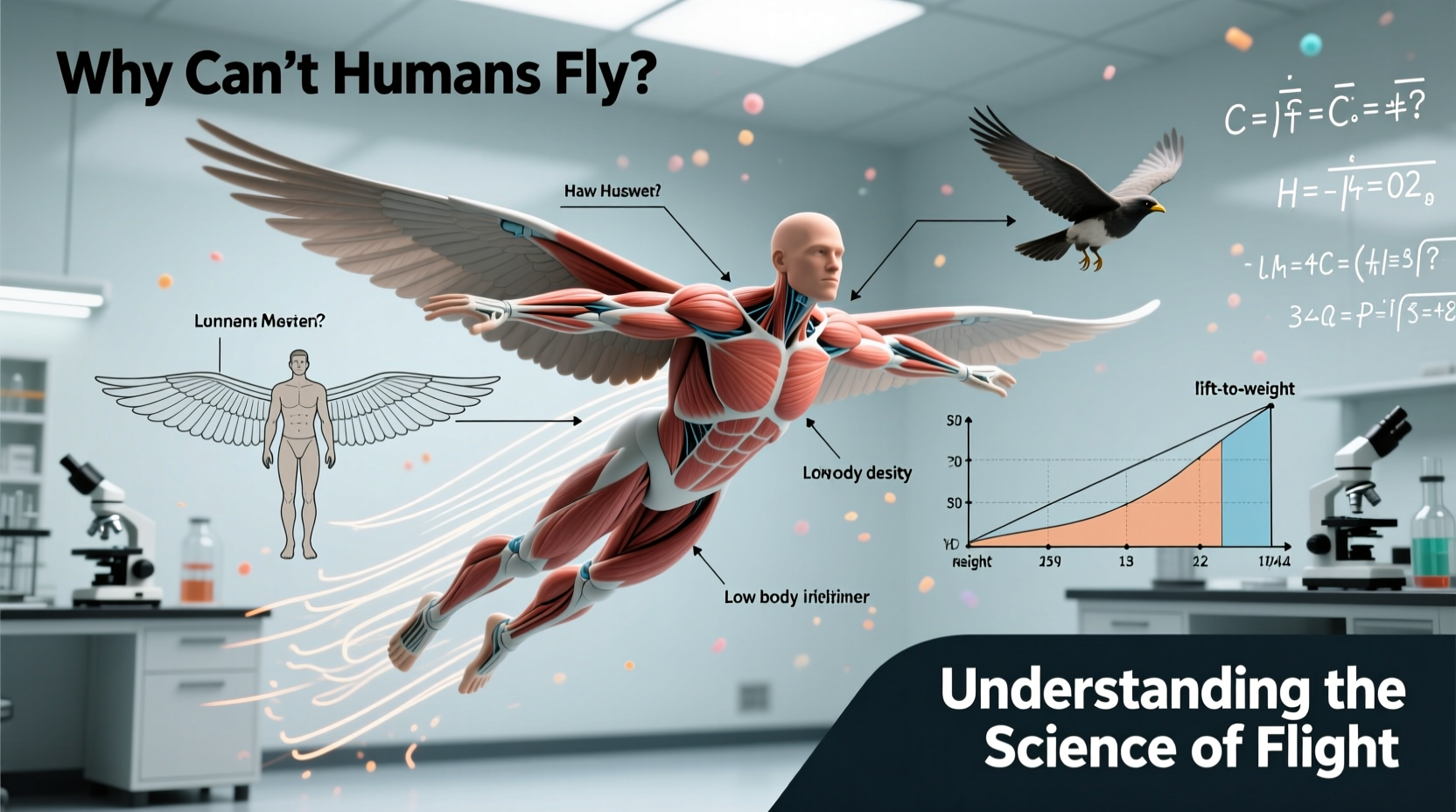
To achieve sustained flight, four fundamental forces must be balanced: lift, weight, thrust, and drag. Lift counteracts weight (gravity), while thrust overcomes drag (air resistance). In birds and aircraft, wings generate lift by shaping airflow so that pressure above the wing is lower than below. This difference creates an upward force.
Humans, however, lack the physical adaptations needed to generate sufficient lift. Our bodies are too heavy relative to our surface area, and we don’t possess wings or muscles powerful enough to produce the necessary thrust. Even if we could flap arms modified into wings, the energy required would far exceed what human muscles can deliver.
“Flight isn’t just about moving through air—it’s about optimizing form, strength, and energy use in a way that evolution hasn’t equipped humans for.” — Dr. Lena Patel, Biomechanics Researcher at MIT
Biological Limitations: Why Our Bodies Aren’t Built to Fly
Human anatomy is fundamentally unsuited for unaided flight. Consider the skeletal structure: birds have hollow bones that reduce weight without sacrificing strength. Their sternums are large and keeled, providing ample attachment points for flight muscles. In contrast, human bones are dense and heavy, optimized for upright walking, not aerial agility.
Muscle power is another barrier. A sparrow’s pectoral muscles make up about 15–20% of its body mass. In humans, those same muscles constitute less than 1%. Even elite athletes can’t match the power-to-weight ratio of flying creatures. Additionally, our metabolism doesn’t support the high-energy demands of flapping flight, which can require oxygen consumption rates ten times higher than resting levels.
How Other Creatures Fly: Lessons from Nature
Flight has evolved independently in four groups: insects, pterosaurs (extinct reptiles), birds, and bats. Each uses different mechanisms, but all share key traits: low body mass, specialized appendages, and efficient propulsion systems.
- Insects use rapid wing beats (up to 1,000 times per second in some mosquitoes) and exploit aerodynamic tricks like leading-edge vortices.
- Birds combine feathered wings with lightweight skeletons and highly efficient respiratory systems.
- Bats have flexible, membrane-covered wings that allow complex maneuvering at slow speeds.
None of these models are scalable to human size without radical changes. For instance, if a human were scaled up from a bird proportionally, their wingspan would need to exceed 20 feet—and even then, muscle strength would still fall short.
Comparison of Flight Adaptations Across Species
| Species | Avg. Wingspan | Body Mass | Wing Loading (N/m²) | Power Source |
|---|---|---|---|---|
| Pigeon | 0.8 m | 0.3 kg | 120 | Flapping (pectoral muscles) |
| Fruit Bat | 1.5 m | 1.0 kg | 85 | Flapping (modified limbs) |
| Human (hypothetical flyer) | 8–10 m* | 70 kg | >600* | Insufficient muscle output |
| Housefly | 0.01 m | 0.00012 kg | ~20 | Indirect flight muscles |
*Estimated values based on scaling laws; actual flight impossible with current human physiology.
How Humans Achieve Flight: Technology Over Biology
While our bodies can’t fly, our minds have engineered solutions. From Leonardo da Vinci’s ornithopter sketches to the Wright brothers’ first powered flight in 1903, humans have used ingenuity to conquer the skies. Modern aviation relies on fixed-wing aircraft, where engines provide thrust and wings generate lift passively as air flows over them.
Jet engines and propellers eliminate the need for muscle-powered flapping. Materials like aluminum and carbon fiber keep aircraft light yet strong. And control systems—ailerons, rudders, elevators—allow precise navigation through three-dimensional space.
Even personal flight devices exist today, though they remain niche. Jetpacks, such as the Gravity Industries model, use micro-turbines to lift a person for short durations. However, they require external fuel sources, extensive training, and are limited by battery or fuel life—far from natural flight.
Step-by-Step: How an Airplane Generates Flight
- Thrust Generation: Engines push the plane forward at high speed.
- Airflow Over Wings: As air moves faster over the curved upper surface, pressure drops (Bernoulli’s principle).
- Lift Creation: The pressure differential between upper and lower wing surfaces produces upward force.
- Overcoming Gravity: When lift exceeds the plane’s weight, it ascends.
- Controlled Movement: Pilots adjust control surfaces to steer, climb, or descend.
Mini Case Study: Attempting Human-Powered Flight
In 1977, engineer Paul MacCready achieved a milestone with the Gossamer Condor—a human-powered aircraft flown by cyclist Bryan Allen. With a wingspan of 29 meters (longer than a Boeing 737) and a weight of just 32 kg, it demonstrated that human-powered flight was possible—but only under ideal conditions and with extreme engineering compromises.
The pilot had to maintain continuous pedaling for over seven minutes to complete a figure-eight course. The aircraft flew slowly, close to the ground, and was highly vulnerable to wind. While a triumph of innovation, it underscored the impracticality of relying on human muscle alone for flight.
Checklist: Could Humans Ever Evolve to Fly?
- ✅ Reduce bone density significantly (without compromising structural integrity)
- ✅ Develop massive pectoral and back muscles (increasing metabolic demand)
- ✅ Evolve wing-like appendages with large surface area
- ✅ Alter body shape to minimize drag (streamlining head, torso, limbs)
- ✅ Increase lung capacity and oxygen efficiency dramatically
- ❌ All of these changes would conflict with terrestrial survival needs
In reality, evolution favors traits that enhance survival and reproduction. Flight would likely reduce human fitness on land—making it an improbable path for natural selection.
Frequently Asked Questions
Can humans ever fly like birds without machines?
No. Due to our body mass, muscle strength, and lack of aerodynamic features, unaided human flight is physically impossible with current biology. Even significant genetic modifications wouldn’t overcome the fundamental challenges of power, weight, and energy efficiency.
Why do some people believe humans should be able to fly?
This belief often stems from mythological stories (like Icarus) or misinterpretations of evolution. While humans are adaptable, evolution doesn’t aim toward \"ideal\" forms—it selects for reproductive success in specific environments. Flying offers no advantage in human ecological niches.
Are there animals similar in size to humans that can fly?
The largest flying animal known is *Quetzalcoatlus northropi*, a pterosaur with a 10–11 meter wingspan and estimated weight of 200–250 kg. However, it had a unique skeletal structure, air sacs throughout its body, and likely launched using all four limbs. No living creature near human size achieves true powered flight.
Conclusion: Embracing Our Limits, Expanding Our Horizons
Humans may never fly under their own power, but our inability to do so has driven some of our greatest achievements. Instead of evolving wings, we built them. We didn’t grow stronger muscles—we invented engines. The story of flight is not one of biological limitation, but of intellectual triumph.
Understanding why we can’t fly doesn’t diminish our connection to the sky—it deepens it. Every time you board a plane, watch a drone hover, or see a bird glide overhead, you’re witnessing the interplay between natural law and human creativity. Rather than wishing for wings, embrace the tools we’ve made to soar beyond them.




 浙公网安备
33010002000092号
浙公网安备
33010002000092号 浙B2-20120091-4
Comments
No comments yet. Why don't you start the discussion?