
Ostriches are among the most iconic birds on Earth—towering, fast, and unmistakable with their long necks and powerful legs. Yet one trait sets them apart from most of their avian relatives: they cannot fly. This absence of flight might seem like a disadvantage, but in reality, it’s the result of millions of years of evolutionary refinement. Flightlessness in birds like the ostrich is not a flaw but an adaptation to specific ecological niches. Understanding why ostriches can’t fly opens a window into broader patterns of evolution, survival, and biodiversity.
The Evolutionary Trade-Off: Flight vs. Ground Adaptation
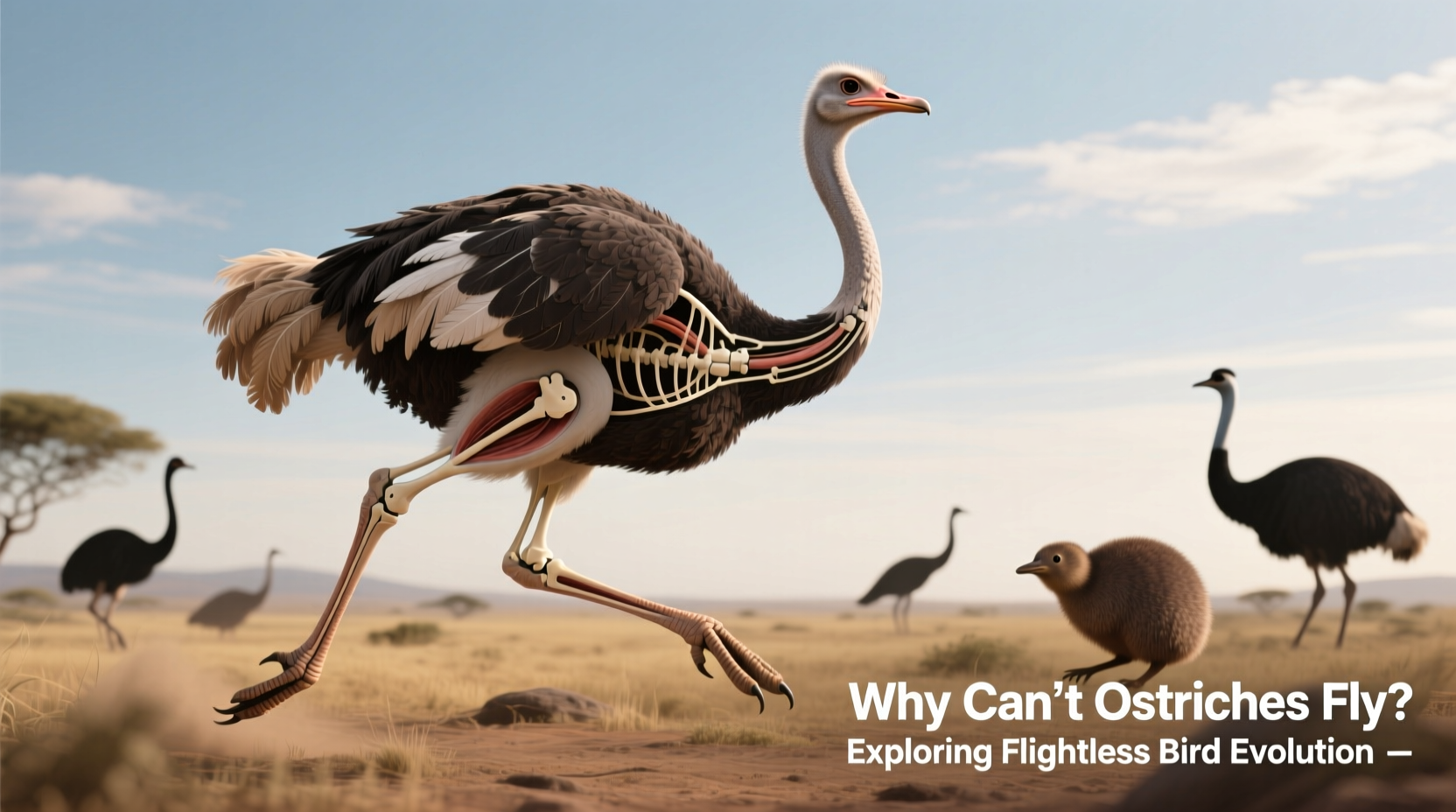
Birds evolved from small, feathered dinosaurs during the Mesozoic Era. Over time, many lineages developed the ability to fly—an energy-intensive but highly advantageous skill for escaping predators, finding food, and migrating. However, some bird species eventually lost this ability. Ostriches, emus, cassowaries, kiwis, and penguins are all modern examples of flightless birds, each evolving independently under similar pressures: stable environments with few predators and abundant ground-level resources.
In such conditions, natural selection favored traits that enhanced survival on land rather than in the air. For ostriches, living in the open savannas and arid regions of Africa, flying became unnecessary—and costly. Maintaining large flight muscles, lightweight bones, and complex wing structures requires significant energy. When those features no longer provide a survival advantage, mutations that reduce or eliminate them can persist and even spread through populations.
Anatomy of a Flightless Giant: How Ostriches Are Built for Speed, Not Sky
The physical structure of an ostrich reveals clear adaptations to terrestrial life. Weighing up to 320 pounds (145 kg) and standing over nine feet tall, ostriches are the largest living birds. Their size alone makes flight impossible—no known flying bird exceeds about 40 pounds, as muscle power and aerodynamics impose strict limits.
Unlike flying birds, which have large keels (sternum extensions) to anchor flight muscles, ostriches have flat, reduced sternums. Their wings are small relative to body size and lack the strong primary feathers needed for lift. Instead of using wings for propulsion, ostriches employ them for balance while running, courtship displays, and shading chicks from the sun.
Their legs, in contrast, are exceptionally developed. Powerful thigh muscles and elongated lower limbs allow ostriches to sprint at speeds up to 45 miles per hour (70 km/h)—faster than any other two-legged animal. Each foot has only two toes, a rare trait among birds, which increases stride efficiency and stability on uneven terrain.
“Flightlessness isn’t regression—it’s redirection. Ostriches didn’t lose the ability to fly; they gained the ability to dominate the ground.” — Dr. Lena Torres, Avian Evolution Biologist, University of Cape Town
Comparative Table: Flying vs. Flightless Birds
| Feature | Flying Bird (e.g., Pigeon) | Flightless Bird (e.g., Ostrich) |
|---|---|---|
| Sternum (Keel) | Large, pronounced keel for flight muscle attachment | Flat or reduced keel |
| Bone Density | Hollow, pneumatic bones to reduce weight | Denser, solid bones for strength and support |
| Wing Structure | Long, rigid primary feathers; aerodynamic shape | Short, soft feathers; non-aerodynamic |
| Leg Development | Lightweight, adapted for perching or walking | Powerful, built for speed and endurance |
| Energy Allocation | High metabolic cost for flight maintenance | Energy redirected to growth, reproduction, and locomotion |
A Global Pattern: Convergent Evolution in Flightless Birds
Flightlessness has evolved independently in at least 10 different bird lineages. This phenomenon—where unrelated species develop similar traits due to comparable environmental pressures—is known as convergent evolution. Ostriches (Africa), emus (Australia), rheas (South America), and moas (New Zealand, now extinct) all followed parallel paths toward flightlessness despite being geographically and genetically distant.
Islands played a critical role in this process. With no large mammalian predators and limited competition, birds like the dodo of Mauritius and New Zealand’s kakapo parrot abandoned flight. The absence of threats meant that investing energy in escape mechanisms like flight was wasteful. Instead, these birds grew larger, reproduced more slowly, and focused on foraging efficiency.
Penguins represent another branch of flightless evolution, though their wings adapted for swimming rather than running. Their \"flight\" occurs underwater, where flippers propel them through water with remarkable agility. This shift underscores a key principle: evolution doesn’t eliminate function—it repurposes it.
Mini Case Study: The Rise and Fall of the Moa
The moa, a group of nine species of giant flightless birds native to New Zealand, provides a sobering example of how quickly flightless species can vanish when new threats emerge. Standing up to 12 feet tall, moas thrived for millions of years in isolation. Without natural predators, they evolved without defensive behaviors or the ability to flee quickly.
When Polynesian settlers arrived around 1300 CE, bringing with them dogs and hunting tools, moas were easy prey. Within just a century, all moa species were driven to extinction. This case illustrates both the success and vulnerability of flightless birds: they thrive in stable ecosystems but collapse rapidly when those systems change.
Step-by-Step: How Flightlessness Evolves Over Time
- Isolation: A population of birds becomes geographically separated, often on an island with no terrestrial predators.
- Reduced Selective Pressure: Without predators, the need to escape via flight diminishes.
- Mutation Accumulation: Random genetic changes affecting wing development or muscle structure are no longer weeded out by natural selection.
- Energy Reallocation: Resources once used for flight are redirected toward reproduction, growth, or improved terrestrial locomotion.
- Fixation: Over generations, flightless individuals become dominant, and the trait becomes fixed in the population.
Expert Insight: Why Flightlessness Persists Today
While many flightless birds have gone extinct due to human activity, others like the ostrich remain resilient. Conservation biologist Dr. Arjun Patel explains: “Ostriches survived because their habitat remained relatively intact, and they evolved effective defenses—speed and keen eyesight. Unlike island species, they coexisted with large predators like lions and hyenas, so they retained strong survival instincts.”
“Evolution isn’t about progress—it’s about fit. An ostrich may not fly, but it’s perfectly adapted to its world.” — Dr. Arjun Patel, Conservation Biologist
FAQ
Can ostriches ever regain the ability to fly?
No. Re-evolving flight would require reversing countless anatomical and genetic changes across millions of years. Once a lineage loses complex traits like powered flight, reacquiring them is extremely unlikely due to the precise coordination of muscles, bones, and neural control needed.
Are all flightless birds large?
Not necessarily. While ostriches and emus are large, some flightless birds like the Inaccessible Island rail (the smallest flightless bird) weigh less than 2 ounces. Size depends on environmental factors, not flightlessness itself.
Do ostriches have any predators despite their speed?
Yes. Lions, cheetahs, leopards, and African wild dogs hunt adult ostriches, while hyenas and jackals target eggs and chicks. Their speed and powerful kicks are key defenses, but young birds remain vulnerable.
Checklist: Key Factors That Lead to Flightlessness
- Geographic isolation (especially on islands)
- Absence of natural predators
- Abundant food sources on the ground
- Low competition from mammals
- Stable climate reducing need for migration
- High energy cost of maintaining flight apparatus
Conclusion
The inability of ostriches to fly is not a shortcoming but a testament to the power of evolution. By shedding the demands of flight, they gained unmatched speed, size, and resilience on land. Their story mirrors that of many flightless birds—species that traded the sky for dominance on solid ground. As habitats continue to change and human influence grows, understanding these evolutionary pathways becomes crucial for conservation and appreciation of biodiversity.




 浙公网安备
33010002000092号
浙公网安备
33010002000092号 浙B2-20120091-4
Comments
No comments yet. Why don't you start the discussion?