
In an era where organizations rely heavily on data to make strategic decisions, the quality and reliability of that data are non-negotiable. Data integrity refers to the accuracy, consistency, and trustworthiness of data throughout its lifecycle—from creation and storage to retrieval and deletion. When data integrity is compromised, even minor errors can cascade into major operational failures, regulatory penalties, or financial loss. Ensuring robust data integrity isn't just a technical requirement; it's a foundational element of trustworthy business operations.
What Is Data Integrity? A Clear Definition
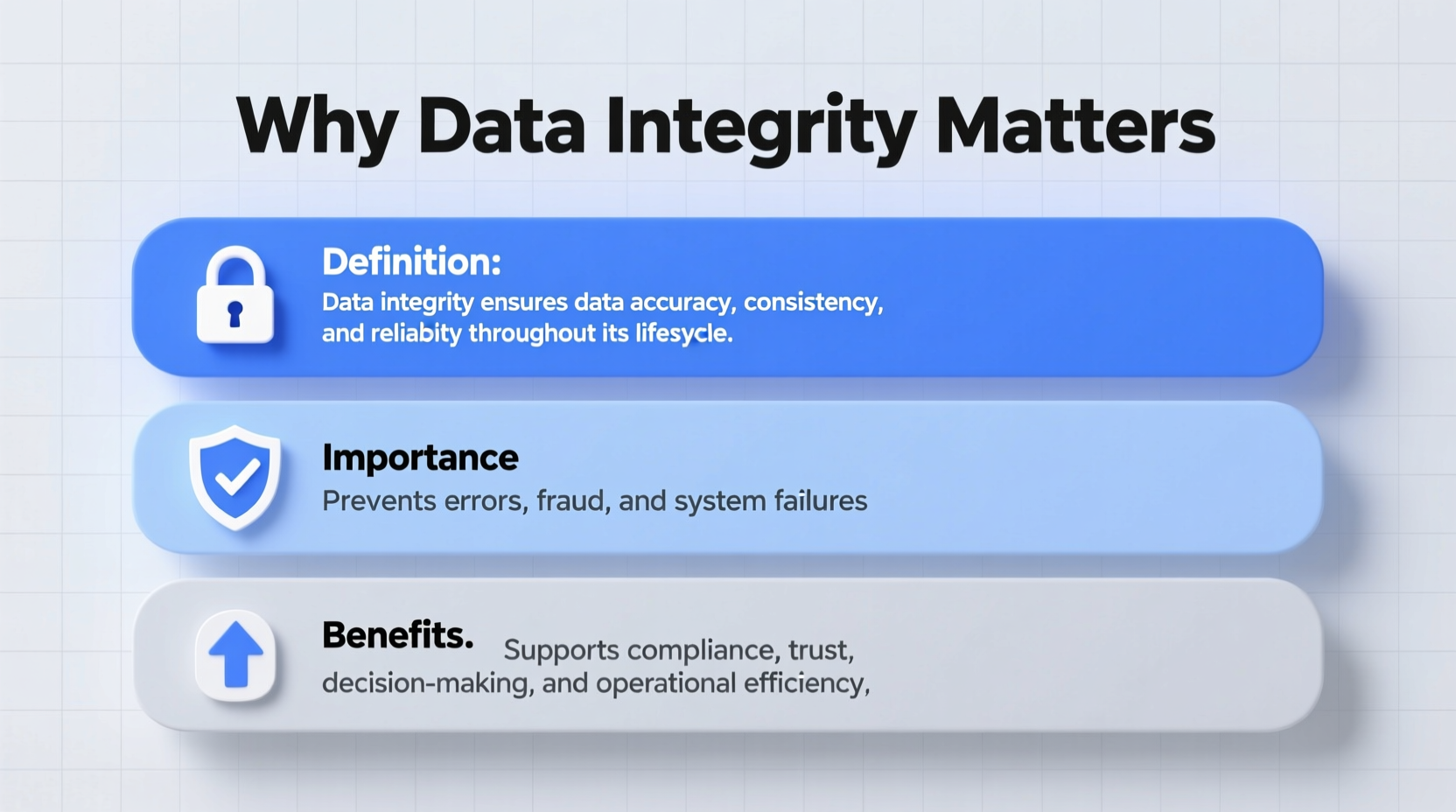
Data integrity is the assurance that data remains unaltered, complete, and accurate during any operation—including transfer, storage, or retrieval. It means that the information stored in databases, spreadsheets, or cloud systems reflects reality and has not been corrupted by human error, cyberattacks, software bugs, or hardware malfunctions.
There are two primary types of data integrity:
- Physical Integrity: Protects data from physical threats such as power outages, fire, natural disasters, or hardware failure.
- Logical Integrity: Ensures data makes sense within its context, maintaining consistency across relationships and preventing unauthorized or illogical changes.
For example, if a hospital database records patient allergies, logical integrity ensures that no contradictory entries exist (e.g., listing a patient as both allergic and non-allergic to penicillin), while physical integrity ensures those records aren’t lost due to server crashes.
The Importance of Data Integrity in Modern Organizations
Data drives nearly every aspect of modern business—from customer relationship management to supply chain logistics and AI-powered analytics. Without reliable data, these systems falter. Poor data integrity leads to misinformation, flawed forecasts, and poor decision-making.
Consider a retail company forecasting inventory needs based on sales trends. If historical sales data contains duplicates, missing entries, or incorrect figures, the forecast will be inaccurate. This could result in overstocking (tying up capital) or stockouts (losing customers). The ripple effect impacts procurement, marketing, and revenue.
Moreover, industries like healthcare, finance, and pharmaceuticals operate under strict regulatory frameworks such as HIPAA, GDPR, or FDA 21 CFR Part 11. These regulations mandate stringent data integrity controls because lives and public safety depend on accurate information.
“Data without integrity is not just useless—it’s dangerous.” — Dr. Lena Patel, Chief Data Officer at MedAnalytics Inc.
Key Benefits of Maintaining Strong Data Integrity
Organizations that prioritize data integrity gain several tangible advantages:
- Improved Decision-Making: Executives and managers can trust reports and dashboards when they know the underlying data is sound.
- Regulatory Compliance: Meeting legal requirements avoids fines, audits, and reputational damage.
- Operational Efficiency: Clean, consistent data reduces time spent correcting errors or reconciling discrepancies.
- Customer Trust: Accurate billing, personalized service, and secure handling of personal information build long-term loyalty.
- Enhanced Security: Systems with strong integrity checks are less vulnerable to tampering and insider threats.
A financial institution using automated fraud detection models, for instance, depends entirely on clean transaction logs. Any manipulation or corruption in this data could allow fraudulent activity to go undetected—or worse, falsely flag legitimate customers.
Common Threats to Data Integrity
Several factors can compromise data integrity, often without immediate detection:
- Human Error: Mistyped entries, accidental deletions, or misconfigured settings.
- Software Bugs: Glitches in applications that alter or misroute data.
- Cyberattacks: Malware, ransomware, or SQL injection attacks designed to corrupt or steal data.
- Hardware Failures: Disk crashes, memory errors, or network interruptions.
- Lack of Access Controls: Unauthorized users modifying or deleting sensitive records.
To mitigate these risks, organizations must implement both preventive and detective measures.
Data Integrity: Do’s and Don’ts
| Do’s | Don’ts |
|---|---|
| Implement role-based access controls | Allow unrestricted editing rights to all employees |
| Use checksums and hash verification for file transfers | Assume files are intact without validation |
| Conduct regular data audits and validation checks | Ignore inconsistent or outlier data points |
| Encrypt sensitive data at rest and in transit | Store confidential data in plain text |
| Automate backups with version control | Rely solely on manual backup processes |
Step-by-Step Guide to Strengthening Data Integrity
Building a culture of data integrity requires deliberate action. Follow this five-step process to establish a solid foundation:
- Assess Current Data Practices: Audit existing databases, identify vulnerabilities, and classify data by sensitivity and criticality.
- Define Data Governance Policies: Establish rules for data entry, modification, retention, and deletion. Assign ownership and accountability.
- Deploy Technical Safeguards: Use database constraints, encryption, logging, and hashing to prevent and detect tampering.
- Train Employees: Educate staff on best practices, phishing awareness, and proper data handling protocols.
- Monitor and Review Continuously: Implement real-time monitoring tools and schedule periodic reviews to ensure ongoing compliance.
Real-World Example: How a Pharma Company Avoided a Regulatory Crisis
A mid-sized pharmaceutical manufacturer was preparing for an FDA audit of its clinical trial data. During an internal review, auditors discovered inconsistencies in temperature logs from sample storage units. Some timestamps were missing, and others showed impossible fluctuations.
Further investigation revealed that a faulty sensor had been sending erratic signals, and no validation mechanism was in place to flag invalid readings. Thanks to proactive auditing and version-controlled backups, the team restored correct data from a trusted source and implemented automated anomaly detection.
The correction prevented a potential compliance violation that could have delayed drug approval by months. More importantly, it reinforced the need for end-to-end data integrity protocols in regulated environments.
Frequently Asked Questions
What is the difference between data quality and data integrity?
Data quality refers broadly to how fit data is for its intended use—covering accuracy, completeness, timeliness, and relevance. Data integrity is a subset of data quality focused specifically on ensuring data remains accurate and consistent throughout its lifecycle. While related, integrity emphasizes protection against corruption and unauthorized change.
Can cloud storage ensure data integrity?
Reputable cloud providers offer built-in mechanisms like redundancy, encryption, and checksums to support data integrity. However, ultimate responsibility lies with the organization. Users must configure access controls, enable logging, and perform independent verification to fully safeguard their data.
How often should data integrity checks be performed?
Frequency depends on data criticality. High-risk systems (e.g., medical devices, financial ledgers) should undergo continuous monitoring. For most organizations, weekly automated scans and quarterly comprehensive audits strike a balance between security and efficiency.
Action Plan: Building a Data Integrity Checklist
Use this checklist to evaluate and improve your organization’s data integrity posture:
- ✅ Identify all critical data assets and map their lifecycle
- ✅ Implement user authentication and granular permission levels
- ✅ Enable audit trails for all data modifications
- ✅ Apply encryption for sensitive data at rest and in transit
- ✅ Schedule automatic backups with offsite storage
- ✅ Run monthly data validation and cleansing routines
- ✅ Train employees annually on data handling policies
- ✅ Conduct third-party audits at least once per year
Conclusion: Make Data Integrity a Strategic Priority
Data is only as valuable as its integrity allows. Inaccurate, incomplete, or corrupted data undermines confidence, distorts insights, and exposes organizations to risk. By defining clear policies, leveraging technology, and fostering a culture of accountability, businesses can protect the authenticity and reliability of their information assets.




 浙公网安备
33010002000092号
浙公网安备
33010002000092号 浙B2-20120091-4
Comments
No comments yet. Why don't you start the discussion?