
The joke \"Why did the deer go to the dentist?\" has become a staple of lighthearted humor across playgrounds, classrooms, and internet meme pages. On the surface, it sounds like a whimsical setup for a punchline rooted in animal absurdity. But beneath its simplicity lies a clever blend of wordplay, phonetic punning, and cognitive surprise—hallmarks of effective comedy. This article dissects why this particular joke works so well, explores variations that keep it fresh, and reveals how such humor engages both children and adults on different levels.
The Classic Punchline and Its Linguistic Twist
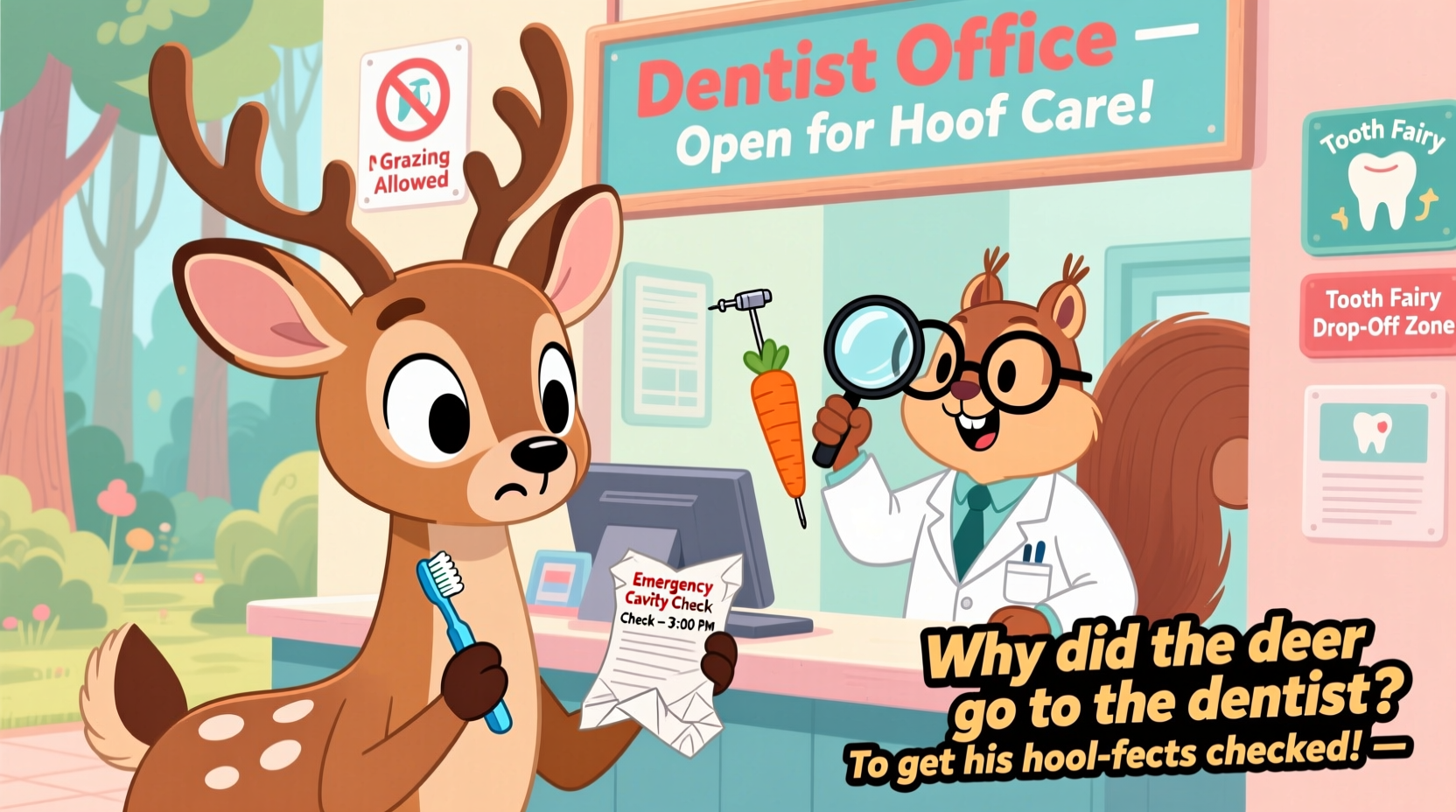
The most common answer to “Why did the deer go to the dentist?” is: “To get a buck fixed!”
This punchline hinges on a double meaning. In American English, “buck” refers to a male deer. At the same time, “buck” is slang for a dollar. So when we hear “get a buck fixed,” our brain initially interprets it as fixing money—perhaps repairing a torn bill or correcting counterfeit currency. But the twist comes when we realize the joke operates on two tracks: biological (a deer needing dental work) and financial (paying for services). The humor emerges from this sudden shift in context—a phenomenon known as incongruity resolution.
“Puns are the highest form of wit because they demand active participation from the listener. You have to decode them.” — Dr. Lydia Chen, Cognitive Linguist at Stanford University
This dual-layer interpretation makes the joke memorable. It’s not just silly; it requires mental agility to appreciate fully. Children may laugh at the image of a deer in a dentist's chair, while adults chuckle at the monetary pun embedded within.
Why Animal Jokes Resonate Across Ages
Jokes involving animals in human scenarios tap into a long tradition of anthropomorphism in storytelling—from Aesop’s fables to modern animated films. When animals act like people, we experience cognitive dissonance that primes us for laughter. The idea of a deer scheduling a dental appointment violates expectations, yet feels oddly plausible in the exaggerated world of joke logic.
Deer, in particular, are associated with grace and timidity. Placing them in a clinical, potentially painful environment like a dentist’s office creates comedic contrast. Add to that the visual of antlers awkwardly bumping into equipment, and you’ve got layers of physical and verbal humor working together.
Variations That Keep the Joke Alive
Like all enduring jokes, this one thrives through adaptation. Here are several popular variations that maintain the core structure while introducing new twists:
- \"Because he had a buck tooth!\" – A direct anatomical pun referencing protruding front teeth, commonly called \"buck teeth.\"
- \"He needed a molar replacement—he lost one during rutting season.\" – Adds faux-scientific detail for comedic exaggeration.
- \"His gums were feeling tender—after all, he’s been chewing cud all day!\" – Incorporates real deer biology (rumination) into the humor.
- \"He heard the dentist was offering a ‘hoof and tooth’ care package.\" – Blends equine terminology with dental services for absurd cross-species marketing.
These adaptations show how a single joke framework can be expanded creatively. Each version appeals to different audiences: kids enjoy slapstick and simple puns, while older listeners appreciate satire and biological accuracy twisted for effect.
A Closer Look at Wordplay Mechanics
To understand why these punchlines succeed, consider the linguistic components at play:
| Element | Description | Example from Joke |
|---|---|---|
| Homophonic Pun | Words that sound alike but have different meanings | “Buck” (animal) vs. “buck” (dollar) |
| Double Entendre | A phrase with two interpretations, one often risqué or humorous | “Get a buck fixed” implies mechanical repair or financial transaction |
| Incongruity | Mismatch between expectation and reality | Deer don’t visit dentists—yet the premise treats it seriously |
| Anthropomorphism | Attributing human traits to non-human entities | Deer making appointments, worrying about oral hygiene |
This table illustrates how multiple comedic devices operate simultaneously. The best jokes aren’t reliant on a single trick—they layer techniques to create richer, more satisfying payoffs.
Real-World Application: Humor in Education and Therapy
Consider a real example from an elementary school classroom in Portland, Oregon. A third-grade teacher used the “deer dentist” joke during a language arts lesson on homonyms. After presenting the riddle, students were asked to identify words with multiple meanings and create their own animal-based puns.
One student responded with: “Why did the bear go to the bakery? Because he kneaded dough!” Another offered: “Why did the owl go to therapy? He had deep-rooted issues.”
The exercise not only boosted engagement but also reinforced vocabulary retention. Students remembered “buck” as both currency and animal far better than through flashcards alone. Teachers reported increased participation and spontaneous use of puns in creative writing assignments.
“When kids laugh while learning, the information sticks. Humor reduces anxiety and opens cognitive pathways.” — Maria Gonzalez, Elementary Educator & Author of *Playful Pedagogy*
Step-by-Step Guide to Creating Your Own Animal Puns
If you want to craft jokes in the same spirit, follow this five-step process:
- Pick an animal with a name that doubles as a common noun or verb (e.g., bear, mole, crane, bat).
- Identify human activities that could comically involve that animal (dentistry, banking, cooking, tech support).
- Find overlapping vocabulary between the animal’s traits and the activity (e.g., “bat” = sports equipment / flying mammal).
- Build a setup using standard joke structure: “Why did the [animal] go to the [place]?”
- Deliver a punchline that exploits the double meaning, ideally with a straight face.
For instance: Why did the bat go to IT support? Because it had some serious bugs in its system!
Common Mistakes to Avoid in Pun Writing
Not all attempts at wordplay land successfully. Here are frequent pitfalls and how to avoid them:
| Do | Don’t |
|---|---|
| Keep punchlines concise and snappy | Over-explain the joke after telling it |
| Use familiar homophones (bear/bare, flour/flower) | Rely on obscure or region-specific slang |
| Match the audience’s age and knowledge level | Assume everyone will get complex references |
| Test delivery timing—pause before the punchline | Rush through the setup without emphasis |
Frequently Asked Questions
Is this joke appropriate for children?
Absolutely. The humor is clean, imaginative, and encourages linguistic thinking. It doesn’t rely on sarcasm, irony, or adult themes, making it ideal for young audiences.
Can puns improve communication skills?
Yes. Constructing and interpreting puns strengthens semantic flexibility—the ability to see multiple meanings in words. This skill enhances reading comprehension, creativity, and even social bonding through shared laughter.
Are there cultural differences in how this joke is received?
Yes. In countries where “buck” isn’t used for dollar (like the UK), the financial pun may fall flat. However, the “buck tooth” version remains universally understandable due to its anatomical reference.
Conclusion: The Lasting Power of Simple Laughter
The joke “Why did the deer go to the dentist?” endures because it balances absurdity with intelligence. It invites us to smile at the ridiculous image of a deer in a dental chair while rewarding us with a clever linguistic payoff. Whether told by a child at recess or shared in a corporate icebreaker, it serves as a reminder that humor doesn’t need complexity to be effective.
More than just a giggle, jokes like this foster connection, stimulate thought, and lighten moods. They prove that sometimes, the simplest ideas—rooted in wordplay and imagination—are the ones that last the longest.




 浙公网安备
33010002000092号
浙公网安备
33010002000092号 浙B2-20120091-4
Comments
No comments yet. Why don't you start the discussion?