
In 2008, a decades-long era in Pacific Northwest sports came to an abrupt end when the Seattle SuperSonics—affectionately known as the Sonics—relocated to Oklahoma City and became the Thunder. For fans who had supported the team since its inception in 1967, the move was more than just a change of venue; it felt like a betrayal. The question remains: why did the Sonics leave Seattle? The answer lies in a complex mix of stadium disputes, ownership decisions, political hurdles, and legal battles that unfolded over several years.
The Rise and Legacy of the Sonics
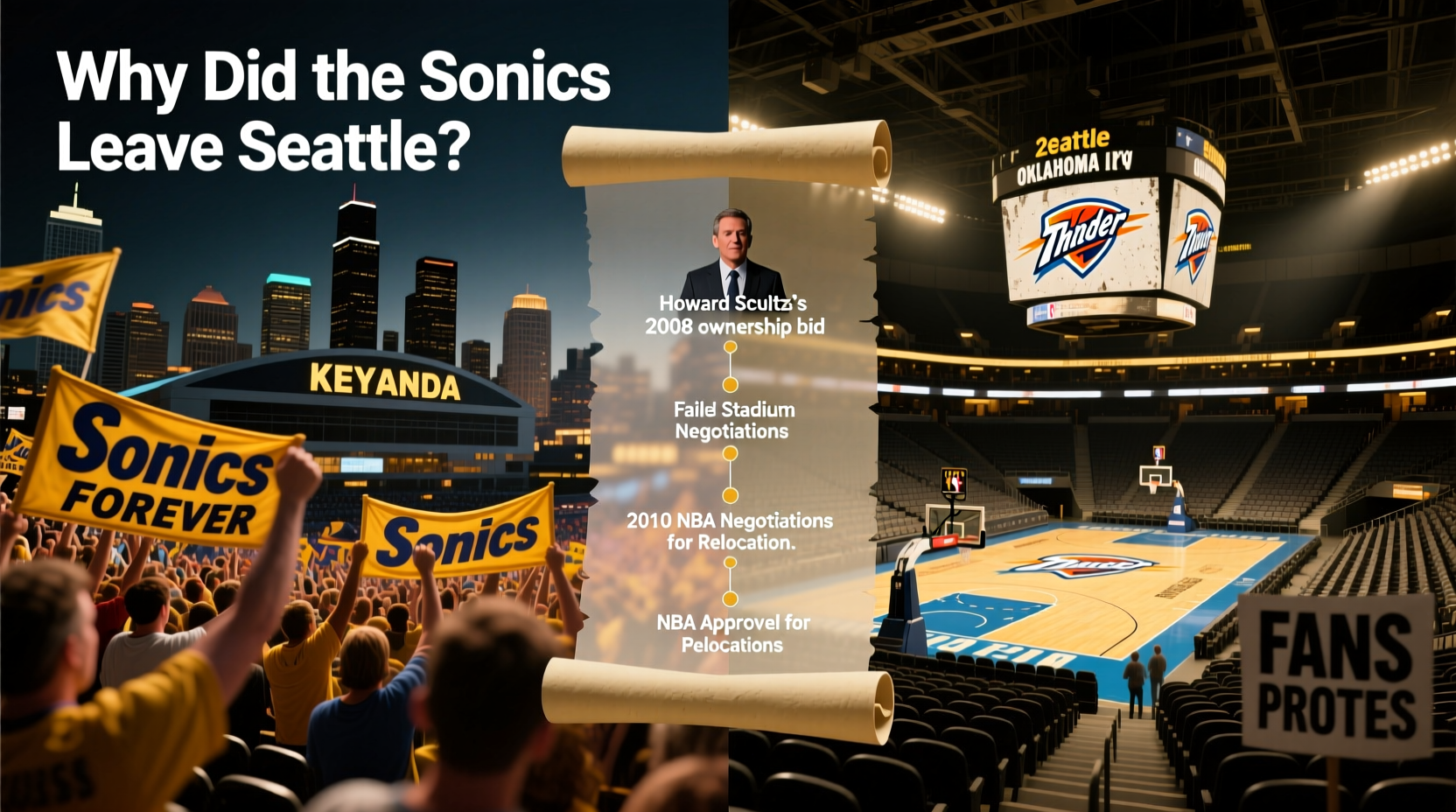
Founded in 1967, the Seattle SuperSonics were one of the NBA’s expansion teams and quickly became a cornerstone of the city’s cultural identity. With three NBA Finals appearances and a championship win in 1979, the team built a passionate fan base known for their electric support at KeyArena (originally the Seattle Center Coliseum).
Throughout the 1980s and 1990s, the Sonics remained competitive, highlighted by the dominant 1995–96 season when they won 64 games and reached the NBA Finals. Players like Gary Payton, Shawn Kemp, and later Ray Allen became household names. Despite ups and downs, the team consistently drew strong attendance and maintained community engagement—factors that made their eventual departure all the more painful.
Stadium Struggles: The Core of the Conflict
The central issue behind the Sonics’ relocation was the deteriorating condition of KeyArena and the lack of public funding for a modern replacement. By the early 2000s, the arena was outdated compared to newer NBA venues. It lacked luxury suites, premium seating, and modern revenue-generating amenities critical to franchise profitability.
In 2004, the ownership group led by Howard Schultz—the Starbucks CEO who purchased the team in 2001—began pushing for public investment to renovate or replace the arena. They proposed a $200 million renovation plan with $120 million expected from public funds. However, Washington State lawmakers rejected the request, citing budget constraints and public opposition to using taxpayer money for a private sports team.
Oklahoma City's Opportunity
While Seattle hesitated, other cities saw an opportunity. Oklahoma City, which had hosted the New Orleans Hornets temporarily after Hurricane Katrina, demonstrated strong attendance and civic enthusiasm for professional basketball. This performance caught the attention of out-of-town investors looking for a viable market.
Ownership Shift and Secret Negotiations
Frustrated by the lack of progress in Seattle, Howard Schultz decided to sell the team in 2006. He sold it to an investment group called the Professional Basketball Club LLC, led by Clay Bennett—a businessman from Oklahoma City. At the time, Bennett claimed his group intended to keep the team in Seattle and continue pursuing a new arena.
However, leaked documents later revealed internal communications suggesting Bennett’s true intention was always to relocate the team to Oklahoma City. Emails showed discussions about branding changes, marketing strategies, and even potential new logos—all before relocation approval.
“From day one, we believed we could make this work in Seattle. But without a viable long-term arena solution, we couldn’t sustain the business.” — Clay Bennett, 2008 testimony
The NBA requires owners to make a “good faith” effort to secure local support before relocating. Critics argued Bennett manipulated this process, prolonging negotiations while preparing for a move. In 2007, he formally requested permission to relocate, citing insufficient public backing for a new arena.
Legal Battle and Failed Stay
The City of Seattle fought back. It filed a lawsuit to enforce the KeyArena lease, which ran through 2010, arguing the Sonics couldn’t break the contract without paying $300 million. The goal was not necessarily to keep the team forever but to buy time for a potential buyer committed to staying.
Ultimately, a settlement was reached in July 2008. Bennett agreed to pay $45 million immediately and up to $30 million more if Seattle didn’t get a replacement team within five years. In exchange, the team was allowed to relocate to Oklahoma City for the 2008–09 season.
The move was finalized, and the Seattle SuperSonics ceased to exist. The Thunder played their first game in OKC in October 2008, marking the end of an era.
What Was Lost—and What Remains
| Aspect | Seattle Era (1967–2008) | Oklahoma City (2008–Present) |
|---|---|---|
| Team Name | SuperSonics | Thunder |
| Championships | 1 (1979) | 0 |
| Home Arena | KeyArena / Climate Pledge Arena | Paycom Center |
| Franchise Records | Retained by NBA, stored in league archives | New franchise history begins 2008 |
| Logo & Colors | Green, gold, navy | Blue, orange, yellow |
Note: While the Thunder is considered a continuation of the Sonics franchise by the NBA, Seattle fans widely view them as separate. The Sonics’ history, records, and legacy remain officially tied to the organization—but not to Oklahoma City’s branding.
Efforts to Bring the NBA Back to Seattle
Since the departure, there has been persistent grassroots momentum to return the NBA to Seattle. In 2018, the renovated Climate Pledge Arena opened with state-of-the-art facilities designed to attract an NBA (and NHL) team. Backed by Oak View Group and billionaire investor David Bonderman, the venue meets modern league standards.
In 2023, the NBA expanded its focus on growth markets, reigniting speculation. Former Sonics players, including Gary Payton and Shawn Kemp, have publicly advocated for a return. Local politicians and business leaders continue lobbying the league.
Mini Case Study: Sacramento Kings Relocation Attempt (2011–2013)
In the early 2010s, the Sacramento Kings faced a similar threat of relocation. Owners sought to move the team to Seattle, where a group led by Chris Hansen proposed building a new arena. The plan nearly succeeded—until the NBA stepped in.
Under Commissioner David Stern, the league blocked the sale and relocation, instead supporting a locally backed effort to build the Golden 1 Center. This precedent showed that the NBA values stability and community investment. Ironically, it also proved that Seattle’s bid was credible enough to be taken seriously—even if unsuccessful.
This case underscores a critical point: Seattle’s failure wasn’t due to lack of interest or capability, but timing, ownership motives, and political will.
FAQ
Did Seattle ever get compensation for losing the Sonics?
Yes. As part of the 2008 settlement, the city received $45 million upfront and up to $30 million more if no NBA team returned within five years. Since no team returned by 2013, Seattle collected the full amount. These funds were used for youth sports programs and arena improvements.
Can the Sonics name and colors come back?
Possibly. The NBA retains control of the SuperSonics name, logos, and color scheme. If Seattle regains an NBA franchise, there is strong sentiment—and likely league cooperation—for reviving the Sonics brand. Several mockups and fan campaigns already exist.
Is another NBA team coming to Seattle soon?
There is no official timeline, but conditions are favorable. With Climate Pledge Arena ready, growing regional wealth, and strong corporate sponsorship potential, Seattle is widely regarded as one of the top candidate cities for expansion or relocation. The next few years could be pivotal.
Conclusion: A Story of Loss, Resilience, and Hope
The Sonics didn’t leave Seattle because fans stopped caring—they left because a narrow window of opportunity closed amid financial disagreements and questionable ownership intentions. The pain of the relocation still lingers, but so does the passion for the game in the Emerald City.
Today, Seattle stands better prepared than ever to host an NBA franchise. The infrastructure is in place, the market is proven, and the desire is undeniable. Whether through expansion or the return of displaced history, the dream of Sonics basketball roaring back to life remains alive.




 浙公网安备
33010002000092号
浙公网安备
33010002000092号 浙B2-20120091-4
Comments
No comments yet. Why don't you start the discussion?