
In the dark and layered world of *Jujutsu Kaisen*, few moments carry as much emotional weight and narrative significance as the confrontation between Toji Fushiguro and his son, Megumi. This brutal encounter isn’t just a clash of strength—it’s a collision of fate, ideology, and familial tragedy. Understanding why Toji attacked Megumi requires delving into character history, thematic contrasts, and the larger philosophical framework of the series. The answer lies not in malice alone, but in a calculated choice shaped by survival, rejection of destiny, and a twisted sense of liberation.
The Origins of a Father-Son Divide
Toji Fushiguro was born into the Zenin clan, one of the three great sorcerer families in Japan. Despite this prestigious lineage, he lacked any cursed energy—a fatal flaw in a world where power is inherited through spiritual ability. Viewed as worthless by his family, Toji was cast out, stripped of his name, and left to survive on the fringes of society. His resentment toward the jujutsu world runs deep, not because he failed it, but because it rejected him for something beyond his control.
Megumi, born years later, possesses immense cursed energy and the rare Ten Shadows Technique—exactly the traits Toji never had. From birth, Megumi was destined to be a tool of the Zenin clan, raised under the expectation that he would serve their legacy. When Satoru Gojo rescues Megumi from this oppressive fate, he gives him freedom—but also separates him from any connection to his father.
Toji doesn’t know Megumi personally. He doesn’t hate him for who he is. But he sees in Megumi everything he was denied: recognition, purpose, and a place in the system that discarded him. This creates a tragic irony—Toji attacks Megumi not out of personal vengeance, but because Megumi symbolizes the very world Toji has sworn to dismantle.
Contract with Suguru Geto: A Mission of Elimination
The immediate reason for the attack stems from Toji’s alliance with Suguru Geto during the Goodwill Event arc. At this point, Geto has abandoned the role of a jujutsu sorcerer and declared war on non-sorcerers. However, before his ideological shift fully crystallizes, he hires Toji—a mercenary with no cursed energy but peak human physicality—to eliminate potential threats among the next generation of sorcerers.
Toji’s target list includes Yuji Itadori and, critically, Megumi Fushiguro. His mission is simple: kill them before they grow strong enough to interfere with future plans. Toji takes the job not out of loyalty to Geto, but because it pays well and allows him to test his body against powerful opponents. For Toji, fighting strong sorcerers—even children—is both profitable and fulfilling.
This context reframes the fight: it wasn’t personal. It was professional. Yet, the emotional impact is deeply personal for Megumi, who learns mid-battle that the man trying to kill him is his biological father.
Key Motivations Behind Toji’s Actions
- Survival and Independence: Toji lives outside the jujutsu system. Killing its heirs reaffirms his autonomy.
- Rejection of Fate: He resents being judged unworthy at birth. Destroying those favored by fate is symbolic revenge.
- Physical Fulfillment: Without cursed energy, combat is his only way to feel alive. Strong opponents are a rare thrill.
- Financial Incentive: The Zenin clan paid him to eliminate Megumi, adding a contractual obligation.
“Power isn’t about cursed energy. It’s about what you can do with your body.” — Toji Fushiguro
The Fight: Brutality and Symbolism
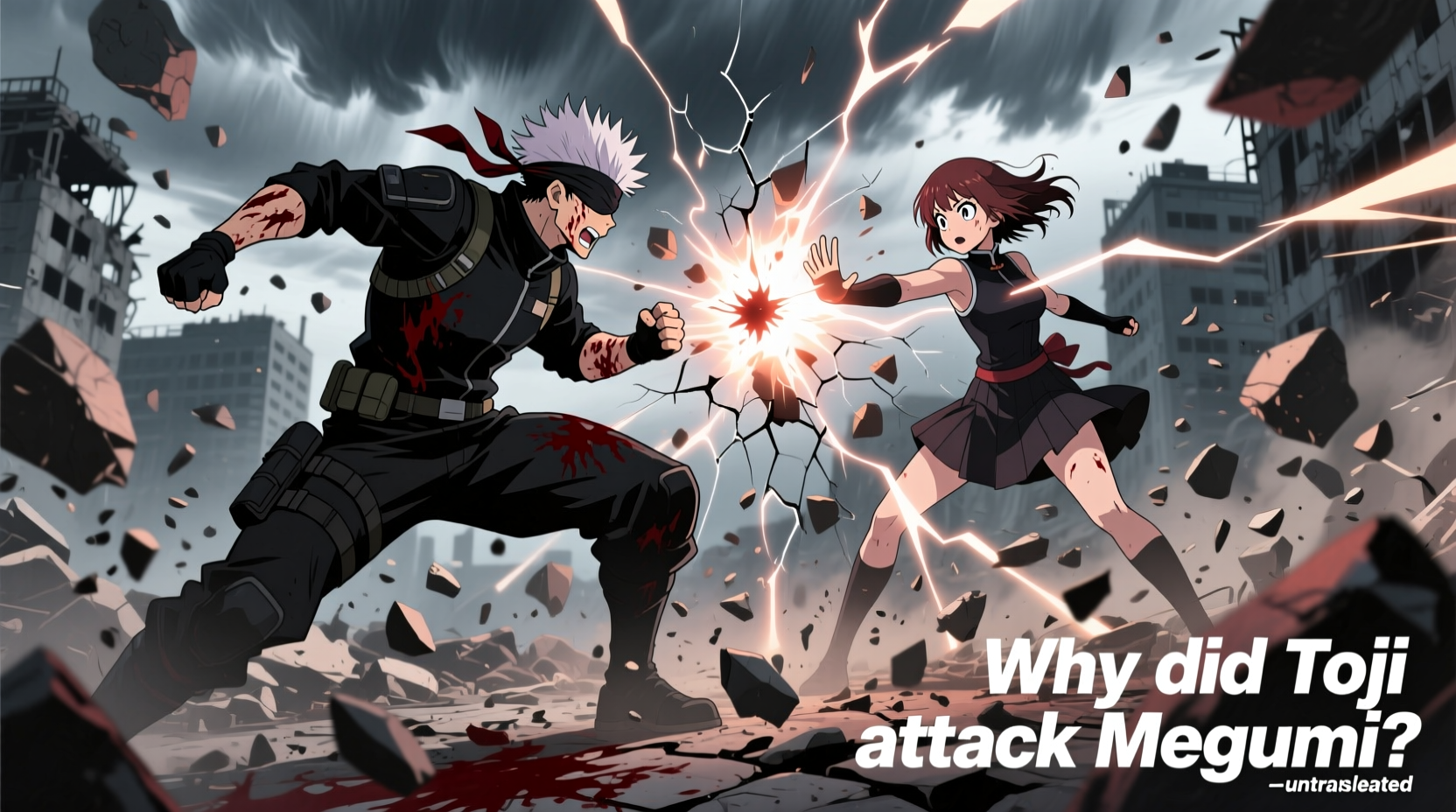
The battle itself is one of the most harrowing in the series. Toji dismantles Megumi’s shikigami one by one, demonstrating how raw physical prowess can overpower even advanced techniques. He doesn’t gloat or taunt—he fights efficiently, clinically, like a predator eliminating prey. When Megumi summons Mahadeva, Toji crushes the shikigami effortlessly, showcasing the terrifying gap between natural talent and trained mastery.
What makes the scene devastating is Megumi’s realization. Mid-fight, he identifies Toji through facial resemblance and confirms it with a locket containing a photo of himself as a baby—left behind by his father. This revelation doesn’t soften Toji. If anything, it hardens him. He tells Megumi: “I don’t care if you’re my son. You’re still a sorcerer.”
This line cuts to the core of Toji’s worldview. Blood means nothing compared to identity. By becoming a jujutsu sorcerer, Megumi aligned himself with the system that exiled Toji. In Toji’s eyes, Megumi chose his enemies—the same people who cast Toji aside.
Timeline of the Encounter
- Pre-Fight: Toji infiltrates Kyoto Jujutsu High under cover of darkness, hired to eliminate key students.
- First Contact: He ambushes Megumi, quickly overwhelming him with speed and precision.
- Shikigami Battle: Megumi summons Nue, then Hanuman, then Mahadeva—all destroyed in rapid succession.
- Emotional Breakpoint: Megumi recognizes Toji as his father after seeing the locket.
- Climax: Toji prepares to deliver a killing blow, but is interrupted by Gojo’s arrival.
Fatherhood, Legacy, and What Could Have Been
The tragedy of this fight lies in its inevitability. There was no version of this meeting that ended peacefully. Toji had already severed all ties to his past. Megumi, raised without knowledge of his father, had built an identity separate from the Zenin name. Their values were diametrically opposed before they ever met.
Yet, Gege Akutami uses this moment to explore deeper themes: the burden of inheritance, the cost of power, and whether blood truly binds people together. Megumi spends much of the series grappling with his dual identity—son of Toji, heir to the Zenin, student of Gojo. This fight forces him to confront the part of himself he never knew, and to reject the nihilism his father embodies.
In a twisted way, Toji’s attack becomes a perverse act of liberation. By trying to kill Megumi, he frees him from the illusion of reconciliation. Megumi realizes he doesn’t need to become like his father—or like the Zenin clan. He can forge his own path.
| Aspect | Toji Fushiguro | Megumi Fushiguro |
|---|---|---|
| Cursed Energy | None (Empty) | High (Ten Shadows Technique) |
| Clan Affiliation | Disowned by Zenin | Biologically tied, but rejects legacy |
| Philosophy | Rejects jujutsu system; lives by strength | Seeks to protect others within the system |
| Relationship to Power | Denied it; overcomes through body | Inherited it; struggles with responsibility |
| Fate | Killed by Gojo | Becomes independent sorcerer |
FAQ
Did Toji know Megumi was his son before the fight?
Yes. Toji was given Megumi’s photo and personal details as part of the assassination contract. He recognized Megumi but chose to proceed anyway, indicating that paternal feeling was irrelevant to him.
Why didn’t Toji spare Megumi despite being his son?
Toji’s entire identity is built on rejecting the jujutsu world. Megumi, as a talented sorcerer embraced by that world, represents everything Toji despises. Blood relation couldn’t override his worldview.
Could Megumi have beaten Toji if he were stronger?
At that stage, no. Even experienced special-grade sorcerers struggle against Toji’s physical capabilities. Only someone like Gojo or Yuki Tsukumo could match him. Megumi’s loss was inevitable, but necessary for his growth.
Conclusion: A Necessary Tragedy
The fight between Toji and Megumi is more than a plot point—it’s a foundational moment in Megumi’s journey. It forces him to face the darkest reflection of what he might have become: a man defined by rejection, anger, and isolation. By surviving the encounter, Megumi doesn’t just escape death; he escapes destiny.
Toji’s attack, while horrifying, serves a narrative and emotional purpose. It underscores the central conflict of *Jujutsu Kaisen*: the struggle between inherited fate and self-determination. Megumi chooses compassion over vengeance, duty over destruction. In doing so, he honors neither his father nor his clan—but himself.




 浙公网安备
33010002000092号
浙公网安备
33010002000092号 浙B2-20120091-4
Comments
No comments yet. Why don't you start the discussion?