
Anime has long been celebrated for its expressive visuals, dramatic pacing, and emotionally charged sequences. One of the most recognizable stylistic choices across countless series—from Attack on Titan to My Hero Academia—is the use of slow-motion running scenes. Characters sprint toward danger, fists clenched, eyes blazing with determination, yet their movements unfold in a deliberate, almost dreamlike crawl. To the uninitiated, it might seem like a quirk or even a production shortcut. But beneath the surface lies a calculated blend of narrative intent, emotional amplification, and cultural storytelling tradition. This isn’t just a trope; it’s a language.
The question isn't whether these moments are effective—they clearly are—but rather why they persist, how they function, and what they reveal about the artistry behind anime as a medium. Is it purely aesthetic? A formulaic cliché? Or does slow-motion running serve deeper psychological and narrative purposes?
The Emotional Amplifier: Slowing Time to Heighten Impact
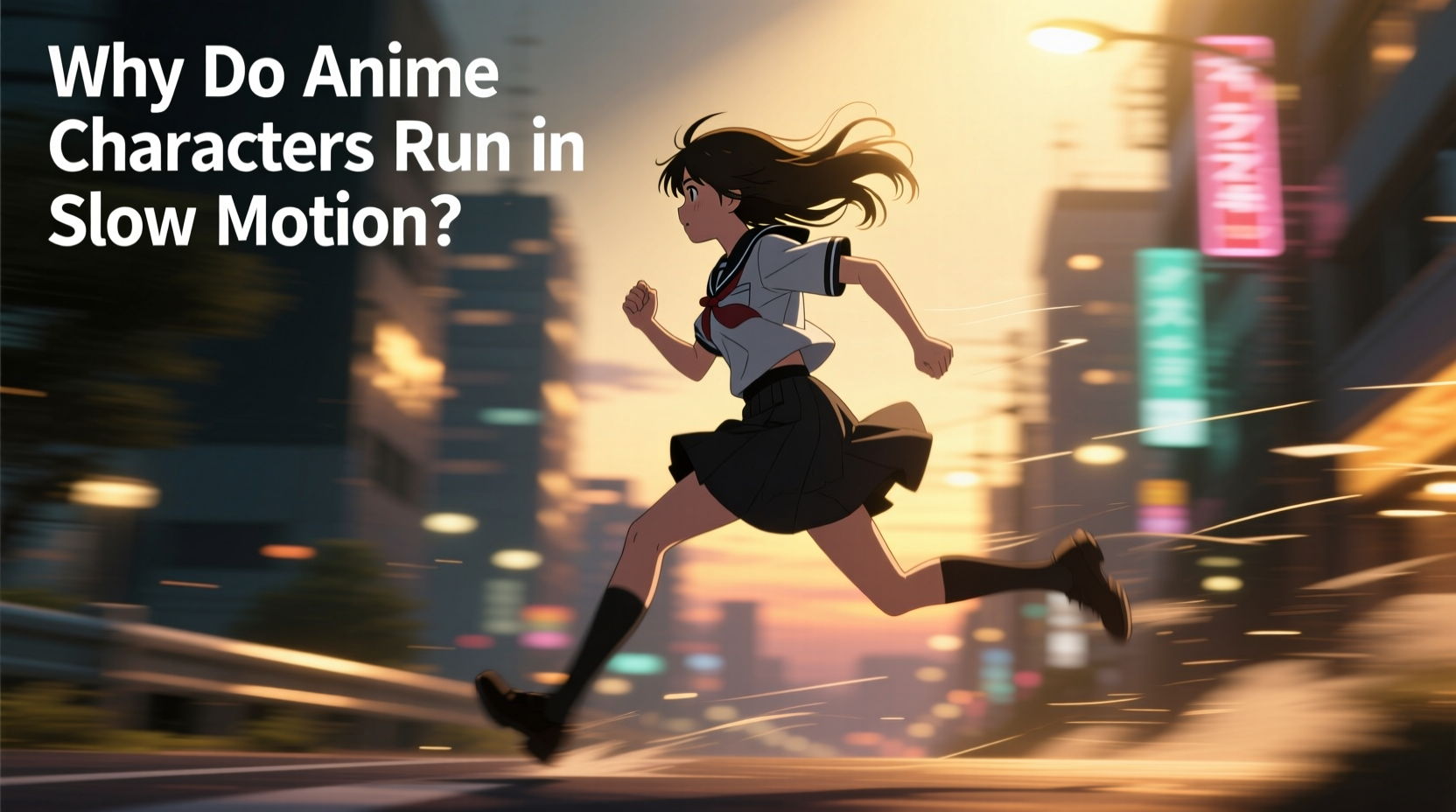
In live-action film and television, slow motion is often used to emphasize pivotal moments—a bullet dodged, a final punch thrown, a last embrace before tragedy. Anime borrows this technique but applies it with greater frequency and symbolic weight. When a character sprints in slow motion, time doesn’t just stretch—it distorts to reflect inner turmoil, resolve, or impending transformation.
Consider the scene in Evangelion where Shinji Ikari runs toward Unit-01 during an emergency activation. His legs move sluggishly, his breath labored, each step drawn out against a haunting score. The physical act of running becomes secondary to the emotional gravity: fear, duty, and reluctant courage collide. By decelerating the action, the audience is forced to sit with those emotions, to feel the weight of every decision.
“Slow motion in anime isn’t about realism—it’s about subjectivity. It shows us not what is happening, but how it feels to the character.” — Dr. Akira Tanaka, Media Studies Professor at Kyoto University of Art
This subjective manipulation of time allows directors to externalize internal states. A racing heartbeat, tunnel vision, or the sensation of time slowing under stress—all are rendered visually through prolonged movement, lingering close-ups, and atmospheric sound design. In this context, slow-motion running isn’t lazy animation; it’s cinematic empathy.
Cultural Roots: From Noh Theater to Modern Storytelling
To understand why this technique feels so natural in anime, one must look beyond technology and into Japan’s rich performance traditions. Classical forms like Noh and Kabuki theater rely heavily on stylized movement, where gestures are elongated, deliberate, and symbolic. A single step forward can represent miles traveled or years passed. Emotion is conveyed not through speed, but through precision and duration.
Modern anime inherits this sensibility. Action isn’t always about efficiency—it’s about meaning. The slow approach before a fight, the extended gaze between rivals, the agonizing crawl toward a fallen comrade—all echo theatrical conventions where silence and stillness carry as much weight as dialogue.
In this light, slow-motion running becomes less a cinematic trick and more a continuation of a performative legacy. It signals importance. It demands attention. And it transforms mundane actions into ritual.
Production Practicality Meets Creative Expression
It would be disingenuous to ignore the practical side of animation production. High-quality, full-motion sequences require hundreds of frames per second, skilled animators, and substantial budgets—resources that aren’t always available, especially in weekly TV series. Limited animation techniques, including repeated frames, static backgrounds, and yes—slow motion—are tools that help studios maintain consistency without sacrificing broadcast schedules.
However, calling slow-motion running a mere cost-cutting measure undersells its intentional use. Directors like Hideaki Anno (Neon Genesis Evangelion) and Tetsurō Araki (Death Note, Attack on Titan) have mastered the art of using limited animation to enhance mood. A character moving slowly through rain-soaked streets while flashbacks flicker across the screen isn’t under-animated—it’s deliberately paced to build tension.
Moreover, modern digital workflows allow for hybrid approaches. A scene may begin in real-time motion, then shift into slow motion at the climax, achieved through frame interpolation and camera effects. This transition signals a shift from external reality to internal experience, making the viewer complicit in the character’s mindset.
Do’s and Don’ts of Slow-Motion Use in Anime
| Do | Don't |
|---|---|
| Use slow motion to highlight emotional turning points | Overuse it in every action sequence |
| Pair it with music or silence for maximum impact | Rely on it to mask poor choreography |
| Combine with symbolic imagery (e.g., falling petals, shattered glass) | Apply it without narrative justification |
| Leverage it during character introspection or sacrifice | Use it purely for fan service or spectacle |
The Psychology of Anticipation: Why We Remember These Moments
Human brains are wired to respond to anticipation. Neurological studies show that dopamine spikes not when a reward is received, but in the moments leading up to it. Similarly, audiences often recall the buildup to a battle more vividly than the fight itself. Slow-motion running exploits this cognitive bias by stretching the threshold between preparation and action.
Take the iconic scene in My Hero Academia where Izuku Midoriya charges toward Shigaraki during the final war arc. He’s battered, barely standing, yet he pushes forward—one foot after another in agonizing slowness. The audience knows what’s coming: a desperate, likely fatal attack. But the delay makes the moment unbearable—and unforgettable.
This technique also reinforces themes of perseverance and willpower, central to many shonen narratives. Speed isn’t the measure of a hero; endurance is. By showing the effort behind each step, anime elevates struggle over success, making victory feel earned rather than inevitable.
Mini Case Study: The Staircase Scene in *Your Lie in April*
One of the most powerful uses of slow motion occurs not in a battle, but in a quiet, personal moment. In episode 17 of Your Lie in April, Kaori Miyazono runs down a staircase after confessing her love to Kousei Arima. Her footsteps echo, her hair flutters, and the camera lingers on each descending step. There’s no danger, no enemy—yet the scene unfolds in exaggerated slow motion.
Later, viewers learn that Kaori is terminally ill. This moment, seemingly ordinary, becomes heartbreakingly significant in retrospect. The slow descent isn’t about physical movement—it’s a metaphor for time slipping away, for youth fading, for love spoken too late. Had the scene played at normal speed, its emotional resonance would have been drastically reduced.
This example illustrates that slow-motion running transcends genre. It appears in romance, drama, and slice-of-life series just as often as in action-packed adventures. Its purpose remains consistent: to make the invisible visible—the pulse of emotion beneath everyday motion.
A Step-by-Step Guide to Recognizing Meaningful Slow Motion
Not all slow-motion scenes are created equal. Some are transformative; others feel repetitive or uninspired. Here’s how to distinguish intentional artistry from formulaic repetition:
- Identify the trigger: Does the slow motion begin after a revelation, loss, or decision? If so, it’s likely narrative-driven.
- Observe sensory details: Are wind, rain, light, or music synchronized with the movement? These elements suggest deliberate staging.
- Note facial expressions: Close-ups on eyes, trembling lips, or clenched jaws indicate emotional focus, not just visual flair.
- Check for contrast: Was the preceding scene fast-paced? A sudden drop in speed creates dramatic tension.
- Reflect afterward: Do you remember how the character felt, not just what they did? That’s the mark of effective slow motion.
Frequently Asked Questions
Is slow-motion running unique to anime?
No, but anime uses it more frequently and symbolically than Western media. While Hollywood employs slow motion for impact (e.g., The Matrix), anime integrates it into daily storytelling rhythms, often without dramatic explosions or gunfire. The difference lies in normalization—slow motion in anime isn’t reserved for climaxes; it’s part of the emotional vocabulary.
Doesn’t overusing slow motion make it lose its effect?
Yes, when applied without intention. Series that rely on slow-motion running in every episode risk desensitizing viewers. However, well-directed anime uses it sparingly and strategically. For instance, Fullmetal Alchemist: Brotherhood reserves slow motion for pivotal deaths or moral crossroads, preserving its power throughout the series.
Can slow motion be considered a crutch for weak writing?
Sometimes. If a scene lacks emotional depth and relies solely on dramatic visuals to evoke feeling, slow motion becomes a substitute for substance. But when paired with strong character development and thematic coherence, it enhances rather than replaces meaningful storytelling.
Making the Invisible Visible: The Lasting Power of the Technique
At its core, slow-motion running in anime is about visibility. It makes internal struggles legible. It turns abstract feelings—doubt, hope, grief, determination—into something tangible. A character doesn’t just run; they push against fate, memory, fear. Each extended stride says: This matters.
It’s easy to dismiss such moments as melodramatic or over-the-top, especially to viewers accustomed to realism-driven Western narratives. But anime operates on a different axis—one where emotion shapes physics, and time bends to the soul’s rhythm. In that space, slow motion isn’t a flaw; it’s a feature.
As global audiences continue embracing anime, understanding these stylistic choices becomes essential. They’re not random quirks—they’re deliberate expressions of a culture that values nuance, restraint, and the unsaid. The next time you see a character sprinting through a battlefield in agonizing slowness, don’t reach for the skip button. Lean in. Listen. Feel the weight of every step.
“Anime doesn’t imitate life—it interprets it. And sometimes, life moves slowly when your heart is racing.” — Yui Saito, Animation Director at Studio Orange
Final Thoughts: Embrace the Pause
Slow-motion running is neither accidental nor arbitrary. It is both artistic choice and narrative trope—a dual identity that reflects anime’s ability to merge form and function. Whether born from budget constraints, theatrical heritage, or emotional insight, the technique endures because it works.
It reminds us that not all movement is measured in distance or speed. Some journeys happen within a single breath, a single glance, a single step stretched across eternity.




 浙公网安备
33010002000092号
浙公网安备
33010002000092号 浙B2-20120091-4
Comments
No comments yet. Why don't you start the discussion?