
Every holiday season, thousands of renters receive a notice from their property manager: “No incandescent C7/C9 string lights on balconies,” “LED only for exterior fixtures,” or “No extension cords visible on common-area railings.” These restrictions often spark confusion—or frustration—especially when neighbors in single-family homes freely drape vintage-style lights across porches and eaves. But these rules aren’t arbitrary aesthetic preferences. They stem from enforceable building codes, insurance mandates, and decades of documented fire incidents tied to improper holiday lighting in multi-unit residential buildings. Understanding the “why” behind the restriction transforms a perceived inconvenience into an essential layer of shared safety.
1. The Hidden Fire Risk of Older Lighting Technologies
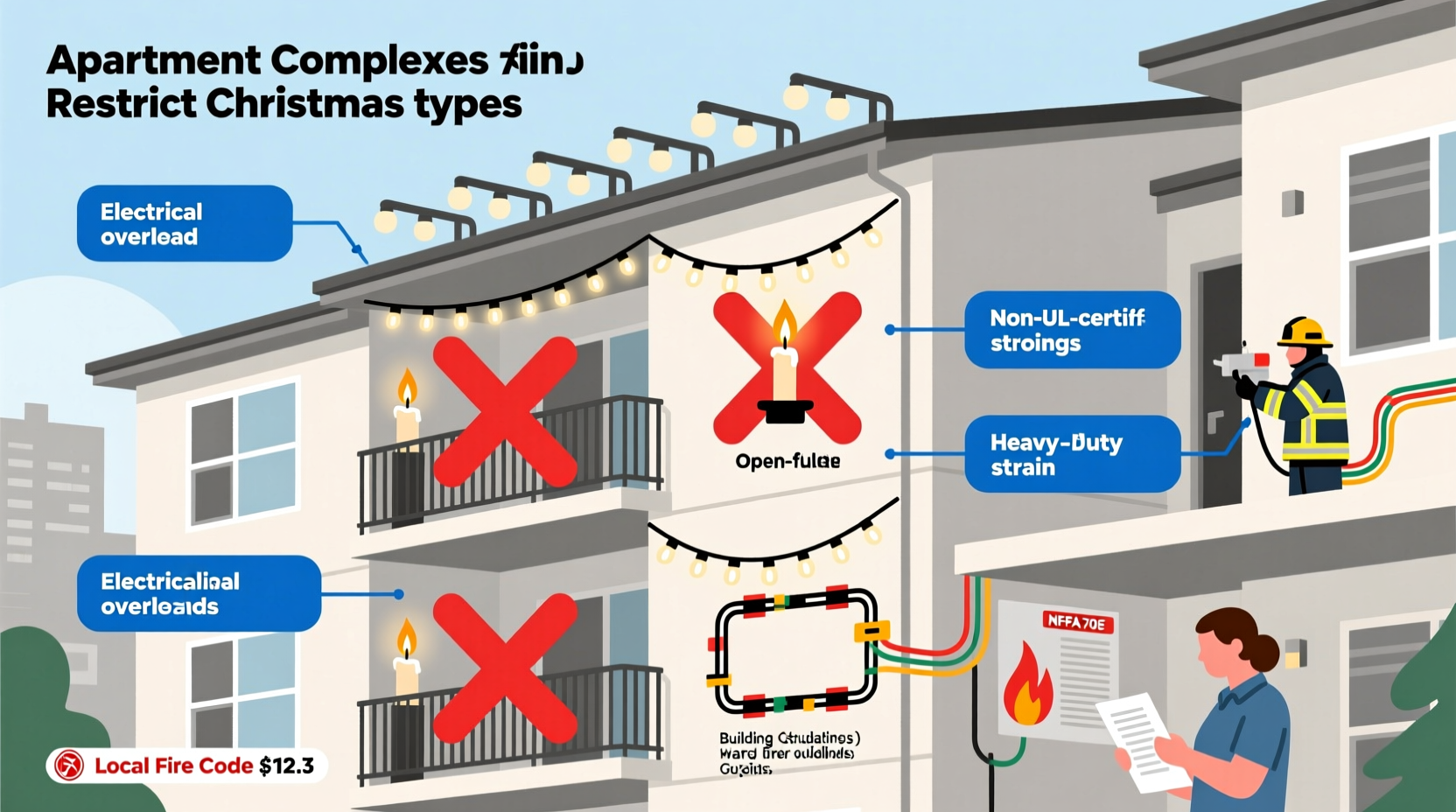
Incandescent mini-lights and traditional C7/C9 bulbs convert only about 10% of their energy into visible light—the remaining 90% becomes heat. A single 100-bulb string of older incandescent lights can generate surface temperatures exceeding 140°F (60°C) after just 30 minutes of operation. In confined spaces like enclosed balconies, stacked storage closets, or vinyl-sided apartment exteriors, that heat builds rapidly. When combined with combustible materials—dry pine garlands, synthetic wreaths, stored cardboard boxes, or even dust-coated HVAC vents—the risk of ignition rises significantly.
The National Fire Protection Association (NFPA) reports that between 2017 and 2021, U.S. fire departments responded to an average of 790 home fires each year caused by decorative lighting—nearly half occurring in apartments and condos. Of those, 42% involved lighting left unattended for extended periods, and 31% were traced to damaged or overloaded cords. Crucially, over 68% of lighting-related fires in multi-family dwellings occurred in common areas or on individual unit exteriors—not inside living spaces—highlighting how shared infrastructure amplifies risk.
2. Electrical Infrastructure Limits in Multi-Unit Buildings
Unlike single-family homes—where dedicated 15–20 amp circuits often serve outdoor outlets—apartment complexes typically share electrical capacity across dozens of units. Common-area lighting, hallway fixtures, elevator controls, laundry room equipment, and HVAC systems all draw from the same panel. Adding high-wattage holiday strings compounds demand during peak winter months, when heating loads are already straining transformers and service drops.
A typical 100-bulb incandescent string draws 40–60 watts; chain ten together, and you’re pulling 400–600 watts—equivalent to running a small space heater continuously. In contrast, a comparable LED string uses just 4–7 watts total. That 90% reduction isn’t merely efficient—it prevents cumulative overloads that trip breakers, damage wiring insulation, or cause arcing at outlet connections—a leading cause of concealed wall fires.
Property managers don’t set wattage caps arbitrarily. They rely on load calculations mandated by the National Electrical Code (NEC) Article 210.23(A)(2), which limits plug-connected loads on 15-amp circuits to 12 amps (1,440 watts) and prohibits continuous loads above 80% of circuit rating. Since holiday lights often operate 12+ hours daily for weeks, they qualify as “continuous loads”—effectively capping allowable wattage per outlet at 1,440 × 0.8 = 1,152 watts. That’s barely enough for two mid-size incandescent wreath lights and one stringer—far less than most renters envision.
3. Building Codes & Local Ordinances That Directly Apply
Federal law doesn’t regulate holiday lights—but state and local amendments to the International Fire Code (IFC) and International Building Code (IBC) do. Most U.S. jurisdictions adopt the IFC with amendments, and Section 307.2.1 explicitly governs “decorative lighting in assembly and residential occupancies”: it requires all temporary lighting to be listed by a nationally recognized testing laboratory (e.g., UL, ETL), prohibits use near exits or fire-rated doors, and bans installation on combustible surfaces unless specifically rated for such use.
In multi-family settings, additional layers apply:
- Life Safety Code (NFPA 101): Mandates clear egress paths. Lights draped across stair railings, balcony entrances, or fire escape ladders violate Section 7.1.10.2, which requires unobstructed access to exits at all times.
- Local Fire Marshal Authority: Many cities (e.g., Chicago, Seattle, Austin) require permits for exterior lighting installations exceeding 500 watts per unit—and impose fines up to $1,000 per violation.
- Insurance Requirements: Apartment owners’ commercial liability policies routinely stipulate compliance with NEC and IFC. A single fire caused by non-compliant lights can void coverage or trigger premium hikes of 25–40%.
These aren’t theoretical concerns. In December 2022, a four-alarm fire broke out in a 12-story Denver apartment tower after an unlisted LED string shorted inside a plastic planter box mounted to a concrete balcony. Though the lights were LED, the power supply lacked proper grounding and was submerged in rainwater runoff—an installation prohibited under NEC Article 400.5(B) for wet locations. The blaze displaced 47 residents and cost the owner $2.3 million in damages and settlements.
4. Real-World Consequences: A Mini Case Study
In November 2021, a 32-unit garden-style complex in Raleigh, North Carolina implemented a new holiday policy: “All exterior lighting must be UL-listed, low-voltage (≤24V), and installed using manufacturer-approved mounting hardware.” The rule followed a near-miss incident the prior year: a resident had wired 12 strands of incandescent lights directly to an indoor outlet via a 100-foot extension cord snaked through a sliding glass door. The cord overheated where it pinched against the door frame, melting its outer jacket and igniting nearby mulch. Firefighters extinguished the smoldering pile before flames reached the building—but thermal imaging revealed adjacent balcony flooring had reached 212°F.
Management responded not with blanket bans, but with education and alternatives. They partnered with a local lighting supplier to offer discounted UL-listed, battery-operated LED icicle lights (with 30-day timers) and hosted an on-site workshop demonstrating safe mounting techniques using adhesive hooks rated for outdoor use. Within three weeks, 89% of residents adopted compliant lighting—and zero code violations were issued that season. Crucially, the property’s insurance carrier renewed its policy without surcharge, citing the proactive risk-mitigation strategy.
“Restrictions aren’t about controlling tenants—they’re about honoring the legal duty of care owed to every resident. One preventable fire compromises safety for everyone in a shared structure.” — Carlos Mendez, CPM®, Senior Director of Risk Management, National Apartment Association
5. What’s Allowed vs. What’s Prohibited: A Practical Compliance Table
| Lighting Type | Generally Allowed? | Key Conditions & Requirements | Risk Level |
|---|---|---|---|
| UL-listed LED mini-lights (battery or plug-in) | ✅ Yes | Must use included power adapter; no daisy-chaining beyond manufacturer specs; no placement within 3 ft of HVAC intakes | Low |
| Low-voltage (12–24V) LED rope lights with transformer | ✅ Yes (with approval) | Transformer must be GFCI-protected and mounted in dry, ventilated location; wiring conduit required if exposed >6 inches | Low–Moderate |
| Incandescent C7/C9 bulbs (non-LED) | ❌ No | Prohibited in 92% of Class R-2 occupancies (apartments/condos) per IFC 307.2.1; violates NEC 410.134 for permanent fixture replacement | High |
| DIY stringer kits with exposed sockets/wiring | ❌ No | Violates UL 588 and NEC 400.7; no recognized listing; creates shock and arc-fault hazards | Critical |
| Commercial-grade LED net lights (outdoor-rated) | ✅ Conditional | Requires written permission; must include built-in timer and thermal cutoff; mounting hardware must not penetrate weatherproofing membranes | Moderate |
6. A Step-by-Step Guide to Installing Compliant Holiday Lighting
- Review your lease and community guidelines—not just the holiday addendum, but the full maintenance section (often Section 5.2 or similar). Note deadlines for submission of lighting plans.
- Calculate your circuit capacity: Locate your unit’s outdoor outlet breaker (usually labeled “PORCH” or “EXT”). Multiply its amperage (e.g., 15A) by 120V, then multiply by 0.8. That’s your max continuous wattage (e.g., 15 × 120 × 0.8 = 1,440W).
- Select only UL 588–listed LED products—check packaging for the UL hologram and “For Outdoor Use” designation. Avoid “indoor/outdoor” hybrids; they lack wet-location ratings.
- Use only grounded, outdoor-rated extension cords (14-gauge minimum)—never exceed 100 feet in length, and never run cords under rugs, through windows, or across walkways.
- Install mounting hardware properly: Use adhesive hooks rated for outdoor temps (–20°F to 150°F) or non-penetrating tension mounts. Never nail, screw, or staple into siding, stucco, or balcony railings.
- Set automatic shut-off: Use a programmable timer (mechanical or smart) to limit operation to 6–8 hours nightly. Unplug entirely during extended absences.
7. FAQ: Clarifying Common Misconceptions
Can my landlord legally ban all Christmas lights—even safe LED ones?
Yes—if the prohibition is applied uniformly and rooted in legitimate safety or structural concerns. Courts consistently uphold reasonable restrictions that align with fire codes and protect shared infrastructure. However, a blanket ban without justification (e.g., “no lights ever”) may be challenged as unreasonable under state landlord-tenant laws. Most balanced policies allow compliant options while prohibiting hazardous ones.
Why can’t I use the same lights my parents used on their house for 30 years?
Your parents’ home likely has dedicated outdoor circuits, copper wiring sized for modern loads, and no shared walls or ventilation shafts. Apartment wiring is often aluminum (more prone to overheating at connections), installed decades ago, and shared across multiple units. What was safe in a detached home isn’t automatically safe in a dense, interconnected structure governed by updated codes.
Do HOAs have more authority than apartment managers to restrict lights?
Condominium associations often have broader architectural control rights via CC&Rs (Covenants, Conditions & Restrictions), allowing them to regulate aesthetics—including color, size, and placement—as well as safety. Apartment managers derive authority from lease agreements and statutory duties of habitability and safety. Both must comply with federal fair housing laws (e.g., cannot prohibit religious symbols like menorahs or nativity scenes), but can regulate *how* they’re displayed for safety reasons.
Conclusion
Holiday lighting restrictions in apartment communities reflect a hard-won balance between festive expression and collective responsibility. They’re not relics of bureaucratic caution—they’re evidence-based responses to real fire data, aging infrastructure realities, and enforceable legal obligations. When you choose UL-listed LEDs, respect circuit limits, and install thoughtfully, you’re not just complying with a rule—you’re actively safeguarding your neighbors’ homes, preserving building integrity, and honoring the shared nature of multi-unit living. This season, let your lights shine brighter knowing they’re anchored in safety, not sacrificed for spectacle.




 浙公网安备
33010002000092号
浙公网安备
33010002000092号 浙B2-20120091-4
Comments
No comments yet. Why don't you start the discussion?