
Aquarium snails are often seen as low-maintenance additions to freshwater tanks—quiet, efficient cleaners, and surprisingly expressive in their own subtle way. But one morning, you glance into your tank and realize: the Malaysian trumpet snail that was burrowing near the gravel yesterday is nowhere to be found. The nerite snail that clung faithfully to the glass has vanished without a trace. No shell, no body, not even a smear. Where did it go?
This phenomenon baffles many hobbyists, especially beginners. Unlike fish, which typically float when they die, snails don’t always leave behind obvious signs. Their disappearance can spark concern, confusion, or even suspicion of predators. The truth, however, lies in understanding snail biology, tank dynamics, and the hidden behaviors that occur when humans aren't watching.
The Hidden Life (and Death) of Aquarium Snails
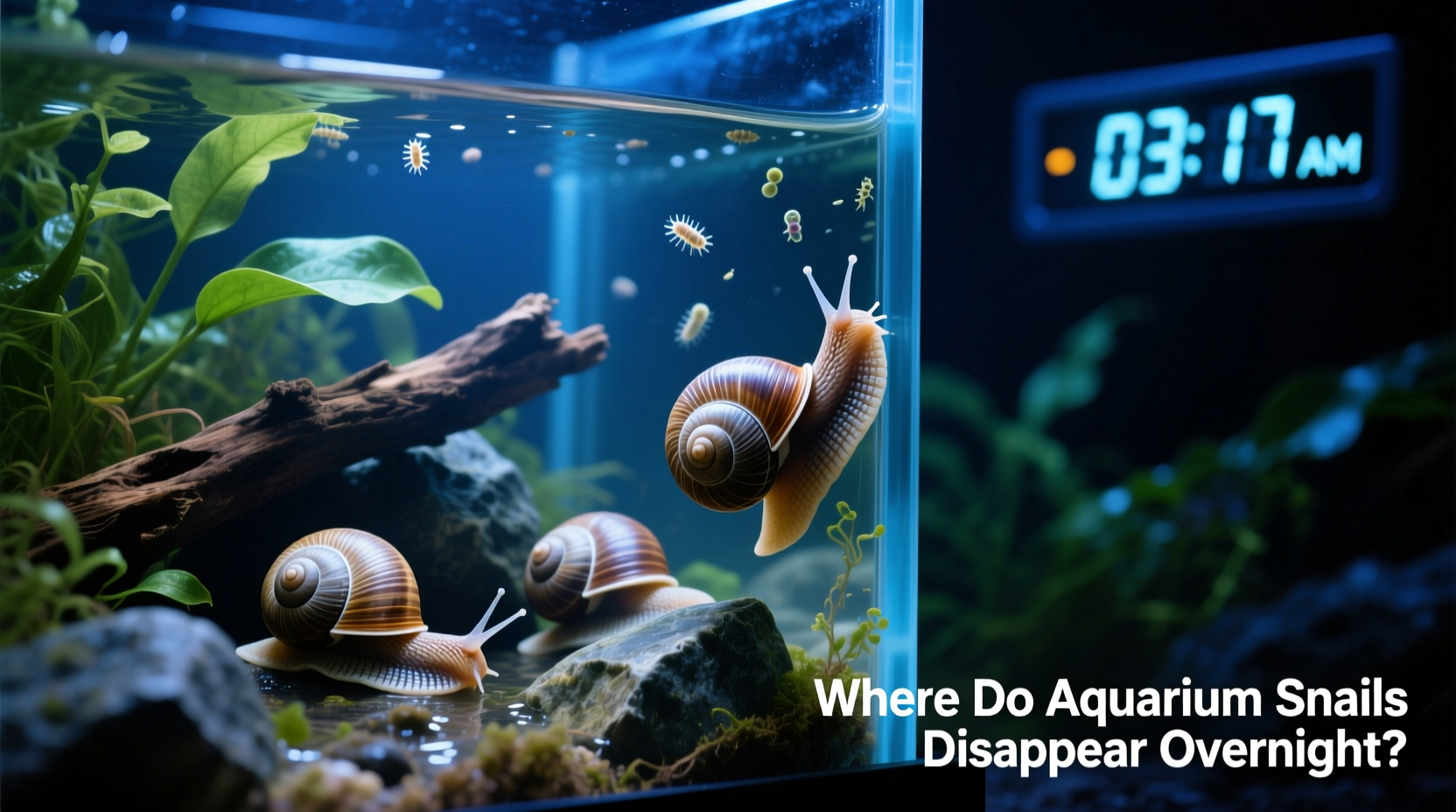
Aquarium snails are masters of stealth. Many species are nocturnal, emerging only after lights out to forage. Others bury themselves deep in substrate during the day. This natural behavior alone explains why some snails seem to “disappear” temporarily—they’re simply hiding in plain sight.
But when days pass with no sign of a snail, and there's no visible shell, the explanation likely involves death and decomposition. Unlike fish, dead snails don’t always float. Soft-bodied species like ramshorn or pond snails may decompose rapidly, especially if consumed by tank mates or broken down by bacteria. In heavily planted tanks with active cleanup crews, a snail’s remains can vanish within 24–48 hours.
Dr. Lena Torres, aquatic biologist at the Institute for Freshwater Ecology, notes:
“Snails have high moisture content and soft tissues that break down quickly in warm water. In a biologically active aquarium, scavengers and microbes can fully process a small snail before most owners even notice it’s missing.” — Dr. Lena Torres, Aquatic Biologist
This rapid breakdown means the absence of a body isn’t necessarily mysterious—it’s natural. But that doesn’t mean every disappearance is harmless. Understanding the underlying causes helps prevent recurring losses.
Common Reasons Why Snails Vanish Overnight
Not all snail disappearances are due to death. Several factors—some environmental, others behavioral—can make a snail seem to vanish into thin water.
1. Natural Hiding Behavior
Many snail species are instinctive burrowers or crevice-seekers. Malaysian trumpet snails, for example, dig deep into sand or fine gravel, sometimes staying underground for days. Nerite snails may wedge themselves behind filter intakes, under driftwood, or inside rock formations. These spots are hard to see from above, creating the illusion of disappearance.
2. Predation by Tank Mates
Some fish view snails as snacks. Goldfish, loaches (especially clown and yo-yo loaches), pufferfish, and certain cichlids actively hunt snails. They may extract them from their shells or consume juveniles whole. If your tank houses any of these species, predation is a likely culprit.
3. Poor Water Conditions
Snails are sensitive to water parameters. Sudden spikes in ammonia, nitrite, or copper (often introduced via tap water or medications) can be lethal. Low pH (<6.0) weakens shells, making snails vulnerable to stress and disease. A snail exposed to poor conditions may die quietly and decompose before detection.
4. Escape Attempts
Believe it or not, some snails climb out of tanks. Nerite snails are notorious escape artists, scaling glass walls in search of algae on tank lids or nearby surfaces. If the tank isn’t securely covered, a snail can dry out and die on the floor, cabinet, or behind equipment—easily overlooked.
5. Decomposition Without a Trace
When a snail dies, its body retracts into the shell. Over time, bacteria and detritivores (like shrimp or worms) break it down. The shell may remain, but tiny or juvenile snails may leave no visible remnants. In tanks with high bioactivity, even shells can dissolve over weeks due to low pH or mineral-deficient water.
Where Do They Actually Go? Tracking the Possible Locations
To solve the mystery, consider both physical and biological possibilities. Here’s a breakdown of where missing snails might actually be:
| Location | Possibility | How to Check |
|---|---|---|
| Inside substrate | High (especially for burrowers) | Gently stir sand/gravel with a net or stick |
| Behind decorations | High | Inspect under rocks, wood, and plants |
| Outside the tank | Moderate (climbers only) | Search floor, lid, and nearby surfaces |
| Digested by fish | High in predator-heavy tanks | No physical trace; observe fish behavior |
| Fully decomposed | High in mature tanks | Look for faint odor or cloudiness in water |
| Trapped in filter | Moderate | Turn off filter and inspect intake tube and media |
In one documented case, an aquarist reported losing three mystery snails over two weeks. After ruling out water issues and predation, she dismantled her tank setup and discovered a single snail wedged behind a silicone-sealed background panel—alive but inactive due to low oxygen in the gap. This highlights how easily snails can access inaccessible zones.
“Always assume the snail is either hidden, dead and decomposed, or eaten—until proven otherwise.” — Mark Renolds, Veteran Aquarist & Forum Moderator, AquaticLife.org
Step-by-Step: What to Do When a Snail Disappears
Instead of panicking, follow this logical sequence to investigate and prevent future losses.
- Wait 24–48 hours. Many snails reappear after resting or hiding. Avoid immediate disassembly.
- Inspect the tank visually. Use a flashlight at night to check glass, substrate, and decor seams.
- Check outside the tank. Look under the stand, behind cords, and on the lid—common drying-out zones.
- Smell the water. A rotting odor indicates decomposition. Perform a 30% water change immediately.
- Test water parameters. Check ammonia, nitrite, pH, and GH (general hardness). Low GH (<4 dGH) weakens shells.
- Examine filter systems. Turn off and disassemble intake tubes—snails can get sucked in, especially juveniles.
- Review tank mates. Observe fish behavior. Are any species poking at snails or showing aggressive interest?
- Document patterns. If multiple snails vanish, consider a systemic issue like poor water quality or predation.
Prevention Checklist: How to Keep Your Snails Safe and Visible
Proactive care reduces the risk of unexplained disappearances. Follow this checklist to create a snail-friendly environment.
- ✅ Maintain stable water parameters: pH 7.0–8.0, GH 6–12 dGH, KH 4–8 dKH
- ✅ Avoid copper-based medications unless absolutely necessary
- ✅ Secure tank lids tightly to prevent escapes
- ✅ Choose compatible tank mates—avoid loaches, puffers, and large cichlids
- ✅ Provide calcium-rich foods (e.g., cuttlebone, boiled spinach, specialized pellets)
- ✅ Clean substrate weekly to prevent toxic gas pockets in deep sand beds
- ✅ Use sponge pre-filters on intakes to prevent snails from being trapped
- ✅ Monitor snail activity daily—note feeding, movement, and shell condition
Frequently Asked Questions
Can a snail play dead?
Not exactly. Snails can enter a dormant state due to poor conditions, retracting fully into their shells for days. This may look like death, but if the operculum (trapdoor) is sealed and the body hasn’t begun to smell, it could revive when conditions improve. However, prolonged inactivity usually indicates illness or impending death.
If I find an empty shell, does that mean my snail died?
Most likely, yes. An empty, clean shell with no tissue residue suggests the snail died and decomposed. However, molting is not a factor—snails do not shed their shells. If the shell is damaged or has holes, predation or shell erosion due to low pH may be the cause.
Will other snails eat a dead one?
While snails are primarily herbivores or detritivores, some species (like larger apple snails) may nibble on dead organic matter, including deceased snails. However, shrimp, worms, and fish are far more efficient at consuming dead snails than live ones are.
Real Example: The Case of the Missing Nerite
Sarah, a beginner aquarist in Portland, noticed her vibrant striped nerite snail had vanished from her 20-gallon planted tank. She checked the water—ammonia and nitrites were zero, pH stable at 7.4. No fish showed predatory behavior. She searched the substrate, moved rocks, and even drained part of the tank with no luck.
Three days later, while wiping the outside of the glass near the waterline, she felt something rough. There, clinging to the outer edge just below the rim, was the snail—completely dried out and lifeless. It had climbed out, likely attracted to light or algae on the hood, and couldn’t return. The tank had a mesh lid, but a small gap near the power strip allowed escape.
Solution: Sarah installed a full-cover glass lid and began checking the perimeter weekly. She also started using a small LED light timer to reduce nighttime reflections that might confuse climbing snails.
Final Thoughts: Acceptance and Awareness
Aquarium snails may disappear overnight—but rarely without reason. While it’s easy to feel alarmed, most cases stem from natural behaviors, environmental stressors, or unnoticed predation. The key is not to assume mystery, but to investigate methodically.
Understanding snail biology, monitoring tank conditions, and designing a safe habitat go a long way toward minimizing losses. Even in well-maintained tanks, occasional deaths occur—just as they do in nature. What matters is learning from each incident to build a more resilient, observable ecosystem.
Remember: a missing snail isn’t always a failure. It’s an invitation to look closer, test deeper, and appreciate the quiet complexity of life beneath the surface.




 浙公网安备
33010002000092号
浙公网安备
33010002000092号 浙B2-20120091-4
Comments
No comments yet. Why don't you start the discussion?