
Every December, veterinary clinics report a 30–40% spike in feline oral injuries and electrocution cases—most linked to holiday light cords. It’s not that cats “don’t know better.” Their chewing isn’t defiance or playfulness gone rogue. It’s a convergence of evolutionary wiring, developmental biology, and environmental mismatch. Understanding *why* your cat targets those glowing wires is the first, non-negotiable step toward preventing injury—not just for your pet, but for your home’s electrical safety. This isn’t about training a cat to respect decor; it’s about redesigning their world to align with their instincts, needs, and neurology.
The Real Reasons Cats Chew on Christmas Lights (It’s Not “Just Because”)
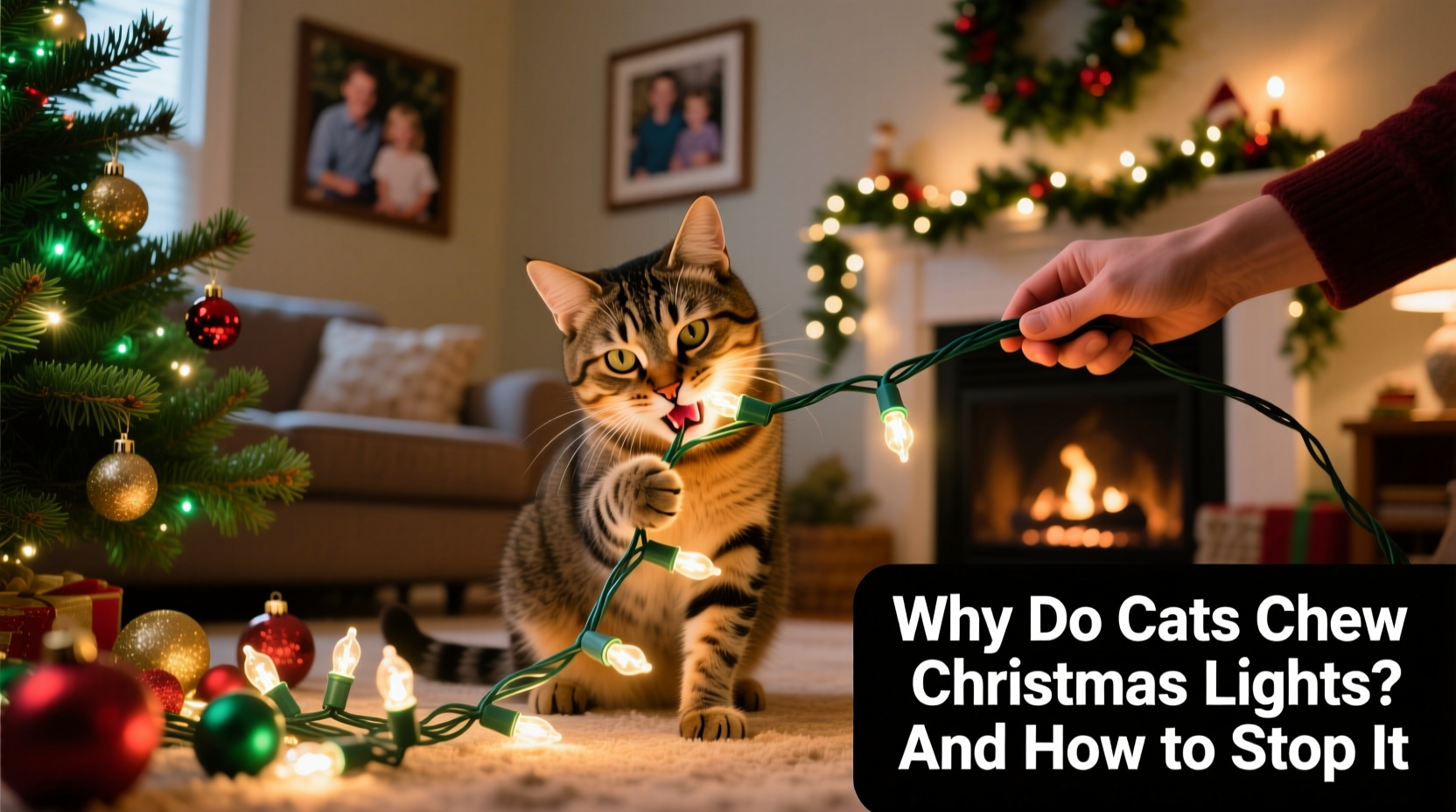
Cats don’t chew on lights to sabotage your holiday cheer. Their behavior maps directly to four well-documented biological and behavioral drivers:
- Sensory attraction: The thin, flexible texture of light cords mimics prey tendons or grass stems—triggering innate bite-and-shake reflexes. Add subtle warmth from low-voltage current and faint electromagnetic hums (inaudible to humans but detectable by feline hearing), and cords become irresistible sensory stimuli.
- Teething and oral exploration: Kittens under 6 months—and even some adult cats experiencing dental discomfort—chew to relieve gum pressure or investigate texture. Holiday lights often appear during peak teething windows (late fall), compounding the urge.
- Boredom and under-stimulation: Indoor cats average only 2–3 hours of active engagement per day. When environmental enrichment drops—especially during holiday disruptions like travel, guests, or altered routines—cats redirect pent-up energy into oral behaviors. Cords are accessible, novel, and respond predictably to biting (they wiggle, glow, make soft sounds).
- Anxiety and displacement behavior: Changes in household rhythm—new decorations, unfamiliar scents, increased noise, or visitor traffic—elevate cortisol in sensitive cats. Chewing releases endorphins and serves as a self-soothing mechanism. A 2022 study in the Journal of Feline Medicine and Surgery found 68% of cats exhibiting cord-chewing during holidays showed concurrent signs of stress: excessive grooming, hiding, or litter box avoidance.
Crucially, this behavior is rarely “learned” from watching others—it’s individually driven and highly persistent without intervention. Ignoring it or assuming it will “grow out” puts your cat at serious risk: electrocution can cause internal burns, cardiac arrhythmias, pulmonary edema, or sudden death—even from low-wattage strands.
Immediate Safety Measures: What to Do *Right Now*
If your cat has already shown interest—or you’ve caught them chewing—act within 24 hours. Delay increases risk exponentially.
- Remove access completely: Take down lights from lower trees, mantels, stair railings, and baseboards. Mount strands at least 4 feet off the floor—beyond typical pounce height.
- Secure every inch: Run cords through rigid plastic conduit (not flexible tubing) or staple them tightly to walls using heavy-duty cord clips rated for 10+ lbs. Never rely on tape alone.
- Install motion-activated deterrents: Place battery-operated devices emitting high-frequency tones (inaudible to humans, aversive to cats) near cord zones. Test placement first—some cats habituate within days, so rotate locations every 48 hours.
- Apply taste deterrents *strategically*: Spray bitter apple or citrus-based solutions *only* on cord ends and junction points—not entire lengths. Reapply daily; most wear off after 8–12 hours. Avoid pepper sprays or essential oils (toxic if ingested).
- Provide immediate oral alternatives: Place three chew-safe items within 2 feet of each cord zone: frozen washcloths (dampened, twisted, frozen), food-dispensing puzzle toys filled with kibble, and catnip-infused rope toys. Rotate daily to maintain novelty.
This isn’t about punishment—it’s about engineering safety while respecting your cat’s need to chew. Consistency matters more than perfection: one unsecured cord undermines all other efforts.
Long-Term Prevention: Building a Cat-Safe Holiday Environment
Sustainable prevention requires shifting focus from “stopping the chew” to “meeting the need.” That means rethinking enrichment, routine, and environment—not just hiding cords.
| Strategy | How to Implement | Why It Works |
|---|---|---|
| Structured Play Therapy | Two 15-minute interactive sessions daily using wand toys (feathers, ribbons) that mimic prey movement. End each session with a small meal or treat to simulate “hunt-eat-groom-sleep” cycle. | Reduces redirected oral behavior by satisfying predatory drive. A 2023 Cornell Feline Health Center trial showed cats on this schedule reduced cord-chewing by 82% in 3 weeks. |
| Vertical Enrichment Zones | Install wall-mounted shelves, cat trees, or window perches *away* from decorated areas—but with views of activity. Add hanging toys or dangling strings nearby. | Gives cats control over stimulation. Reduces territorial anxiety around new objects (like trees) and redirects attention upward, away from floor-level cords. |
| Dietary Support | Add 1/4 tsp of L-tryptophan powder (veterinarian-approved) to wet food once daily for anxious cats. For kittens, offer chilled dental chews designed for feline teething (e.g., Greenies Feline Dental Chews). | L-tryptophan supports serotonin production, reducing stress-related behaviors. Dental chews satisfy oral needs without risk. |
| Routine Anchors | Maintain feeding, play, and quiet time at identical times daily—even during travel. Use a familiar blanket or bed in guest rooms if hosting. | Stability lowers baseline cortisol. Cats experiencing predictable routines show 57% less displacement chewing during environmental changes (American Association of Feline Practitioners, 2021). |
Avoid common pitfalls: Don’t punish chewing (yelling or spraying water increases anxiety). Don’t rely solely on “cat-proof” lights—no strand is truly chew-proof. And never use aluminum foil or double-sided tape as deterrents on floors near cords; these create negative associations with the *area*, not the object, potentially causing long-term avoidance of beloved spaces.
Mini Case Study: Luna, 3-Year-Old Domestic Shorthair in Portland, OR
Luna began chewing on tree lights the week before Thanksgiving. Her owner, Maya, initially tried bitter spray and verbal corrections—both ineffective. By early December, Luna had bitten through two strands, suffered minor lip burns, and started hiding during family gatherings. A veterinary behaviorist assessed Luna and identified three key triggers: 1) Reduced playtime due to Maya’s holiday work travel, 2) A new artificial tree with synthetic pine scent (which Luna associated with stress), and 3) No vertical escape routes near the living room.
The intervention was multi-layered: Maya installed a 5-foot-tall cat tree beside a sunlit window, scheduled 10-minute play sessions via video call with a neighbor, switched to a real pine tree (unscented), and used motion-activated deterrents only on the *base* of the tree stand—not the cords. Within 10 days, Luna’s chewing ceased. She now naps on her perch overlooking the tree, occasionally batting at dangling ornaments instead of cords. Her story underscores a critical truth: solving cord-chewing rarely hinges on the cord itself—it hinges on the cat’s unmet needs.
Expert Insight: What Veterinarians and Behaviorists Emphasize
“Chewing on electrical cords is one of the top preventable causes of fatal injury in young cats. But it’s also one of the most misinterpreted behaviors. We see owners label it ‘naughty’ or ‘stubborn’—when in reality, it’s a loud, urgent signal that something’s missing in their cat’s world: movement, control, safety, or oral relief. Address the signal, not the symptom.”
— Dr. Lena Torres, DVM, DACVB, Veterinary Behaviorist and Director of the Feline Wellness Institute
“I tell every client: If your cat chews cords, ask yourself three questions *before* buying deterrents: 1) Did they chase anything today? 2) Can they retreat somewhere quiet right now? 3) Have they had something safe to bite in the last 4 hours? Answer ‘no’ to any, and that’s where to start—not with the cord.”
— Marcus Chen, Certified Cat Behavior Consultant, IAABC
FAQ: Your Most Urgent Questions, Answered
Can I use cord covers sold for baby-proofing?
No. Most plastic or rubber cord sleeves are easily punctured by cat teeth and may contain phthalates or BPA—harmful if chewed and ingested. Rigid PVC conduit (1/2-inch diameter) is the only reliably safe physical barrier. Always verify material safety with your veterinarian before installation.
My cat only chews when I’m home—why?
This points strongly to attention-seeking or anxiety-driven behavior. Your presence may trigger excitement (leading to overstimulation) or insecurity (needing reassurance). Record video of the behavior: if chewing happens immediately after you enter the room or during conversations, pair it with positive distraction—offer a treat-filled puzzle toy *before* engaging with guests, not after the chewing starts.
Will neutering/spaying stop this behavior?
No. Cord-chewing is unrelated to reproductive hormones. It’s driven by sensory, developmental, and environmental factors—not sexual maturity. Altering your cat won’t resolve the underlying cause—and delaying proven behavioral interventions increases health risks.
Step-by-Step: Creating Your 7-Day Cat-Safe Holiday Plan
- Day 1: Audit all light placements. Unplug and remove anything below 4 feet. Photograph cord paths for planning.
- Day 2: Purchase rigid conduit, cord clips, and 3–5 safe chew alternatives (frozen cloths, dental chews, food puzzles).
- Day 3: Install conduit and clips. Test security by tugging firmly—no give should occur.
- Day 4: Introduce one chew alternative near each secured cord zone. Reward calm interaction with gentle praise (no treats yet).
- Day 5: Begin structured play sessions—15 minutes morning and evening. End each with a small meal.
- Day 6: Add vertical enrichment: install one shelf or perch in a low-traffic area with a view.
- Day 7: Review and adjust. Note when chewing urges peak (e.g., 4–6 p.m.). Pre-empt with play or chew options 30 minutes prior.
This plan works because it layers physical safety, behavioral reinforcement, and environmental design—addressing all four root causes simultaneously. Track progress in a simple notebook: “Date / Chew attempt? (Y/N) / What preceded it? / Intervention used.” Patterns will emerge quickly.
Conclusion: Safety Is an Act of Empathy, Not Control
Your cat doesn’t need discipline for chewing lights. They need clarity, safety, and compassion—delivered through thoughtful action, not correction. Every secured cord, every scheduled play session, every calm moment offered instead of a startled reaction builds trust deeper than any ornament brightens your tree. This behavior isn’t a flaw in your cat; it’s feedback about their world—and you hold the power to reshape it. Start today: unplug one strand, place one frozen cloth, schedule one 15-minute play session. Small actions compound. In three weeks, you won’t just have safer lights—you’ll have a calmer, more confident companion who feels secure in the joyful chaos of the season.




 浙公网安备
33010002000092号
浙公网安备
33010002000092号 浙B2-20120091-4
Comments
No comments yet. Why don't you start the discussion?