
Cats have a reputation for being enigmatic companions. One moment they’re curled up in peaceful slumber; the next, they’re swatting your coffee mug off the nightstand with pinpoint precision. If you’ve ever found yourself picking up shattered glass or rescuing a pen from under the couch—all thanks to your feline friend—you’ve likely asked: Why do cats knock things off tables? Is it pure mischief? A cry for attention? Or could this seemingly destructive act actually be rooted in instinctual hunting behavior? The answer lies in a blend of biology, psychology, and environment, all shaped by thousands of years of evolution.
The Evolutionary Roots of Feline Behavior
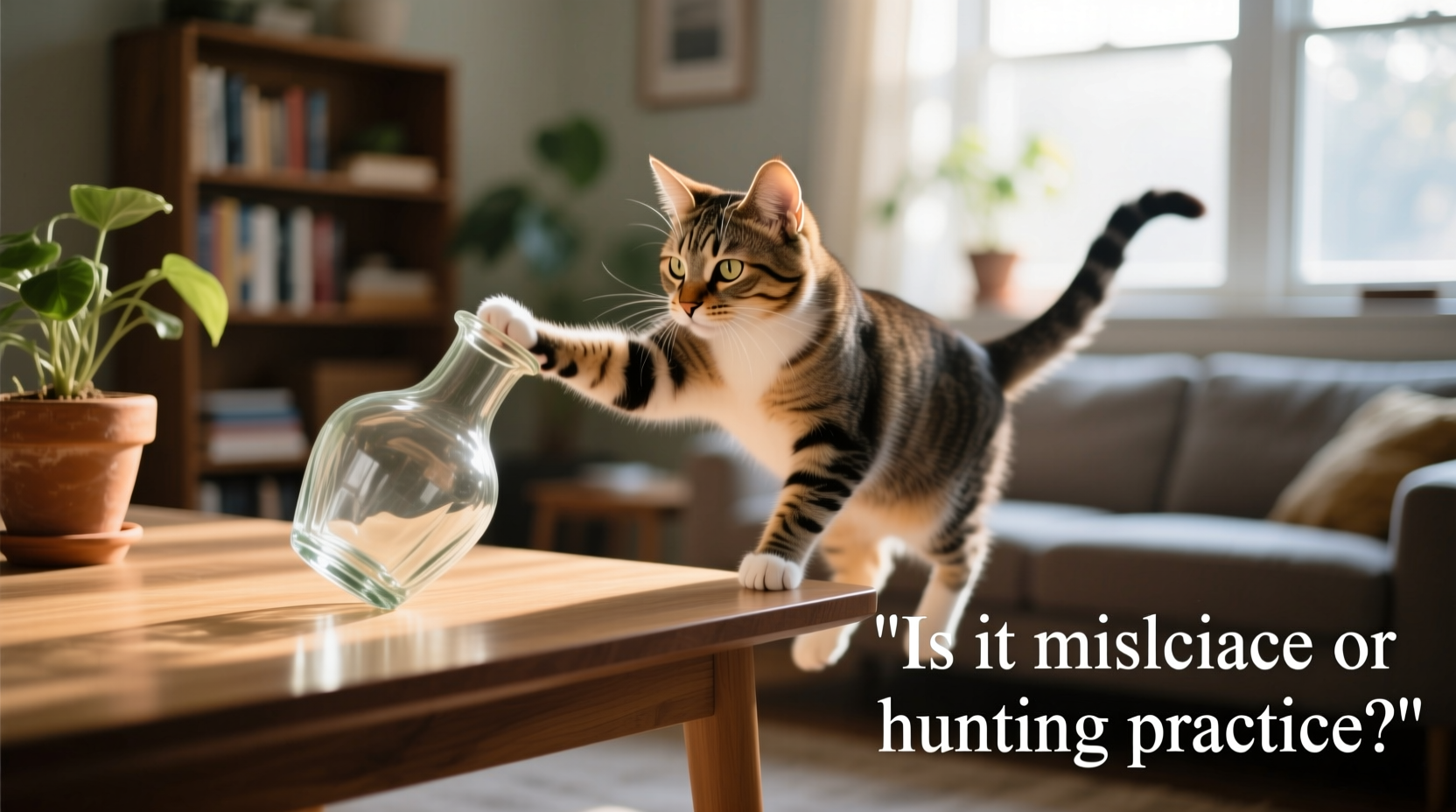
To understand why cats engage in object-knocking, we must first consider their lineage. Domestic cats (Felis catus) are descendants of solitary hunters who relied on stealth, precision, and sensory awareness to survive. In the wild, a cat’s ability to detect movement—even slight shifts in an object’s position—could mean the difference between catching prey and going hungry. Today’s housecats may not need to hunt for food, but their brains remain wired for environmental scanning and interactive exploration.
When a cat bats at a pen, nudges a phone, or deliberately pushes a cup over the edge, it’s often testing the object’s responsiveness. Does it move? Does it make noise? Is it predictable or erratic? These reactions mimic the behaviors of small prey like insects, rodents, or birds. The flicker of motion triggers the same neural pathways involved in stalking and pouncing. This isn’t random destruction—it’s investigative play driven by deeply ingrained survival instincts.
“Cats don’t knock things over to annoy us—they’re gathering data. Every falling object provides sensory feedback that satisfies their cognitive curiosity.” — Dr. Sarah Ellis, Feline Behavior Scientist, University of Lincoln
Hunting Practice vs. Mischief: What’s Really Going On?
While it’s tempting to label this behavior as “mischief,” especially when your cat watches your reaction with wide, unblinking eyes, true mischief implies intent to provoke or disrupt. Cats lack the human concept of malice. Instead, their actions are better understood through three primary motivations:
- Prey simulation: Objects that dangle, roll, or fall mimic the movement of potential prey.
- Sensory enrichment: The sound and motion of a falling item stimulate auditory and visual senses.
- Attention-seeking: If knocking something down consistently results in interaction—even scolding—the cat learns it’s an effective way to initiate contact.
A study published in *Applied Animal Behaviour Science* found that cats presented with novel objects were significantly more likely to manipulate them if the items produced sound or movement upon contact. This supports the idea that cats aren’t acting out of boredom alone, but are actively engaged in environmental assessment—a skill critical to their evolutionary success.
The Role of Play in Adult Cats
Unlike many species, cats retain juvenile behaviors well into adulthood—a trait known as neoteny. This means adult cats continue to play, explore, and engage in mock hunting long after kittenhood. For indoor cats especially, opportunities for natural predatory sequences (stalk, chase, pounce, bite, chew) are limited. Knocking objects off surfaces becomes a substitute for full hunting cycles, allowing cats to fulfill part of that behavioral chain.
This play isn’t frivolous. It maintains motor skills, sharpens reflexes, and reduces stress. When a cat knocks a water bottle off a desk, it may not be trying to destroy property—it’s rehearsing a vital survival skill in the only way available to it.
Environmental and Social Triggers
While instinct plays a major role, a cat’s environment can amplify or redirect these tendencies. Factors such as space constraints, lack of stimulation, and inconsistent routines influence how frequently and intensely a cat engages in object manipulation.
For example, a cat living in a small apartment with minimal vertical space and few interactive toys may resort to knocking over items simply because there’s nothing else to do. Conversely, a cat in a richly enriched home might still knock things down—but selectively, often choosing shiny or noisy objects that offer the most sensory payoff.
| Factor | Encourages Knocking? | Why? |
|---|---|---|
| High shelves or ledges | Yes | Elevated spaces increase visibility and access to objects, encouraging exploration. |
| Limited toy variety | Yes | Cats seek novelty; household items become substitutes. |
| Owner reaction (even negative) | Yes | Any attention reinforces the behavior. |
| Daily hunting-style play sessions | No | Fulfills predatory needs, reducing need for alternative outlets. |
Communication Through Action
Some researchers suggest that object-knocking can also serve as a form of communication. A cat may push something off a table not just to investigate it, but to signal a need—such as hunger, loneliness, or overstimulation. In multi-pet households, this behavior can even function as social manipulation, drawing human attention away from another animal.
In one documented case, a Siamese cat named Milo consistently knocked over his owner’s glasses each morning at 6:15 a.m. After tracking patterns, the owner realized Milo only did this on days when breakfast was delayed. Once feeding time was adjusted, the behavior decreased by over 80%. While not definitive proof of intentional messaging, it illustrates how context shapes feline actions.
How to Respond: Strategies That Work
Punishing a cat for knocking things over is ineffective and counterproductive. Not only do cats not associate punishment with past actions, but fear-based responses can lead to anxiety, hiding, or aggression. Instead, focus on redirection and enrichment. The goal isn’t to stop natural behavior, but to channel it appropriately.
Step-by-Step Guide to Reducing Unwanted Knocking
- Assess the environment: Identify high-risk zones—surfaces near perches or windows where cats spend time.
- Remove tempting objects: Keep fragile, noisy, or valuable items out of reach. Use shelf liners with non-slip backing to stabilize remaining items.
- Introduce alternative targets: Place dangling toys, crinkle balls, or battery-powered mice nearby to redirect attention.
- Engage in daily interactive play: Use wand toys to simulate prey movement for 10–15 minutes twice a day, ideally before meals.
- Reinforce desired behavior: Reward your cat with treats or affection when they interact with appropriate toys instead of household items.
- Modify surface appeal: Cover tables with double-sided tape or aluminum foil temporarily to deter pawing (most cats dislike the texture).
- Provide vertical territory: Install cat shelves or climbing trees to satisfy high-ground instincts without relying on furniture.
Checklist: Cat-Friendly Home Adjustments
- ✅ Remove breakable items from ledges and side tables
- ✅ Install at least one vertical climbing structure
- ✅ Offer 2–3 types of interactive toys (feathers, motors, crinkle)
- ✅ Schedule two 10-minute play sessions daily
- ✅ Use pheromone diffusers (like Feliway) in high-stress areas
- ✅ Rotate toys weekly to maintain interest
- ✅ Provide scratching posts near common knocking zones
Real Example: Luna and the Midnight Mug Incident
Luna, a 3-year-old tabby, lived with her owner in a downtown studio apartment. Every few nights, her owner would wake to the sound of ceramic shattering. A favorite mug had been pushed off the nightstand—again. After months of frustration, the owner consulted a certified cat behavior consultant.
The assessment revealed several contributing factors: Luna spent 14 hours alone each day, had no window perch, and her only toy was a faded stuffed mouse. The consultant recommended installing a window shelf with a bird feeder outside, introducing a rotating toy system, and implementing structured play before bedtime.
Within three weeks, the mug incidents stopped. Luna now spends evenings batting at a feather teaser and watching pigeons from her new ledge. Her owner reported not only fewer accidents but also increased affection and reduced nighttime vocalization. The solution wasn’t about stopping a “bad habit”—it was about meeting unmet needs.
FAQ: Common Questions About Object-Knocking Behavior
Is my cat being spiteful when it knocks things over?
No. Cats do not act out of spite or revenge. Their behavior is driven by instinct, environment, and learned outcomes—not moral judgment. Even if your cat stares at you after causing chaos, it’s observing cause and effect, not expressing defiance.
Should I ignore the behavior completely?
Complete ignoring isn’t always best. If the action is dangerous (e.g., knocking over hot liquids or electronics), gently interrupt and redirect. Use a neutral verbal cue like “Oops” followed by offering a toy. Avoid yelling or physical correction, which can damage trust.
Are certain breeds more prone to this behavior?
Some breeds, like Bengals, Abyssinians, and Siamese, tend to be more active and curious, which may increase the frequency of object manipulation. However, individual personality and environment play larger roles than breed alone.
Conclusion: Understanding Over Judgment
Cats knock things off tables not because they’re mischievous, but because they’re cats—intelligent, curious, and hardwired to interact with their world in ways that ensure survival. Labeling this behavior as “annoying” overlooks its biological significance. With empathy and insight, we can transform frustration into opportunity: a chance to enrich our cats’ lives, deepen our bond, and create homes where both species thrive.




 浙公网安备
33010002000092号
浙公网安备
33010002000092号 浙B2-20120091-4
Comments
No comments yet. Why don't you start the discussion?