
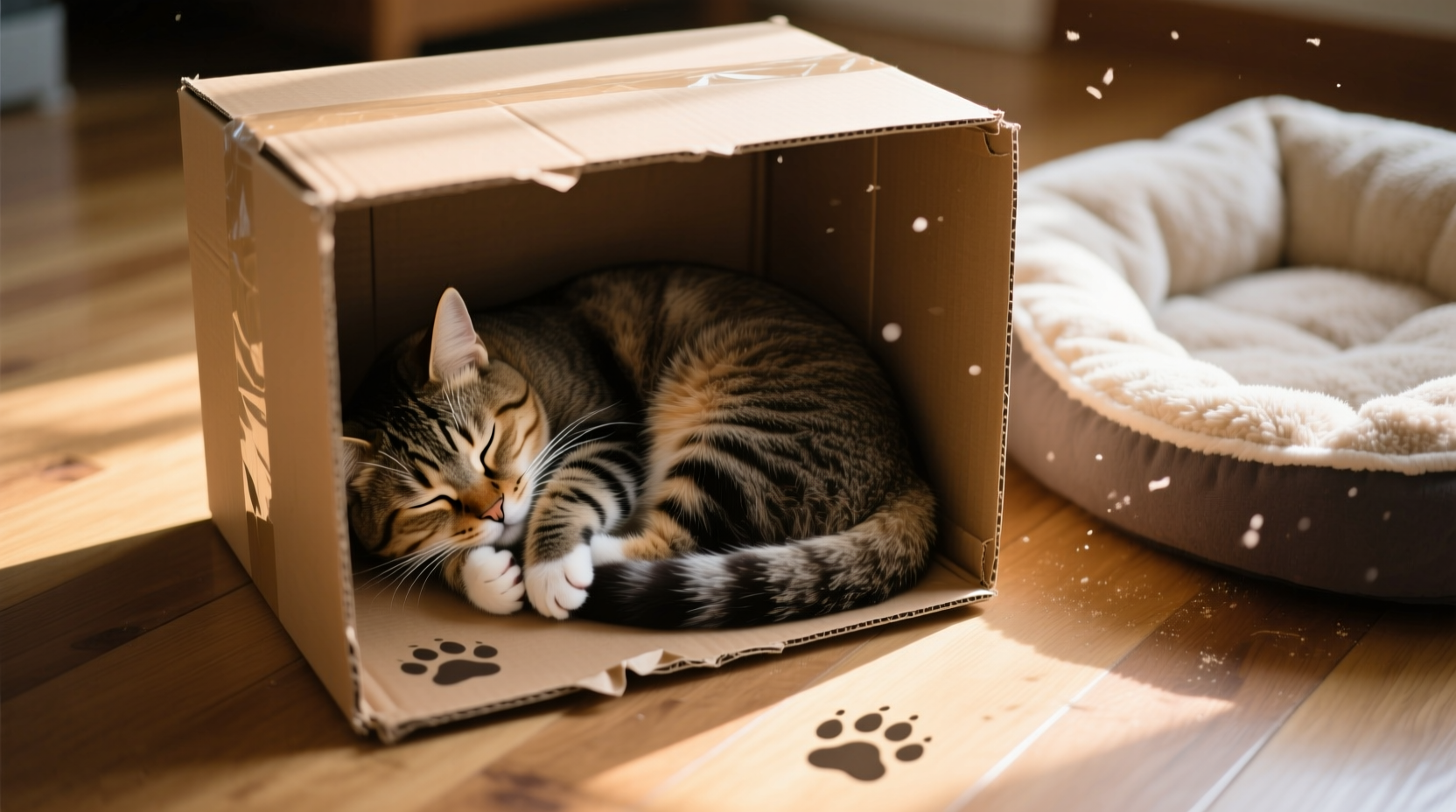
Cats are creatures of comfort—but their definition of comfort often baffles human logic. You invest in a plush, orthopedic cat bed, only to find your feline curled up inside an empty Amazon shipping box or wedged behind the toilet tank. This behavior is so common it’s become a meme, but behind the humor lies a deep-rooted set of biological and psychological instincts. Understanding why cats prefer confined spaces over soft, open beds reveals much about their evolutionary past, stress responses, and natural need for security.
The answer isn’t simply that cats “like boxes.” It’s more complex—and far more fascinating. From thermoregulation to emotional safety, the preference for tight spaces reflects survival strategies hardwired into domestic cats through millennia of evolution. Even well-fed, indoor-only cats retain these instincts. Let’s explore the science, psychology, and practical implications behind this seemingly odd behavior.
Evolutionary Roots: The Wild Ancestor’s Influence
Domestic cats (Felis catus) evolved from wild desert-dwelling ancestors like the African wildcat (Felis lybica). These solitary hunters lived in environments where exposure meant danger. Open spaces left them vulnerable to predators and extreme temperatures. To survive, they sought out enclosed shelters—rock crevices, hollow logs, dense brush—that offered concealment and insulation.
This instinctual drive to seek shelter persists in modern housecats. A cardboard box mimics the den-like environment their ancestors relied on. Unlike open beds, which leave a cat exposed on all sides, a box provides walls on three or four sides, reducing visual stimuli and creating a sense of enclosure. This perceived safety allows cats to relax more deeply, even if they’re not consciously aware of the threat.
Dr. Sarah Ellis, a feline behavior expert at the University of Lincoln, explains:
“Enclosed spaces provide cats with a sense of control over their environment. In the wild, being seen often meant becoming prey. Today’s cats may live indoors, but their brains still operate under those same survival rules.” — Dr. Sarah Ellis, Feline Behavior Researcher
This evolutionary lens helps explain why even confident, socialized cats will retreat into tight spots when stressed or uncertain. It’s not a sign of fear—it’s a strategy for managing environmental input.
Thermoregulation: Warmth and Energy Conservation
Cats have a higher baseline body temperature than humans—typically between 100.5°F and 102.5°F (38°C–39.2°C). To maintain this, they must conserve heat efficiently. Open beds, especially those made of breathable fabric, allow heat to escape quickly. In contrast, cardboard boxes act as insulators, trapping warm air around the cat’s body.
A study published in *Applied Animal Behaviour Science* found that shelter cats given access to hiding boxes showed significantly lower stress levels than those without. Researchers noted that the boxes helped stabilize body temperature, reducing the energy needed to stay warm—a critical factor in high-stress environments like animal shelters.
This principle applies even in climate-controlled homes. Floors can be cold, drafts exist near windows, and central heating doesn’t always reach corners. A box creates a microclimate where warmth accumulates. Add a cat’s tendency to curl into a tight loaf shape, and you’ve got a highly efficient thermal package.
Stress Reduction and Emotional Security
Cats are highly sensitive to environmental changes. New people, loud noises, rearranged furniture, or even a different brand of laundry detergent can elevate their stress hormones. In such moments, a tight space becomes a refuge.
Neurologically, enclosed areas reduce sensory overload. Walls block peripheral movement, muffle sound, and limit airflow—each of which can trigger vigilance in cats. By retreating into a box, a cat minimizes unpredictable stimuli, allowing its nervous system to shift from “alert” to “rest.”
This behavior is particularly evident in multi-cat households. Dominant cats may claim open sleeping areas, while subordinate ones choose hidden or elevated enclosures. Even in single-cat homes, boxes serve as emotional anchors during transitions like moving, guests visiting, or home renovations.
A real-life example illustrates this well:
In a case observed at a Portland-based cat café, a newly adopted rescue cat named Miso refused all provided beds. Staff placed a cardboard box in a quiet corner with a fleece liner. Within hours, Miso entered the box, stayed for two days with brief exits for food, and gradually began exploring. After one week, she was using the box selectively and eventually started napping on sofas—but only after establishing it as a safe fallback zone.
Miso’s story reflects a broader pattern: tight spaces aren’t just for sleeping—they’re psychological sanctuaries that enable exploration and confidence-building.
Preference vs. Design: Why Soft Beds Often Fail
Many commercial cat beds fail because they ignore feline behavioral needs. They’re designed for human aesthetics—soft, fluffy, open-top models that look inviting but lack functional appeal to cats. Below is a comparison of typical bed features versus what cats actually seek.
| Feature | Common Cat Bed Design | What Cats Prefer |
|---|---|---|
| Structure | Open, flat, or shallow | High-sided, enclosed, cave-like |
| Material | Faux fur, cotton, memory foam | Cardboard, felt, wool—natural insulators |
| Location | Center of room, near foot traffic | Corner, near wall, with escape route |
| Temperature | Ambient, no insulation | Heat-retaining, draft-free |
| Sensory Input | Exposed to noise and motion | Shielded, low-stimulus |
The mismatch is clear. A $50 designer bed placed in the middle of a living room may be comfortable by human standards, but it offers little protection from sightlines or drafts. Meanwhile, a discarded box in a hallway corner checks nearly every box on the feline preference list.
Interestingly, some cats do use soft beds—but usually only after claiming them as territory through scent marking (cheek rubbing) and integrating them into a secure area. Location and context matter more than cushion quality.
How to Encourage Better Use of Cat Beds: A Step-by-Step Guide
You don’t need to abandon cat beds altogether. With thoughtful adjustments, you can make them more appealing while respecting your cat’s instincts. Follow this timeline to transition your cat toward designated resting spots.
- Week 1: Observe Natural Preferences
Track where your cat currently sleeps. Note whether locations are high/low, enclosed/open, warm/drafty. Identify patterns. - Week 2: Replicate the Preferred Environment
Place a covered cat cave or DIY box bed (cut a hole in a cardboard box lined with fleece) in one of the favored zones. Avoid moving existing boxes—add alternatives nearby. - Week 3: Enhance Comfort Gradually
Introduce a heated pad (low setting) or place the bed near a sunlit wall. Sprinkle catnip or silver vine to encourage investigation. - Week 4: Transition Toward Designed Beds
Replace the cardboard box with a similar-shaped commercial bed (e.g., donut bed with high sides or hooded cave). Keep it in the same location. - Ongoing: Rotate and Refresh
Cats enjoy novelty. Swap bedding materials monthly or reposition beds slightly to maintain interest.
This gradual approach respects your cat’s autonomy while guiding preferences toward safer, cleaner, and more durable options.
Checklist: Creating a Cat-Friendly Resting Environment
- Provide at least one enclosed space per cat in the household
- Place beds against walls or in corners for added security
- Use natural, washable liners (wool, cotton fleece) instead of synthetic plush
- Avoid strong detergents—cats are sensitive to residual scents
- Ensure multiple escape routes in multi-pet homes
- Monitor usage and adjust placement based on observation
- Incorporate vertical spaces (shelves, catios) with covered retreats
FAQ: Common Questions About Cats and Tight Spaces
Is it safe for my cat to sleep in cardboard boxes?
Yes, as long as the box is clean, free of staples or tape, and replaced when worn. Avoid treated cardboard (e.g., chemical-coated shipping containers). Plain corrugated boxes are safe and biodegradable.
Should I stop my cat from sleeping in small spaces?
No—unless the space poses a physical risk (e.g., a washer drum or oven). Restricting access to safe hiding spots increases stress. Instead, offer equally secure alternatives.
Why does my cat only sleep in boxes when I’m watching?
This may reflect trust and attention-seeking. Some cats perform “cute” behaviors when observed. Others feel safer napping in a box when you’re present because your presence deters other household pets or perceived threats.
Expert Insight: The Role of Control in Feline Wellbeing
Dr. Elizabeth Colleran, a board-certified feline veterinarian and past president of the American Association of Feline Practitioners, emphasizes the importance of environmental control:
“Cats thrive when they feel they can predict and influence their surroundings. A box isn’t just a nap spot—it’s a tool for managing anxiety. When we remove these refuges, we inadvertently increase cortisol levels, which can lead to health issues like cystitis or overgrooming.” — Dr. Elizabeth Colleran, DVM, ABVP (Feline)
This insight underscores a crucial point: allowing your cat to choose its sleeping spot isn’t indulgence—it’s part of responsible care.
Conclusion: Respecting Instinct Over Aesthetics
Cats sleep in boxes and tight spaces not out of whimsy, but because these spots fulfill deep-seated needs for warmth, safety, and control. While soft beds may look more comfortable to us, they often fail to meet the behavioral criteria that govern feline rest. Rather than forcing a change, the smarter approach is to adapt our offerings to align with natural preferences.
Start by observing your cat’s habits. Introduce enclosed, insulated, and strategically placed alternatives. Respect their choices—even if it means sharing your dining table with a shoebox fortress. In doing so, you’re not just accommodating a quirk; you’re supporting your cat’s mental and physical wellbeing.




 浙公网安备
33010002000092号
浙公网安备
33010002000092号 浙B2-20120091-4
Comments
No comments yet. Why don't you start the discussion?