
Cats are creatures of habit, mystery, and undeniable charm. Among their many quirks—kneading blankets, chasing invisible prey, and knocking objects off tables—one of the most endearing is their tendency to squeeze into cardboard boxes far too small for their frames. It’s not uncommon to see a cat curled into a paper bag, nestled in a shipping container, or perched precariously on the edge of a shoebox, tail dangling over the side. But why? What drives a cat to choose confinement over space, restriction over freedom? The answer lies at the intersection of evolutionary instinct, thermoregulation, emotional security, and sensory preference.
The Evolutionary Roots of Box-Sleeping Behavior
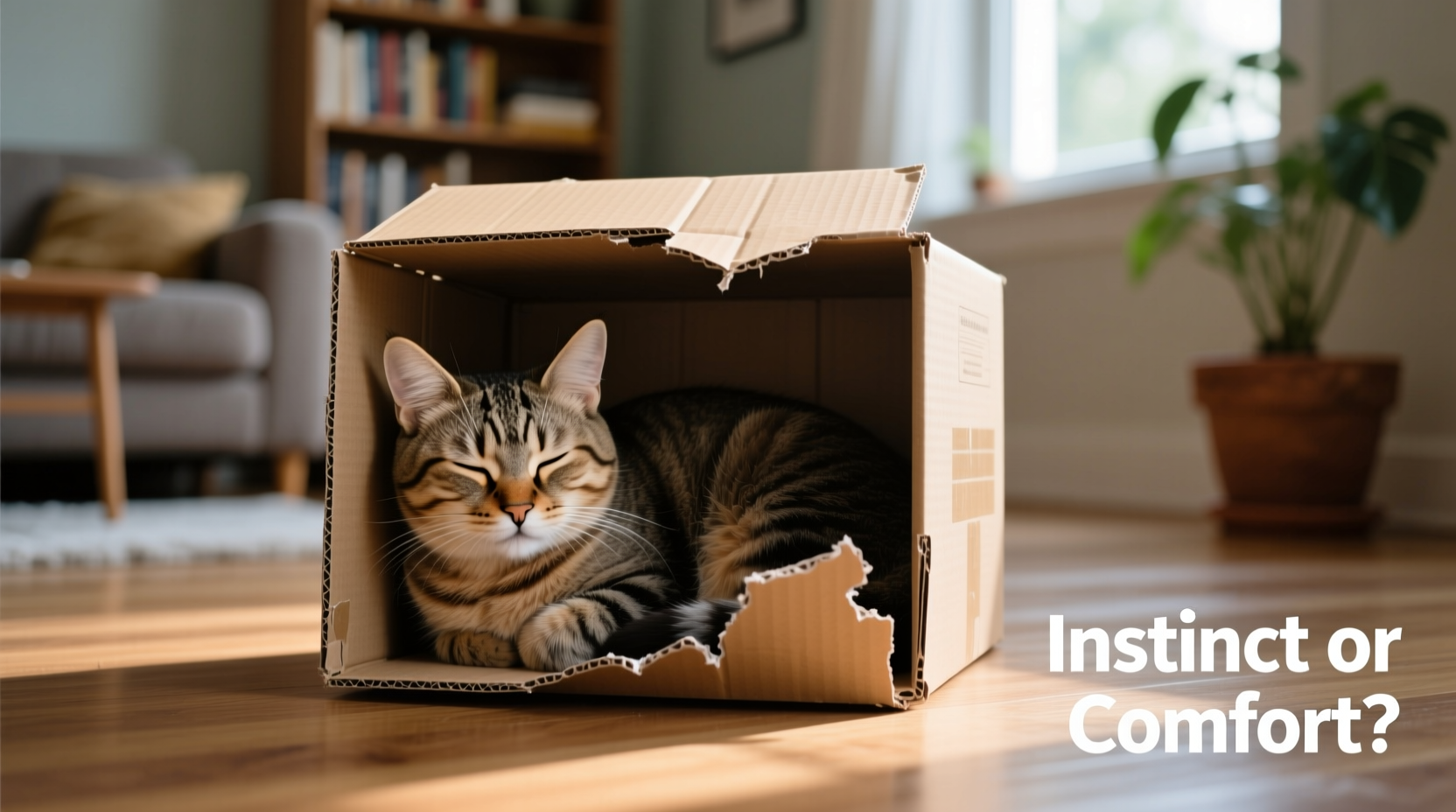
Cats, even domesticated ones, retain strong ties to their wild ancestors. In the wild, survival depends on avoiding detection. Small, enclosed spaces mimic natural shelters such as rock crevices, hollow logs, or dense underbrush—locations that offer protection from predators and concealment while stalking prey. This instinctual need for cover persists in modern house cats, despite the absence of real threats in a living room environment.
From an evolutionary standpoint, tight spaces signal safety. A box with high sides limits visibility from above, reducing a cat’s exposure to perceived threats. Even though your tabby knows you’re not about to pounce, her brain still responds to environmental cues rooted in millennia of survival programming. Enclosed areas also provide a buffer against sudden movements or loud noises, giving cats a sense of control over their surroundings.
“Cats are hardwired to seek out confined spaces because they reduce stress by offering predictability and shelter.” — Dr. Sarah Thompson, Feline Behavioral Scientist, Cornell University College of Veterinary Medicine
This behavioral trait isn’t unique to domestic cats. Big cats like leopards and lynxes often rest in caves or thickets during daylight hours, emerging only when necessary. The domestic version of this behavior simply takes place in more accessible forms: delivery boxes, storage bins, or even empty packaging from online orders.
Thermoregulation: The Warmth Factor
One of the most practical reasons cats favor small boxes is temperature regulation. The average cat maintains a body temperature between 100.5°F and 102.5°F (38°C–39.2°C), which is higher than humans. To conserve energy and stay comfortable, cats prefer warm environments—ideally around 86°F to 97°F (30°C–36°C).
Cardboard is a natural insulator. When a cat curls up inside a box, especially one slightly smaller than her body, she creates a microclimate. Her body heat gets trapped within the confined space, warming the air and surfaces around her. The snug fit minimizes airflow, enhancing heat retention. This effect is amplified if the box has been sitting indoors, absorbing ambient warmth from floors or sunlight through windows.
In colder months, this behavior becomes more pronounced. You may notice your cat choosing boxes over plush cat beds or heated pads—simply because the box offers superior thermal efficiency due to its enclosed structure.
Psychological Comfort and Stress Reduction
Beyond physical warmth, boxes serve as emotional sanctuaries. Multiple studies have shown that access to hiding places significantly reduces stress in cats, particularly in new or unpredictable environments. A landmark 2014 study published in *Applied Animal Behaviour Science* observed shelter cats given access to cardboard boxes versus those without. The results were clear: cats with boxes adapted faster, showed fewer signs of anxiety, and engaged socially sooner.
The act of hiding provides what experts call “behavioral buffering”—a way for animals to manage environmental stressors. For a cat, stepping into a box is akin to pulling the covers over your head during a thunderstorm. It’s a self-soothing mechanism that restores a sense of control.
This explains why cats often retreat to boxes after disruptions: moving homes, introducing new pets, or hosting guests. Even routine changes like rearranging furniture can trigger a need for refuge. A simple box becomes a portable safe zone—a familiar shape and texture in an otherwise shifting world.
When Boxes Become Emotional Anchors: A Mini Case Study
Luna, a three-year-old rescue Siamese mix, was adopted into a bustling household with two young children and frequent visitors. Despite being affectionate, she would disappear for hours each day. Her owners placed multiple expensive cat trees and designer beds around the home, but Luna consistently chose a used Amazon box near the laundry room.
After consulting a veterinary behaviorist, they learned that Luna wasn’t rejecting comfort—she was seeking security. The box offered consistent acoustics, limited entry points, and predictable positioning. Over time, they added a second identical box in a quieter area and gradually introduced covered cat beds with similar dimensions. Within weeks, Luna began using both, indicating that it wasn’t the material but the enclosure design that mattered most.
Do’s and Don’ts of Supporting Your Cat’s Box Habit
| Action | Recommendation | Rationale |
|---|---|---|
| Provide multiple boxes | ✅ Do | Gives cats choices based on mood, temperature, or location needs. |
| Use plastic containers instead of cardboard | ⚠️ Caution | Plastic doesn’t breathe well and may trap moisture; ensure ventilation if used. |
| Remove boxes immediately after use | ❌ Don’t | Sudden removal disrupts routine and increases insecurity. |
| Place boxes in quiet, low-traffic zones | ✅ Do | Enhances sense of privacy and safety. |
| Force your cat out of a box | ❌ Don’t | Can lead to stress, fear-based aggression, or avoidance behaviors. |
Understanding Size Paradox: Why Smaller Is Better
At first glance, it seems counterintuitive. How can a cat weighing ten pounds find comfort in a space barely large enough for six? Yet, this apparent contradiction reveals key insights into feline psychology.
Cats don’t measure comfort by square inches—they assess it by containment. A slightly undersized box forces the cat into a tighter curl, increasing surface contact with the walls. This tactile feedback mimics the sensation of being pressed gently on all sides, similar to swaddling in human infants. The pressure activates calming neurological pathways, promoting relaxation and faster onset of sleep.
Additionally, smaller boxes limit peripheral vision. While humans rely heavily on sight, cats process their environment through a combination of sound, scent, and touch. Reducing visual input helps them focus inward, lowering mental stimulation and easing the transition into rest.
Step-by-Step: Creating the Ideal Feline Hideaway
- Select a sturdy cardboard box – Choose one without sharp edges or ink residue. Avoid boxes that previously held chemicals or food with strong odors.
- Modify the entrance – Cut one or two openings large enough for easy access but not so wide that the space feels exposed. Rounded corners are safer than sharp angles.
- Add soft lining – Place a removable fleece blanket or towel inside. Avoid loose threads or materials that could be ingested.
- Position strategically – Place the box in a quiet corner, near a heat source (but not a radiator), or beside a window with indirect light.
- Maintain consistency – Leave the box available even when unused. Rotate cleaning weekly to preserve familiar scents while ensuring hygiene.
Alternative Enclosures and Modern Adaptations
While cardboard boxes remain a favorite, some cats adapt to other enclosed structures: bathroom sinks, closets with doors ajar, wicker baskets, or even laundry hampers. Pet manufacturers have responded with products designed to replicate the box experience—igloo-style beds, cave-shaped loungers, and padded tunnels.
However, many cats still prefer the original: plain, unadorned cardboard. Experts suggest this preference stems from predictability. Unlike manufactured beds, which vary in texture, smell, and resilience, a standard box offers uniform sensory input. There’s no surprise element—just reliable enclosure.
Interestingly, the appeal isn’t solely about size. A 2020 observational study at the University of Utrecht found that cats spent more time in boxes they could partially observe from while remaining hidden—supporting the idea that controlled visibility matters more than absolute concealment.
Frequently Asked Questions
Is it normal for my cat to sleep in spaces too small to move around in?
Yes. As long as your cat can enter and exit freely, choosing tight spaces is perfectly normal. It reflects instinctual nesting behavior and a preference for warmth and security. Only intervene if the space poses a physical risk (e.g., staples, unstable stacking, or poor ventilation).
My cat ignores expensive cat beds but loves boxes. Should I stop buying them?
Not necessarily. Some cats appreciate variety. Try placing a high-quality bed inside a box-like frame or choose beds modeled after enclosures (such as hooded or cave-style designs). Often, it’s the shape and coverage—not the price—that determines appeal.
Can kittens and older cats benefit from boxes too?
Absolutely. Kittens use boxes for exploration and play, which supports cognitive development. Senior cats, especially those with arthritis or anxiety, often rely on boxes for warmth and a sense of safety. Just ensure entrances are low and interiors cushioned to accommodate mobility issues.
Final Thoughts: Respecting the Box Instinct
The next time you catch your cat wedged into a package half her size, resist the urge to pull her out—or toss the box once the shopping spree ends. That humble container serves a vital role in your cat’s emotional and physical well-being. Far from being a whimsical habit, box-sleeping is a deeply rooted behavior shaped by evolution, physiology, and psychology.
By understanding why cats choose these spaces, we gain insight into their inner world—a world where safety, warmth, and control matter more than luxury labels or ergonomic design. You don’t need to buy special gear to support your cat’s needs. Sometimes, the best thing you can offer is a clean box, a quiet corner, and the respect to let her enjoy it undisturbed.




 浙公网安备
33010002000092号
浙公网安备
33010002000092号 浙B2-20120091-4
Comments
No comments yet. Why don't you start the discussion?