
Among the many subtle ways cats communicate, the slow blink stands out as one of the most meaningful yet often overlooked gestures. Unlike dogs, which express affection through wagging tails or excited greetings, cats rely on nuanced body language. The slow blink—sometimes called a “cat kiss”—is not just a random eye movement; it’s a deliberate signal of comfort, trust, and emotional connection. Understanding this behavior can transform how you interact with your cat, deepening your relationship in quiet but powerful ways.
Cats are naturally cautious animals, evolved from solitary hunters who needed to assess threats constantly. In such a context, closing their eyes—even briefly—is a vulnerable act. When a cat chooses to slowly close its eyes while looking at you, it is signaling that it feels safe enough to let its guard down. This gesture, far from being passive, is an active expression of emotional security and acceptance.
The Science Behind the Slow Blink
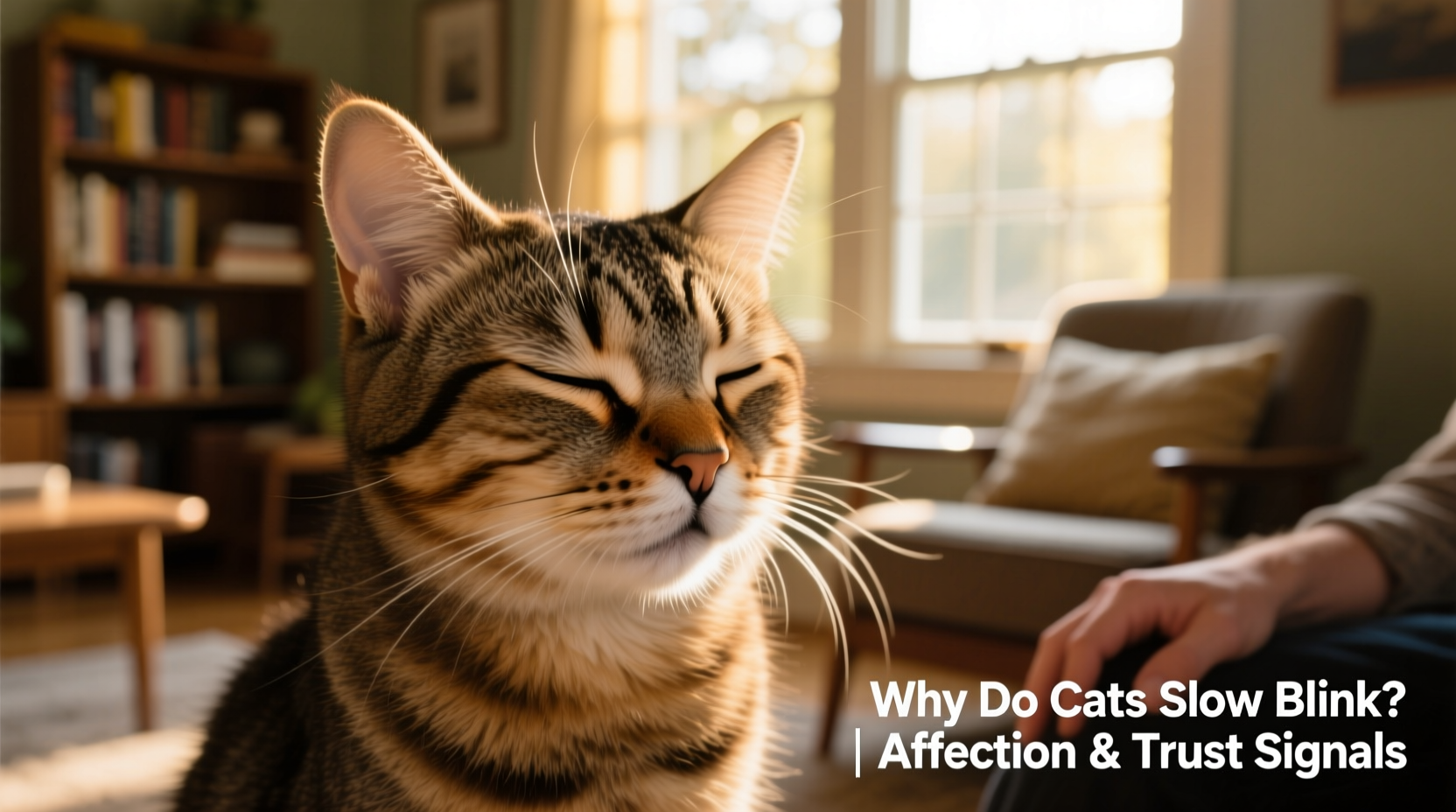
Research has confirmed what many cat owners have long suspected: slow blinking is a genuine form of positive communication. A 2020 study conducted by the University of Sussex found that cats are more likely to return slow blinks from humans and show increased approach behaviors when greeted with this gesture. The study involved two experiments—one where participants slow blinked at their own cats, and another where strangers engaged unfamiliar cats using the same technique. In both cases, cats responded more positively to slow blinks than to neutral expressions.
Dr. Karen McComb, one of the lead researchers, explained:
“The slow blink isn’t just a relaxation response—it appears to be a signal of goodwill. Cats seem to recognize it as a friendly overture, especially when it comes from someone they know.”
The biological mechanism behind the slow blink ties into the cat’s autonomic nervous system. When a cat feels calm and unthreatened, its parasympathetic system dominates, promoting relaxed physical behaviors like half-closed eyes, slow breathing, and soft facial muscles. The slow blink emerges naturally in this state. But when repeated intentionally—especially in the presence of another individual—it becomes a social signal, much like a human smile.
How the Slow Blink Functions as a Trust Signal
In the wild, showing vulnerability can be dangerous. Predators exploit hesitation, and prey species remain hyper-vigilant. For domestic cats, which retain many ancestral instincts despite generations of cohabitation with humans, any moment of reduced alertness carries risk. Therefore, choosing to slow blink at you is a significant behavioral cue.
- Eye contact in cats is inherently intense. Direct staring is often perceived as a challenge or threat. By contrast, breaking eye contact gently through a slow blink, a cat de-escalates tension and communicates peaceful intent.
- It mirrors maternal bonding behaviors. Kittens often engage in mutual slow blinking with their mothers during nursing and grooming, reinforcing attachment and safety.
- It is reciprocal in trusted relationships. Just as humans mirror smiles, cats are more likely to return a slow blink when they view the other individual as part of their social group.
This behavior isn’t limited to interactions with humans. Cats also slow blink at other cats they consider companions—particularly those they groom or sleep near. It’s a universal peace offering within feline society.
How to Use the Slow Blink to Strengthen Your Bond
Building trust with a cat requires patience and sensitivity to nonverbal cues. The slow blink is not only a way to interpret your cat’s feelings but also a tool you can use proactively to foster closeness.
Start by incorporating slow blinking into your daily interactions. Choose a calm moment—when your cat is resting nearby or observing you from a distance. Avoid forcing interaction; instead, sit quietly and offer a soft gaze. Then, slowly close your eyes and reopen them. Repeat this 2–3 times. Many cats will respond by mirroring the behavior, sometimes followed by a head tilt, ear twitch, or even a stretch—signs of deep relaxation.
- Begin in low-stimulation environments. High noise or activity levels may distract your cat or make it too alert to engage.
- Avoid direct staring before blinking. Prolonged unbroken eye contact can feel threatening. Initiate the blink sequence gently.
- Be patient. Shy or newly adopted cats may take days or weeks to respond. Consistency matters more than frequency.
- Pair it with other calming signals. Soft vocal tones, slow movements, and avoiding sudden gestures reinforce the message of safety.
Over time, this ritual can become a private language between you and your cat—a silent affirmation of mutual trust.
Decoding Other Feline Affection Signals Alongside the Slow Blink
The slow blink rarely occurs in isolation. It is usually part of a broader repertoire of affiliative behaviors. Recognizing these accompanying signs enhances your ability to interpret your cat’s emotional state accurately.
| Behavior | Meaning | Associated With Slow Blink? |
|---|---|---|
| Head bunting (rubbing head against you) | Scent marking and social bonding | Yes – common combination |
| Purring | Contentment or self-soothing | Frequent – indicates deep relaxation |
| Kneading with paws | Comfort rooted in kittenhood | Sometimes – especially when lying down |
| Tail held upright | Greeting and friendliness | Rarely simultaneous, but precedes interaction |
| Slow tail flicks or swishes | Irritation or overstimulation | No – indicates opposite emotional state |
When combined with a slow blink, head bunting and purring create a powerful triad of trust indicators. These behaviors suggest your cat views you not just as a provider of food, but as a valued companion. Conversely, if your cat avoids eye contact, flattens its ears, or rapidly flicks its tail, it is signaling discomfort—regardless of whether it blinks slowly at any point.
Real-Life Example: Building Trust with a Rescue Cat
Sophie adopted Luna, a three-year-old domestic shorthair, from a shelter after the cat had spent six months in temporary housing due to behavioral concerns. Initially, Luna would hide under the bed whenever Sophie entered the room. Direct approaches caused her to flee. Determined to build trust without pressure, Sophie began using slow blinking as part of her daily routine.
Each evening, she sat quietly on the floor near Luna’s favorite corner, avoided direct eye contact, and offered slow blinks during brief moments when Luna peeked out. She paired this with soft-spoken reassurances and placed treats nearby without expecting interaction. After two weeks, Luna began lingering longer during these sessions. One night, she returned a slow blink while sitting five feet away. Within a month, Luna was sleeping beside Sophie on the couch, regularly initiating physical contact.
“It wasn’t about winning her over,” Sophie said later. “It was about showing her she didn’t have to win me over either. The slow blink became our first real conversation.”
Common Misinterpretations and Mistakes to Avoid
While the slow blink is a positive signal, misreading feline behavior can hinder progress. Some owners mistake a slow blink for drowsiness or disinterest, missing the opportunity to reciprocate. Others attempt to force interaction immediately after the blink, undermining the sense of safety the cat was expressing.
- Mistaking squinting for aggression. Cats often squint or half-close their eyes when relaxed. This should not be confused with narrowed eyes during stress, which are accompanied by tense facial muscles and flattened ears.
- Overusing the gesture. Like any form of communication, excessive repetition can lose meaning or feel intrusive.
- Ignoring context. A cat may slow blink while lying in sunlight simply because it’s sleepy. Look for intentionality—repeated blinks directed at you, especially after eye contact.
Step-by-Step Guide to Mastering the Cat Slow Blink
Follow this simple process to integrate slow blinking into your relationship with your cat:
- Observe your cat’s current mood. Is it relaxed? Alert but calm? Avoid attempting the blink if your cat seems anxious or agitated.
- Position yourself at a comfortable distance. Sit or crouch so you’re not towering over the cat. Keep your body turned slightly sideways.
- Make gentle eye contact. Lock eyes softly—not intensely—for 1–2 seconds. <4> Close your eyes slowly. Take about one second to shut them, hold for a beat, then open them gradually.
- Pause and observe. Watch for any response: a returned blink, ear movement, or shift in posture.
- Repeat 2–3 times. Don’t overdo it. Let the interaction unfold naturally.
- Reward any positive response. If your cat blinks back or approaches, acknowledge it calmly—perhaps with a whisper or treat, but avoid sudden motion.
Practice this daily, especially during quiet times like early morning or late evening. Over time, your cat may begin seeking out these exchanges.
Frequently Asked Questions
Do all cats slow blink?
Most cats are capable of slow blinking, but not all do so frequently. Personality, early socialization, and past experiences influence how openly a cat expresses trust. Shy or traumatized cats may take longer to display this behavior.
Can I use the slow blink with unfamiliar cats?
Yes, but cautiously. Stray or shelter cats may not respond immediately, but slow blinking can still serve as a non-threatening way to introduce yourself. Pair it with averted gaze and minimal movement to appear less intimidating.
Is slow blinking the same as cat nictitating membrane movement?
No. The third eyelid (nictitating membrane) may partially cover the eye due to illness, injury, or fatigue. A true slow blink involves full lid closure and re-opening, typically with both eyes, and occurs in a relaxed context.
Conclusion: Speak the Language of Trust
The slow blink is more than a quirky feline habit—it’s a window into your cat’s emotional world. By recognizing and reciprocating this gesture, you participate in a silent dialogue built on mutual respect and affection. In a relationship where words are absent, these small acts of visual tenderness carry profound weight.
Cats don’t demand love in loud or obvious ways. Their affection is quiet, earned, and deeply intentional. When your cat slow blinks at you, it’s offering one of the highest compliments in feline terms: I am safe with you. Return that gift with patience, understanding, and a gentle blink of your own.




 浙公网安备
33010002000092号
浙公网安备
33010002000092号 浙B2-20120091-4
Comments
No comments yet. Why don't you start the discussion?