
It’s a familiar holiday ritual: unpacking last year’s string lights, plugging them in—and watching half the strand flicker, dim, or stay stubbornly dark. You sigh, toss the tangled mess into the recycling bin, and head to the discount aisle for another $9.99 set. By January, you’re already planning next year’s replacement. This isn’t bad luck. It’s predictable engineering failure—designed into the product. Cheap lights don’t fail because of misuse; they fail because they were never built to survive more than 30–60 days of seasonal use. Understanding *why* reveals what to look for when investing in lights that last—not just through December, but for five, eight, or even twelve seasons.
The Hidden Cost of “Cheap”: What Happens Inside the Bulb and Wire
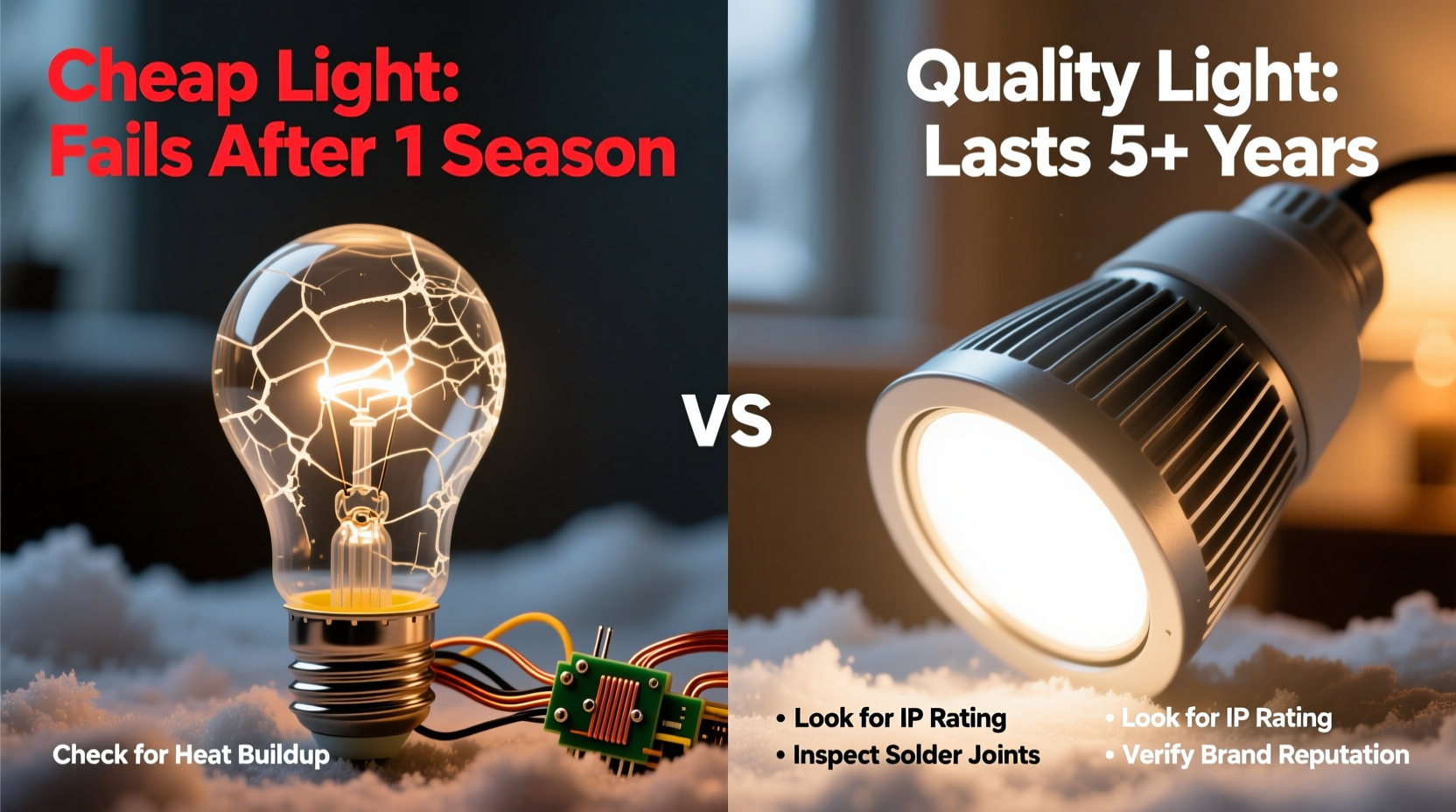
At first glance, two strands of 100-bulb LED lights look identical. One costs $7.99. The other, $29.99. The difference isn’t markup—it’s material science and manufacturing rigor. Let’s follow the current from plug to bulb.
Cheap lights almost always use non-isolated AC-to-DC conversion. Instead of a proper transformer or switching power supply, they rely on capacitive dropper circuits—tiny, unregulated components that pass voltage directly to the LEDs with no surge protection or thermal regulation. When voltage spikes (common during winter storms or grid fluctuations), these circuits overheat. The LEDs burn out—not gradually, but catastrophically. Worse, the heat degrades nearby solder joints, creating intermittent connections that appear as “half-strand failures.”
The wire itself tells another story. Budget strings use 28–30 AWG copper-clad aluminum (CCA) wire, not pure copper. CCA has 40% higher electrical resistance than solid copper. Under load, it heats up faster, accelerating insulation brittleness. That thin PVC jacket? It contains minimal UV stabilizers and zero cold-flex additives. After one winter outdoors, it cracks at stress points—especially near plugs and bulb sockets—exposing conductors to moisture and corrosion.
And the bulbs? Most inexpensive sets use generic 5050 or 3528 SMD LEDs rated for 20,000 hours—but only under ideal lab conditions: 25°C ambient, constant current, no thermal cycling. In reality, those bulbs sit inside sealed plastic housings with no heat dissipation. Temperatures inside can exceed 70°C on sunny winter days—halving their rated lifespan before the first season ends.
How Quality Lights Are Built Differently
True longevity starts with architecture—not aesthetics. Premium lights prioritize three non-negotiable elements: intelligent power management, thermally robust construction, and weather-resilient materials.
Isolated, regulated drivers are the single biggest differentiator. These small, potted modules convert AC to stable DC output, maintaining consistent voltage even during brownouts or surges. They include thermal cutoffs and short-circuit protection. You’ll find them embedded in the plug housing or inline controller—not hidden behind flimsy plastic caps.
Wire gauge matters profoundly. Look for 22–24 AWG pure copper wire with double insulation: an inner layer of cross-linked polyethylene (XLPE) for heat resistance, and an outer layer of UV-stabilized PVC or, better yet, silicone rubber. Silicone remains flexible down to –60°C and resists cracking, ozone, and salt spray—critical for coastal or snowy regions.
Bulbs aren’t just smaller—they’re engineered. High-end strings use 2835 or 5730 SMD LEDs mounted on aluminum PCB substrates. That metal pulls heat away from the diode junction. Some premium brands even add micro-fans or passive heat sinks inside larger decorative bulbs (like C9 or G12 shapes). And crucially, they’re rated for IP65 or higher—meaning dust-tight and protected against low-pressure water jets.
“Most ‘outdoor-rated’ lights sold at big-box stores meet the letter of IP44—but fail the spirit. True outdoor durability requires IP65 minimum, plus thermal derating below 50°C operating temp. Anything less is seasonal theater.” — Dr. Lena Torres, Lighting Engineer, Illumination Standards Institute
Spotting Quality Before You Buy: A Real-World Checklist
You don’t need a multimeter or microscope to identify durable lights. With this field-tested checklist, you can assess quality in under 90 seconds—even while standing in the aisle.
- Check the plug housing: Is it thick, rigid, and fully sealed? Does it feel heavy (indicating internal potting compound)? Avoid thin, hollow-feeling plastic with visible seams or gaps.
- Inspect the wire: Bend a 6-inch section sharply. Does it spring back smoothly—or crackle, stiffen, or leave a permanent kink? Does the jacket peel easily from the conductor?
- Examine bulb sockets: Are they deep-set, with tight friction fit? Do bulbs wobble or slide in too easily? High-quality sockets have brass contacts (not nickel-plated steel) and integrated strain relief.
- Read the fine print—not the marketing: Look past “Weather Resistant” or “All-Weather.” Find the actual IP rating (e.g., “IP65”) and temperature range (e.g., “–25°C to +50°C”). If it’s missing, assume it’s not certified.
- Verify warranty terms: Reputable brands offer 3–5 year limited warranties covering both LEDs and wiring. “One season” or “90-day” warranties are red flags—not promises.
Real Example: The Lake Tahoe Lodge Test
In 2021, the historic Timberline Lodge in Lake Tahoe upgraded its exterior lighting for its centennial celebration. Their previous vendor supplied $12.99/strand bulk LEDs. Over three winters, they replaced 87% of their inventory annually—mostly due to socket corrosion and cracked wire jackets caused by freeze-thaw cycles and road salt drift.
They switched to a commercial-grade brand specifying 22 AWG pure copper wire, IP67-rated bulbs with stainless-steel sockets, and UL-listed, potted drivers rated for –40°C operation. Initial cost was 3.2× higher per foot. But after four seasons—including two record snowfalls—their failure rate dropped to 6%. Maintenance labor fell by 70%. Their ROI wasn’t measured in dollars saved on replacements, but in uninterrupted guest experience and reduced service calls during peak occupancy.
This isn’t theoretical. It’s what happens when you treat lighting as infrastructure—not decoration.
What to Look For: A Side-by-Side Comparison
| Feature | Budget Lights ($7–$15) | Quality Lights ($25–$65) |
|---|---|---|
| Wire Material & Gauge | 28–30 AWG copper-clad aluminum (CCA); thin PVC jacket | 22–24 AWG pure copper; XLPE + UV-stabilized silicone jacket |
| Power Supply | Capacitive dropper; no surge protection; overheats above 30°C | Isolated, potted switching driver; thermal cutoff; 10kV surge rating |
| Bulb Rating & Mounting | Generic 5050 SMD; epoxy-sealed; no heat sinking; IP44 max | 2835/5730 SMD on aluminum PCB; active/passive cooling; IP65–IP67 |
| Socket Construction | Thin plastic; nickel-plated steel contacts; no strain relief | Reinforced polycarbonate; brass contacts; integrated cable grip |
| Certifications & Warranty | UL Recognized (not Listed); 90-day warranty | UL Listed (not Recognized); ETL certified; 3–5 year limited warranty |
Step-by-Step: How to Evaluate Your Existing Lights (or Next Purchase)
Don’t guess—test. Here’s how to perform a quick diagnostic that reveals true build quality:
- Unplug and inspect the cord near the male plug. Look for discoloration, swelling, or softness in the jacket. Heat damage here signals poor driver design.
- Gently twist a bulb 90 degrees in its socket. Does it rotate freely? If yes, contact pressure is insufficient—leading to arcing and premature burnout.
- Hold the wire taut and tap it lightly with your fingernail. Listen: a dull thud means solid copper. A high-pitched “ping” suggests aluminum or CCA.
- Check for labeling on the plug or packaging. Legitimate UL Listing includes the full UL Mark (a circle with “UL” inside) and file number (e.g., E123456). “UL Recognized” or “UL Approved” are not equivalent.
- Plug in a single strand—then unplug and immediately smell the plug. A faint burnt-plastic odor indicates thermal stress in the driver. Walk away.
FAQ
Can I repair cheap lights instead of replacing them?
Rarely—and not cost-effectively. The root cause is systemic: undersized wire, unregulated power, and thermally unstable LEDs. Replacing one bulb may work temporarily, but adjacent bulbs will fail within days due to shared circuit stress. Soldering repairs often create new weak points. For under $30, replacement is faster and more reliable.
Why do some “premium” lights still fail early?
Not all premium branding equals engineering integrity. Some import brands use high-grade bulbs but pair them with budget drivers or CCA wire to hit price targets. Always verify the *entire system*: driver specs, wire gauge/material, and certification level—not just the bulb type or color accuracy.
Do solar-powered holiday lights solve the durability problem?
No—they introduce new failure modes. Lithium batteries degrade rapidly in freezing temperatures, and low-light winter days prevent full recharging. Most solar strings last 1–2 seasons before battery swelling or controller failure occurs. They’re convenient for low-power accent lighting—not primary architectural illumination.
Conclusion
Lighting shouldn’t be disposable. When you understand that cheap lights fail by design—not accident—you stop accepting annual replacement as inevitable. You start asking better questions: What’s inside the plug? What’s holding the wire together? How does heat escape from that tiny bulb? These aren’t technical nitpicks. They’re the difference between a $30 investment that serves you for a decade and a $10 gamble that costs $120 over five years in repeated purchases, wasted time, and mounting frustration.
Quality isn’t defined by brightness or color variety. It’s defined by thermal resilience, electrical intelligence, and material honesty. It’s in the weight of a well-potted driver, the flexibility of cold-rated silicone, and the reassuring click of a brass-contact socket. It’s the quiet confidence of plugging in the same strand year after year—and watching it glow, steady and strong, through wind, snow, and time.




 浙公网安备
33010002000092号
浙公网安备
33010002000092号 浙B2-20120091-4
Comments
No comments yet. Why don't you start the discussion?